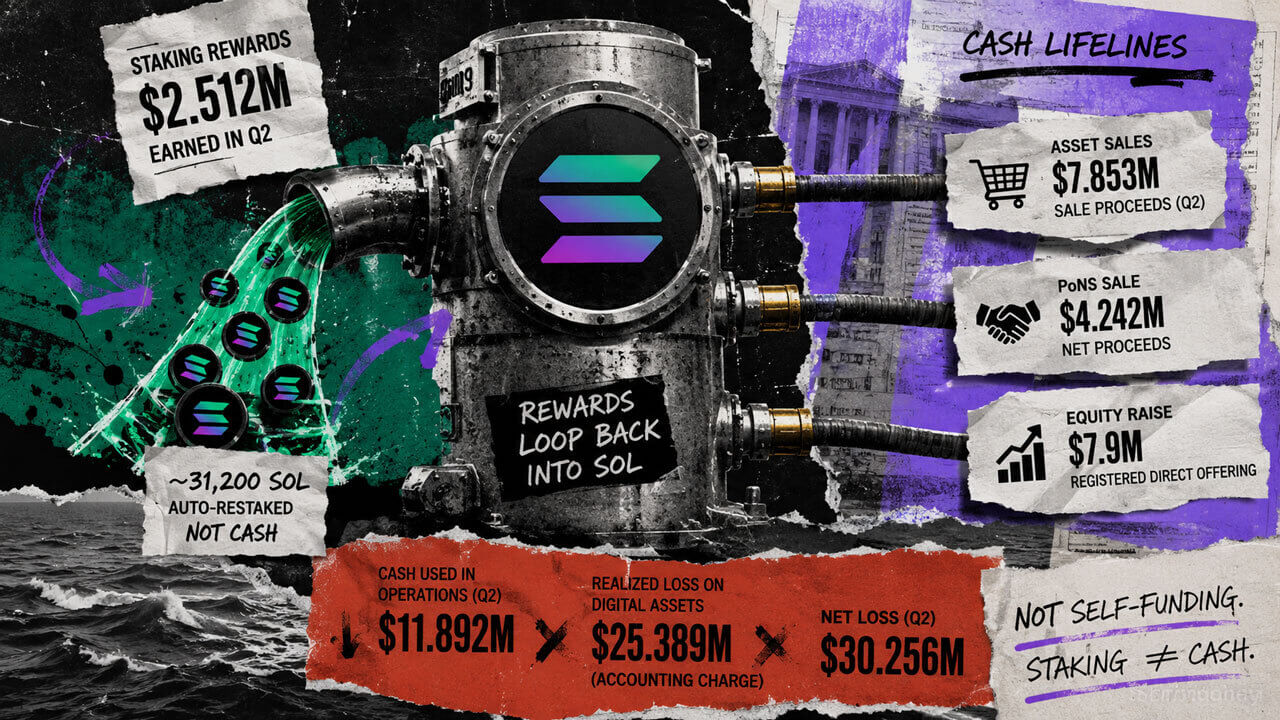
We talk a lot about the 'on-paper' wealth of big blockchain foundations. If you look at a balance sheet during a bull run, these entities look like sovereign wealth funds. But the recent financial report from the Solana Foundation tells a different story—one that every founder building in this space needs to pay attention to. It is the story of the liquidity trap.
The headline numbers are technically impressive: the Solana treasury pulled in roughly $2.5 million in staking rewards recently. In a vacuum, that sounds like a self-sustaining machine. However, despite that passive income, the foundation still had to sell off $12 million in equity and liquidate other assets just to keep the lights on and the developers paid. This disconnect between staking yield and operating cash is the reality of building at scale.
The Staking Illusion
For most builders, staking is pitched as the ultimate passive income stream. You lock up your native tokens, secure the network, and get a haircut of the inflation. But there is a massive catch that often gets ignored until the quarterly reports come out: staking rewards are often 'trapped' capital. They are denominated in a volatile asset that, if sold in large chunks to pay for payroll or AWS bills, could negatively impact the very market the foundation is trying to support.
Solana’s $2.5 million in rewards didn't translate into immediate operating runway because, as the data suggests, these rewards were largely restaked. This creates a cycle where the foundation grows its influence and security on the network but remains 'cash poor.' When you have a global team of engineers and a massive marketing spend, you cannot pay for high-end talent in theoretical future yield.
The $12 Million Reality Check
To bridge the gap between their crypto-heavy balance sheet and their fiat-heavy liabilities, the foundation turned to traditional financing methods. They sold equity and divested certain assets to raise $12 million. This is a move of necessity, not necessarily one of strength. It tells us that even one of the most successful ecosystems in the world cannot yet rely solely on its own decentralized economy to fund its survival.
For founders, this is a warning. If you are building a project and your entire treasury management strategy is 'we will stake our tokens and live off the yield,' you are setting yourself up for a liquidity crisis. Markets are fickle, and the slippage on selling millions of dollars worth of tokens every month to cover operating expenses can be a death spiral for a project's price action.
Building for Sustainability
The Solana Foundation is essentially behaving like a late-stage startup rather than a fully decentralized protocol. They are managing a complex treasury that requires diversified inflows. By selling equity, they are diluted, but they gain the hard currency needed to survive a bear market or a period of stagnancy. This is the 'adult' way to run a foundation, even if it feels less 'cypherpunk' than we might like.
We have to look at what this means for the builders in the Solana ecosystem. If the core foundation is selling equity to stay liquid, it implies that the cost of maintaining the network is still significantly higher than the organic revenue the network generates for its central stewards. We are still in the subsidized growth phase of the industry.
Why Equity Sales Matter
- Fiat Runway: You can't pay taxes or legal fees in restaked SOL without significant friction.
- Market Pressure: Selling equity to private investors is often less damaging to the token price than dumping rewards on the open market.
- Validation: Raising $12 million in cash shows that outside investors still see long-term value in the foundation’s structure, not just the token.
The Founder's Takeaway
The lesson here is simple: Revenue is not the same as liquidity. You can have a treasury worth nine figures on a dashboard, but if you can't access $10 million in cash without crashing your token price or waiting for a staking unlock, you are in a vulnerable position. Solana is navigating this by diversifying their capital raises, and smaller projects should follow suit.
Stop looking at your staking rewards as a salary pool. Start looking at them as a security mechanism for the network that happens to provide a bonus. Your operating cash needs to be decoupled from the volatility of your own token as much as possible. If the giants like Solana have to sell equity to keep moving, your small-cap project definitely shouldn't be relying on 'moon math' to pay your developers.
Ultimately, this report shows a foundation that is being pragmatic. They are choosing survival and growth over the purity of only using native tokens. It is a sober reminder that in the world of crypto-infrastructure, cash is still king, even when you own the kingdom.
Read the original at CryptoSlate →