The Economics of Self-Preservation
Infrastructure is expensive. In the world of Proof of Stake, being a validator isn't just about running a server; it's about managing a delicate balance between token inflation, operating costs, and the fickle loyalty of stakers. When that balance shifts, the people holding the keys to the network usually act to protect their bottom line. We are seeing this play out in real-time within the Solana ecosystem, and it serves as a masterclass in how protocol governance often boils down to basic accounting.
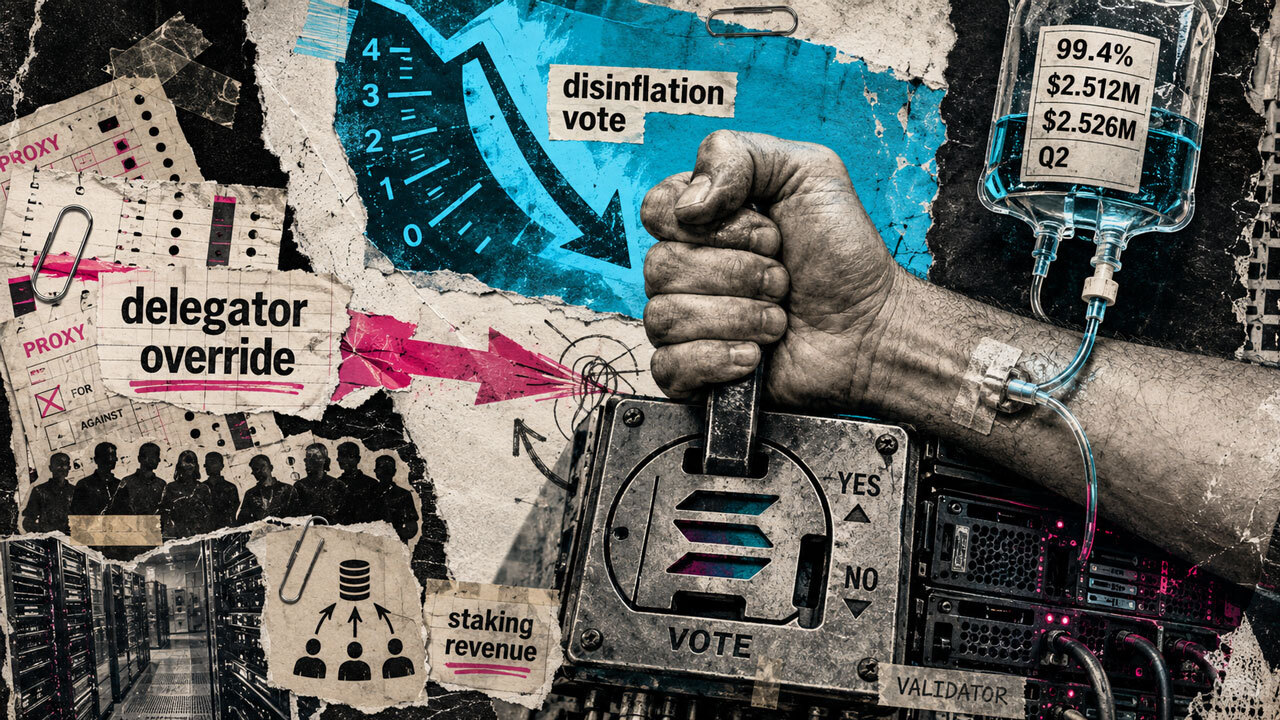
A major treasury firm recently signaled its opposition to accelerating the disinflation schedule of SOL. On the surface, this sounds like a technical debate about monetary policy. In reality, it is a fight for survival. For many of these large-scale operations, a staggering 99.4% of their revenue comes directly from inflationary rewards. When your business model is that heavily subsidized by the protocol's printing press, any move to slow down that press is a direct threat to your existence.
The Inflation Trap
Solana was designed with a specific disinflationary curve. The idea is simple: start high to attract security and liquidity, then gradually taper off as the network matures and transaction fees (hopefully) take over as the primary incentive. The problem for builders and founders is that the "transaction fee" part of that equation hasn't yet reached a scale where it can replace inflation. We are still in the subsidy era.
If the network speeds up its disinflation—meaning it reduces the amount of new SOL issued every year—the yield for stakers naturally drops. For the average user, this is a minor annoyance. For a treasury firm running massive validator sets, a reduction in inflation is a massive haircut to their top-line revenue. They aren't just protecting the network; they are protecting a revenue stream that hasn't yet found a way to be self-sustaining without the protocol's help.
Why Builders Should Care
As a founder, you have to look past the headlines about "yield cuts" and see the underlying structural risk. If a network’s primary gatekeepers (the validators) are 99% dependent on inflation, that network is effectively a subsidized economy. It’s a startup that hasn't figured out its product-market fit yet, living entirely off VC funding—except in this case, the VC is the token holder who gets diluted every day.
This creates a friction point between the long-term health of the token (which benefits from lower inflation) and the short-term stability of the infrastructure. If validators can't pay their bills, they shut down, and the network becomes less secure. If the inflation stays too high for too long, the token loses its value proposition as a store of wealth or a productive asset. It’s a classic Catch-22 that every builder needs to account for when choosing where to deploy their applications.
The Staker's Veto
The interesting wrinkle in the Solana model is the power of the individual staker. While large firms can lobby and vote their preference, native stakers have the ability to override a validator’s default settings. This is a crucial check and balance, but it relies on an informed and active participant base. In reality, most stakers are passive. They set it and forget it, which effectively hands their power back to the large entities managing the pools.
We have to ask ourselves: is this actual decentralization, or is it just the appearance of it? When a single firm can influence the economic trajectory of a multi-billion dollar network because their revenue is at stake, the "community" aspect of crypto starts to look a lot like corporate lobbying. For builders, this means you are building on a platform where the rules of the game can be influenced by the financial needs of the few who run the hardware.
The Yield Squeeze
The pushback against faster disinflation is ultimately an admission of weakness in the current fee market. If Solana were generating enough in MEV (Maximal Extractable Value) or base transaction fees to sustain these firms, they wouldn't care as much about the inflation schedule. The fact that they are fighting so hard to preserve it tells you everything you need to know about the current state of on-chain revenue.
Stakers are now facing a period of diminishing returns. As the network attempts to move toward a more sustainable economic model, the yields will compress. The firms protecting their 99.4% revenue share are essentially asking the stakers to take the hit so the infrastructure stays profitable. It’s an honest, if brutal, realization of how these systems operate when the hype dies down and the spreadsheets come out.
Founder's Perspective: Building on Subsidies
If you're building a project on Solana, you need to be aware that your underlying infrastructure is currently on life support provided by inflation. This isn't necessarily a reason to leave, but it is a reason to be cautious. You want to see a clear path toward fee-based sustainability. A network that can't survive without high inflation is a network that is perpetually devaluing its own currency to stay alive.
We should be watching how this conflict resolves. If the stakers roll over and allow the high-inflation status quo to continue, it signals that the network is prioritizing the comfort of its validators over the long-term value of the SOL token. If the disinflation proceeds despite the treasury firm's protests, it might cause some short-term pain and validator churn, but it will result in a healthier, more robust economic environment in the long run.
The Takeaway
Don't be distracted by the talk of "yield cuts" as if it’s a tragedy. It’s a necessary evolution. The real story is the extreme dependence of infrastructure providers on protocol subsidies. Until that 99.4% figure drops significantly, the network isn't truly independent—it’s just a very expensive experiment in subsidized computing. Builders should prioritize ecosystems that are moving aggressively toward fee-based revenue, even if it means lower yields in the short term. The long-term stability of your platform depends on the network being able to pay its own way without printing more money.
- Validator revenue is still almost entirely tied to protocol inflation, not user fees.
- Large firms are actively lobbying to prevent inflation cuts to protect their margins.
- Builders face a risk of platform instability if the economic model doesn't transition to sustainability.
- Native stakers have power, but rarely use it to challenge the validator status quo.
Ultimately, the goal of any blockchain is to reach a state where the users pay for the security, not the token holders through dilution. Solana is currently stuck in the middle of that transition, and the gatekeepers are making it clear they aren't ready to let go of the safety net just yet.
Read the original at CryptoSlate →