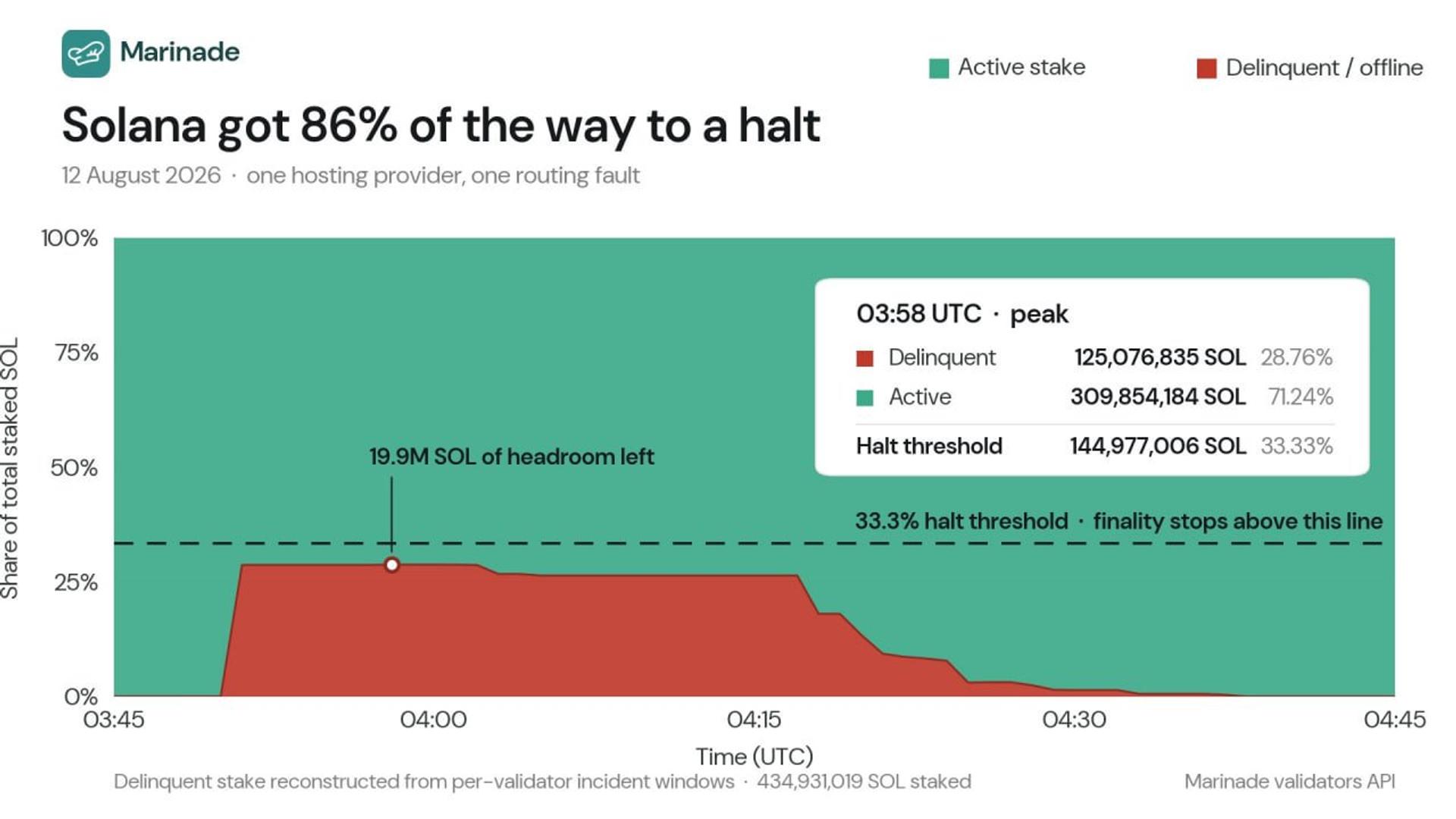
We almost saw the screen go dark on Solana again this week. For a few hours on Wednesday, the network flirted with a full-blown halt after a significant portion of its validator set dropped offline simultaneously. While the Solana Foundation is framing this as a victory for uptime, founders and builders need to look at the plumbing to understand how close we actually came to a standstill.
The 33% Threshold
In the world of proof-of-stake networking, there is a magic number: 33.3%. If more than a third of the active stake goes dark or stops communicating, the network can no longer reach consensus. It stops producing blocks. It freezes. According to reports from Marinade Finance, Solana hit roughly 29% offline stake during the peak of this week’s volatility. We were about four percentage points away from a complete network lockout.
The culprit wasn’t a bug in the code or a sophisticated exploit. It was a routing glitch at a major data center provider. A single point of failure in the physical world nearly paralyzed a multi-billion dollar digital economy. This is the reality of modern infrastructure that many marketing teams prefer to ignore.
Foundation Optimism vs. Builder Reality
The Solana Foundation is taking the glass-half-full approach. Their stance is simple: the network held up under stress. Transactions were still being processed, and blocks were still being minted. Technically, they are right. The system didn’t break. But for those of us building products on top of this stack, "it didn't die" is a pretty low bar for success.
When 29% of the network vanishes, performance degrades. Even if the chain stays alive, the user experience suffers. High-frequency applications, decentralized exchanges, and real-time gaming protocols feel the jitter. For a founder, a network that is "technically alive" but struggling is almost as bad as one that is down, because it creates unpredictable state changes and failed transactions that lead to support tickets and frustrated users.
The Centralization Tax
This incident exposes the uncomfortable truth about validator concentration. We talk a lot about decentralization in the abstract, but in practice, validators often congregate in the same handful of high-tier data centers because it’s cheaper, faster, and provides better peering. When one of those providers has a bad day, the whole industry holds its breath.
This is what I call the Centralization Tax. We save money on latency and operational overhead by clustering together, but we pay for it in systemic risk. If you are a builder, you have to ask yourself: how much of your stack relies on a single provider like AWS, Google Cloud, or the specific data centers favored by Solana validators? The answer is usually "too much."
What This Means for Builders
If you’re currently building on Solana, don’t panic, but do diversify. This event is a reminder that the underlying infrastructure is still maturing. Here is how you should be looking at your technical roadmap in light of this close call:
- State Awareness: Your application needs to be able to communicate network health to the user. If the network is nearing a consensus threshold, don’t let users initiate complex transactions that might hang in limbo.
- Infrastructure Redundancy: If you run your own RPC nodes or indexers, don’t put them in the same regions or providers where the majority of validators sit. Be the outlier.
- Risk Modeling: Build your financial models assuming a 24-hour network freeze once a year. If your protocol can’t survive that, you aren’t building for the long term.
The Resilience Paradox
There is an argument to be made that Solana is getting better at handling these shocks. In years past, a 29% drop might have cascaded into a total collapse that required a manual restart. The fact that the network kept moving suggests that the software optimizations and the "Firedancer" spirit of improving the client diversity are starting to pay off.
However, we shouldn’t let the success of the software blind us to the fragility of the hardware. We are building supposedly "unstoppable" code on top of very stoppable servers. As long as a single routing error at one provider can take out nearly a third of the stake, we are playing a dangerous game of chicken with global infrastructure.
Takeaway for the Founder
The takeaway here isn’t that Solana is broken. The takeaway is that hardware decentralization lags far behind software decentralization. As a founder, you cannot control the network's consensus, but you can control how your application reacts to these brownout scenarios. Don't buy into the hype that these networks are invincible. They are experimental, they are fragile, and they are dependent on the same boring internet cables and data centers as everything else.
We dodged a bullet this time. Use the reprieve to audit your own dependencies. The next time the offline stake hits 34%, you won’t have the luxury of reading about it in a post-mortem; you’ll be dealing with a dead chain and angry customers.
Read the original at CoinDesk →