The Institutional Seal of Approval
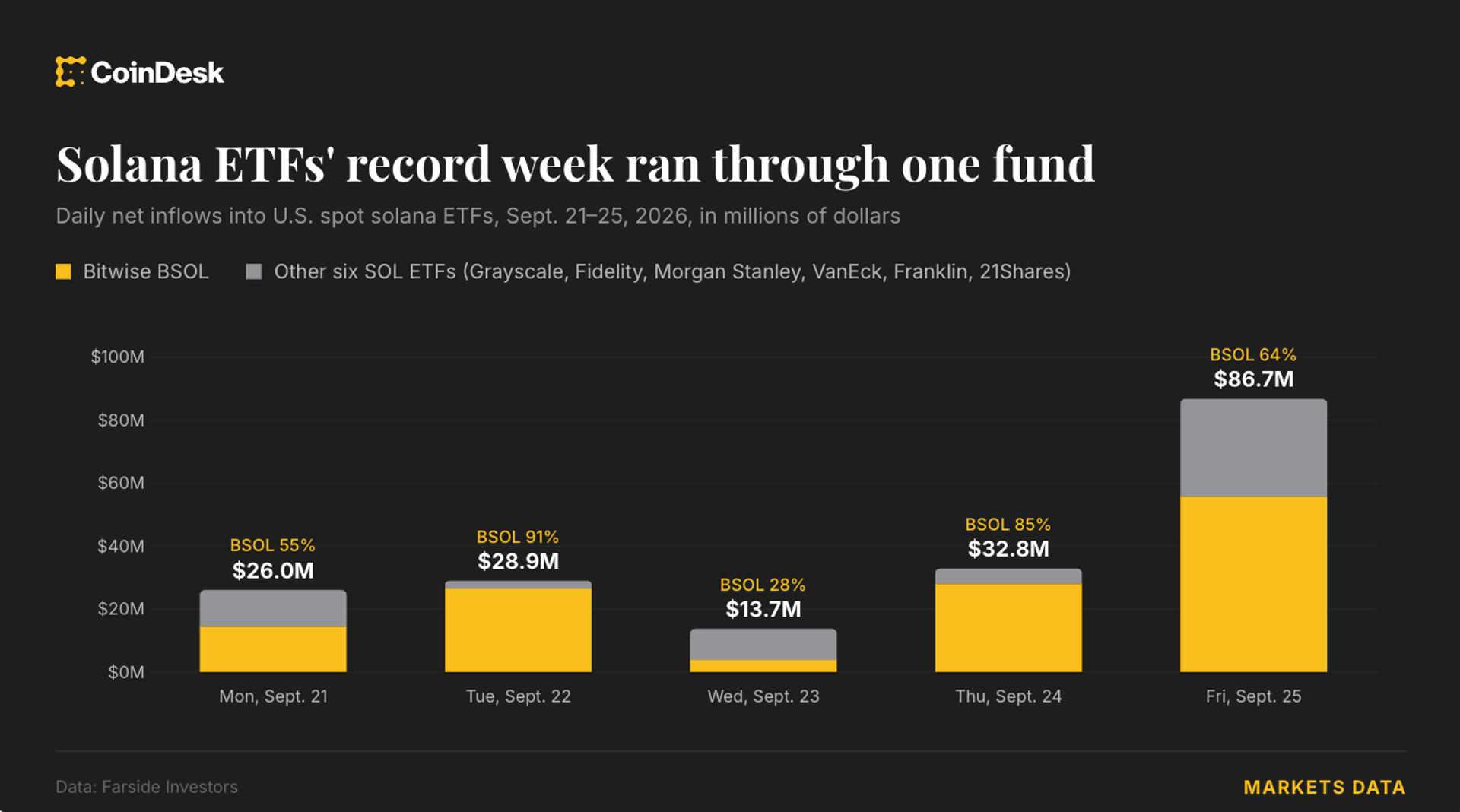
Wall Street has finally stopped looking at Solana as just another experimental sidechain and started treating it like a legitimate asset class. The latest numbers don't lie: $188 million in a single week is a massive vote of confidence, especially when you consider that Bitwise managed to capture two-thirds of those inflows. Even more telling was the Friday surge, where $87 million flooded in, setting a new daily record for the ecosystem.
As someone who has been building in this space for a long time, I have a healthy skepticism toward ETF hype. Usually, these vehicles are just ways for legacy finance to extract fees from retail investors. But this time feels different. When all seven major funds are attracting fresh capital simultaneously, it signals that the market is no longer just betting on Bitcoin or Ethereum. They are betting on the infrastructure of the future, and right now, that infrastructure is being built on Solana.
Bitwise and the Distribution Advantage
Why did Bitwise take such a massive chunk of the pie? It isn't just luck. It comes down to distribution and education. Bitwise has spent years talking to financial advisors and institutional allocators who are traditionally risk-averse. By the time they launched their Solana product, they had already primed the pump. They weren't selling a memecoin casino; they were selling a high-throughput, low-latency settlement layer.
For founders, this is a lesson in positioning. You can have the best tech in the world, but if you cannot explain your value proposition to the people who hold the purse strings, you will lose to the person who can. Bitwise didn't build a better Solana; they built a better bridge for capital to enter the ecosystem. We should be looking at our own projects through that same lens. Are we building cool tech for other developers, or are we building tools that solve real-world problems for people who don't care how the consensus mechanism works?
Moving Beyond the EVM Narrative
For years, the industry narrative was that everything had to be Ethereum-compatible to survive. The logic was that the developer mindshare and the capital were all locked into the Ethereum Virtual Machine (EVM). The recent performance of these ETFs suggests that the narrative is shifting. Investors are looking for diversification, and they are finding it in the Solana ecosystem.
This is a major win for builders who chose to learn Rust instead of Solidity. It validates the decision to build on a chain that prioritizes speed and cost over legacy compatibility. If institutions are willing to put hundreds of millions of dollars into a non-EVM asset, it means they believe the technology is robust enough to handle the next generation of financial applications. It also means the liquidity moat that Ethereum enjoyed for so long is starting to show cracks.
What This Means for Founders
If you are a founder, you shouldn't be distracted by the green candles. Price is a lagging indicator of utility. What you should be looking at is the stability and maturity of the ecosystem that these inflows represent. When $188 million moves into a specific ecosystem in five days, it creates a trickle-down effect. That capital eventually finds its way into DeFi protocols, NFT marketplaces, and infrastructure providers.
However, there is a catch. With institutional money comes institutional scrutiny. As these ETFs grow, the pressure on Solana to maintain 100% uptime and fix its congestion issues will only increase. We can no longer afford to 'move fast and break things' when there are billions of dollars of pension fund money on the line. The era of the amateur developer is ending, and the era of the professional architect is beginning.
The inflow of institutional capital is a double-edged sword: it provides the fuel for massive growth, but it demands a level of stability that many decentralized networks are not yet ready to provide.
The Skeptic's Corner
I wouldn't be doing my job if I didn't point out the risks. Record inflows are often followed by periods of exhaustion. We are seeing a lot of hot money enter the space, and hot money is notoriously fickle. If the broader market takes a hit, or if Solana experiences another significant outage, that $188 million could exit just as fast as it entered. We've seen this movie before, and it usually ends with retail investors holding the bag while the big funds pivot to the next trend.
Also, we have to consider the centralization risk. While ETFs are great for price, they are terrible for decentralization. A few large entities now hold a significant portion of the SOL supply. This gives them outsized influence over governance and the future direction of the network. As builders, we need to ensure that we are creating protocols that remain permissionless and censorship-resistant, regardless of who owns the underlying tokens.
The Road Ahead
Despite the risks, the momentum is undeniable. We are witnessing the maturation of the Solana ecosystem in real-time. The fact that all seven funds are seeing inflows shows that this isn't a fluke—it's a trend. The market is waking up to the fact that there is more than one way to build a decentralized future.
For those of us on the front lines, the mission remains the same. Ignore the noise, focus on the tech, and build products that people actually want to use. The capital will follow the utility. The record-breaking week for Solana ETFs is just a signal that we are heading in the right direction, but the hard work of building the actual applications is still up to us.
Takeaway for Builders
- Institutional Trust: The record inflows prove that Solana is no longer a 'fringe' network; it is a primary target for institutional capital.
- Positioning Over Hype: Bitwise succeeded by educating their audience rather than chasing trends. Founders should do the same.
- Sustainability is Key: With large capital comes the need for professional-grade stability and security. The bar for quality has been raised.
Read the original at CoinDesk →