Price action grabs attention
Infrastructure upgrades rarely do.
The Upgrade Most People Will Miss
Solana has just implemented one of the most consequential builder focused changes of the year: a 90% reduction in the deposit required to create new onchain accounts.
The change arrived through SIMD-0437 as part of the Agave 4.2 upgrade, which began rolling out to mainnet validators during the week of August 17. For founders, creators, and developers building on Solana, the impact is immediate. The capital required to create accounts, manage user state, and scale applications has dropped dramatically.
On its own, that would be meaningful.
What's more interesting is that it arrives alongside two other network upgrades that expand transaction capacity and reduce confirmation times, creating a combination that could materially improve both the economics and user experience of building on Solana.
What Is SIMD-0437?
SIMD stands for Solana Improvement Document, the framework used to propose and implement protocol-level changes across the Solana ecosystem.
SIMD-0437 introduces a major reduction in Solana's account storage requirements by lowering the network's
amports-per-byte parameter from 6,960 to 696. The result is a roughly 90% reduction in the refundable deposit required to create new on-chain accounts.
How Does the Solana SIMD-0437 Upgrade Reduce Account Creation Costs?
The term "rent" on Solana often causes confusion.
Unlike a traditional recurring fee, Solana's rent mechanism functions as a refundable storage deposit. Every account created onchain must hold a minimum amount of SOL to compensate validators for storing that account's data across the network.
When the account is closed, that deposit is returned in full.
SIMD-0437 lowers the underlying storage constant, known as lamports-per-byte, from 6,960 to l696.
This change reduces the minimum deposit required for new accounts by approximately 90%, making it significantly cheaper to create token accounts, NFT accounts, and application state accounts.
For a standard SPL token account, the required deposit falls from approximately $0.16 to about $0.016.
The rollout is being introduced gradually through multiple phases rather than a single network-wide switch, allowing the ecosystem to monitor storage growth and network behavior before progressing to the next stage.
Existing accounts remain unaffected. The change primarily impacts the cost of creating new accounts going forward.
Solana Rent Reduction: Before vs After SIMD-0437
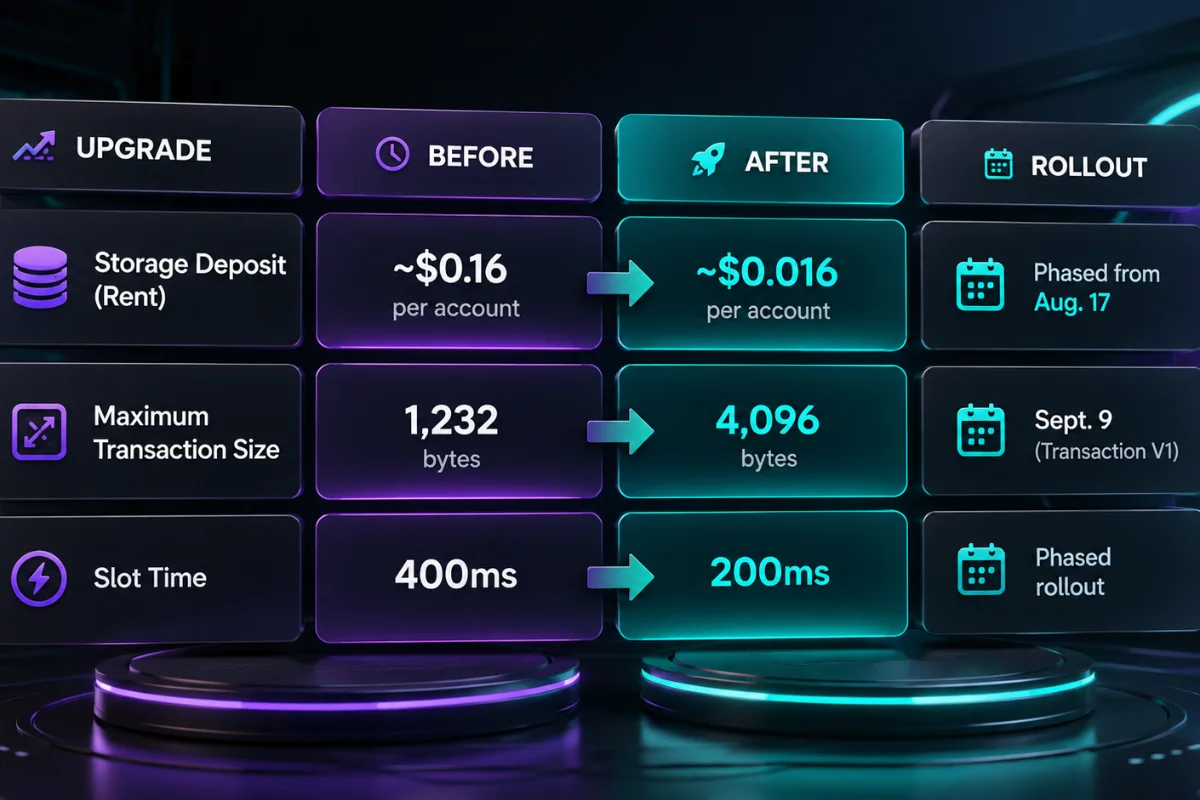
The reduction becomes increasingly meaningful as applications scale. What once required substantial capital to reserve storage space can now be achieved with a fraction of the previous cost.
What Other Solana Upgrades Are Arriving Alongside SIMD-0437?
The rent reduction is only one piece of a broader infrastructure push.
Three separate improvements are landing within the same period, each targeting a different bottleneck in the builder experience.
Larger transaction sizes create room for more complex interactions, including batched operations, advanced multisignature workflows, and zero-knowledge proof integrations that previously required multiple transactions.
Faster slot times reduce confirmation latency and improve responsiveness for end users.
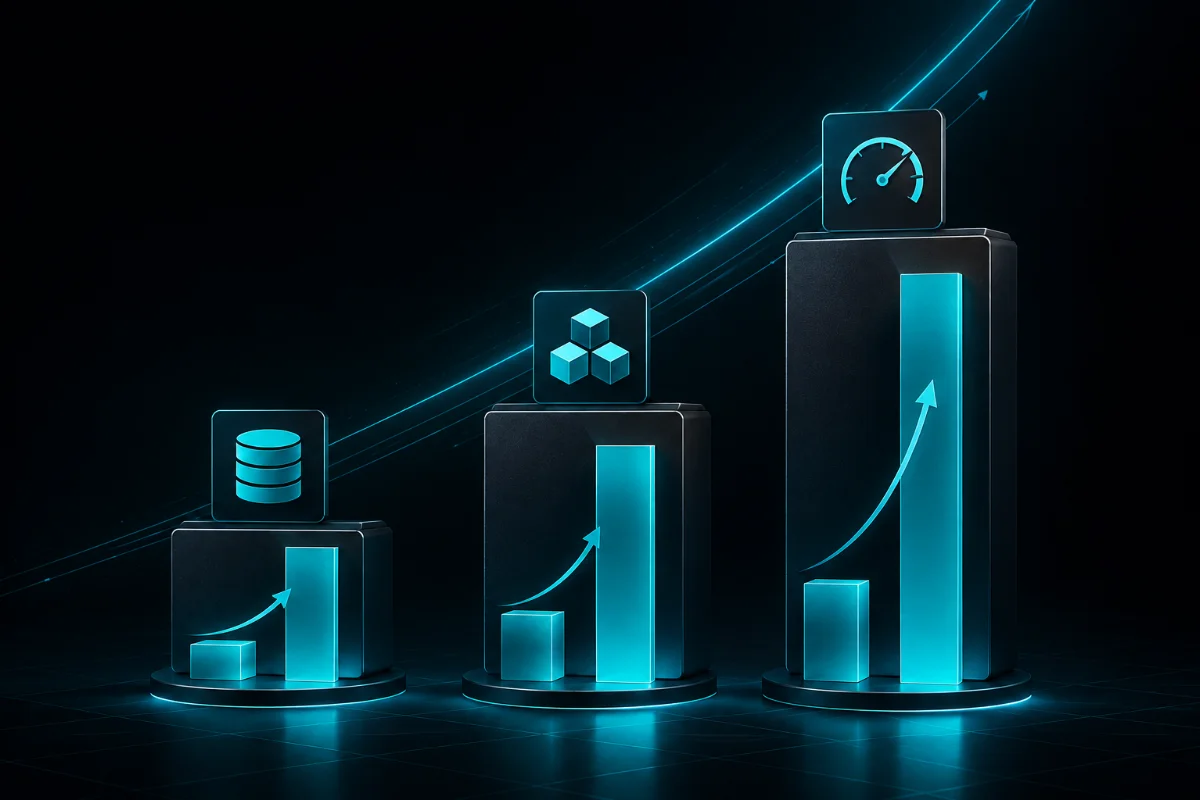
Individually, each upgrade solves a specific limitation. Together, they point toward a network increasingly optimized for large scale consumer applications.
Impact of the Agave 4.2 Upgrade on Solana Developers
For developers, the Agave 4.2 upgrade primarily changes the economics of scaling applications.
Products that create large numbers of accounts no longer need to lock significant amounts of SOL into refundable storage deposits. This frees capital for product development, user acquisition, and infrastructure.
Applications likely to benefit include:
Consumer onboarding platforms
Social and reputation systems
NFT ecosystems
Creator communities
Loyalty and rewards programs
Onchain gaming projects
Contributor coordination networks
The impact becomes more significant as user counts increase.
A consumer application onboarding 100,000 users previously needed to lock up roughly $16,000 worth of SOL in refundable deposits to create associated accounts.
Under the new parameters, that requirement drops closer to $1,600
That's capital that can remain available for product development, marketing, hiring, or user acquisition rather than sitting idle as network collateral.
What Does This Mean for Builders and Creators?
The benefits extend beyond traditional consumer applications.
Creator ecosystems, loyalty systems, contributor networks, and reputation-based platforms often generate large numbers of user-specific accounts by design.
Skill Stacker provides a useful example. Because contributor participation, staking activity, rewards, and reputation data are tracked across many individual accounts, account creation becomes a meaningful operational cost at scale.
A 90% reduction in storage deposits directly lowers the cost of onboarding contributors and maintaining participation records on-chain.
NFT collections, membership programs, and token launches also benefit from reduced account creation costs, particularly for projects onboarding thousands of users rather than a handful of early adopters.
How Much SOL Is Required for a Standard SPL Token Account After the Rent Reduction?
The required deposit for a standard SPL token account falls from approximately $0.16 to roughly $0.016, representing a reduction of about 90%.
Because the requirement is denominated in SOL, the exact dollar amount will vary with market prices. However, the underlying protocol change permanently lowers the minimum deposit requirement for new accounts.
Market Impact
The significance of SIMD-0437 extends beyond lower storage costs.
Combined with larger transaction capacity and faster confirmations, the upgrade removes several friction points that historically made consumer-scale applications more expensive to operate.
While traders may focus on short
term price movements, infrastructure improvements like rent reduction often have a greater long-term effect on ecosystem growth. Lower onboarding costs, improved scalability, and better user experiences create stronger incentives for developers to build products that can support millions of users.
What's notable is not simply that Solana made account creation cheaper. Several competing ecosystems already offer low-cost account structures.
What's notable is that Solana is reducing those costs while simultaneously increasing transaction capacity and improving speed within the same operating environment.
That combination strengthens the argument for building consumer-scale products directly on Solana rather than relying on fragmented execution environments elsewhere.
Key Takeaway
Price movements generate headlines.
Infrastructure determines adoption.
By cutting storage deposits by 90%, expanding transaction capacity, and pushing toward faster confirmations, Solana is making a clear bet on the next generation of consumer applications.
Personally, I don't think this upgrade gets the attention it deserves, because "cheaper storage rent" doesn't sound like news the way a price move or an ETF filing does. It's worth reading alongside Solana's record fee revenue and accelerated inflation cuts together, the two moves show a network re-pricing itself on two fronts at once: transaction fees are climbing as inflation subsidies wind down, while storage costs are being deliberately engineered downward to keep mass onboarding cheap.