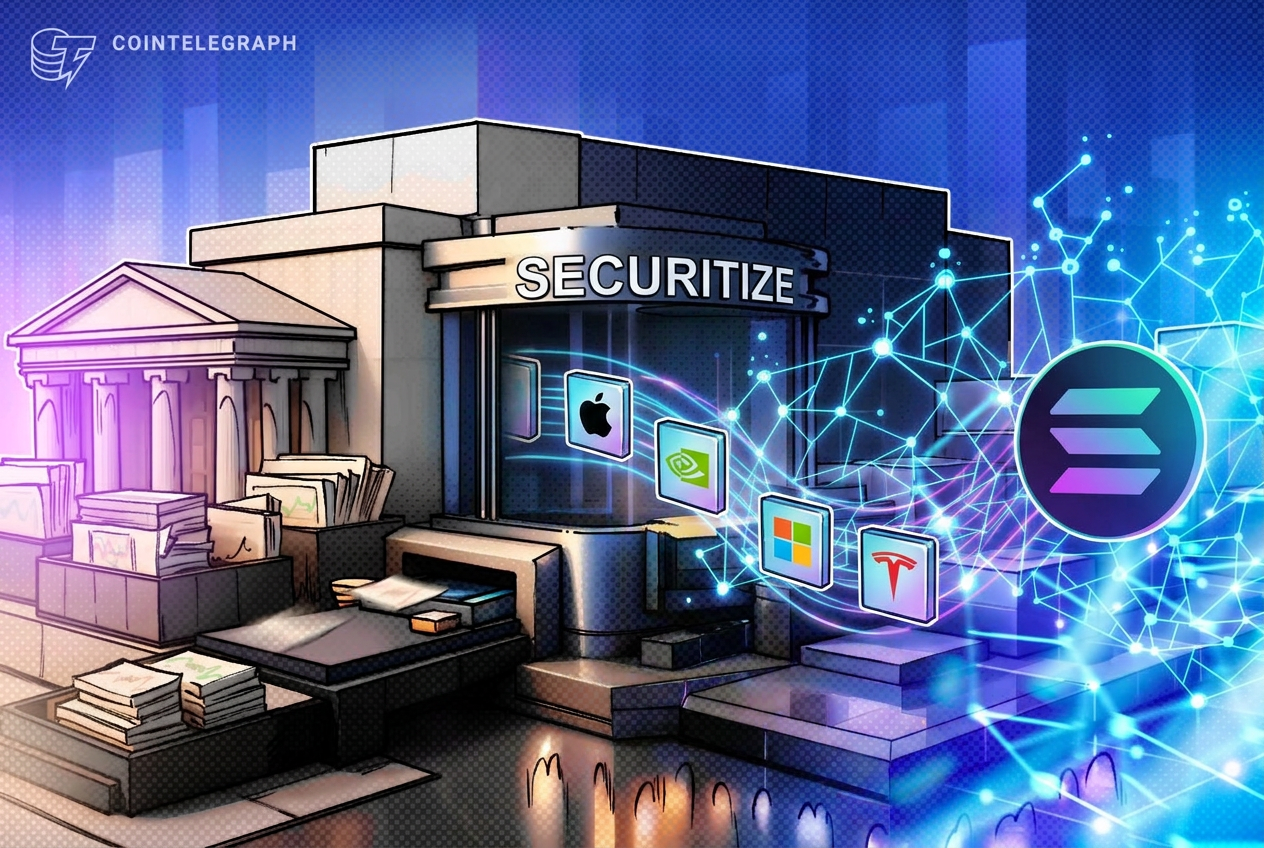
The line between traditional finance and decentralized rails just got a lot thinner. Securitize, a firm that has been quietly grinding on the infrastructure for real-world assets for years, just announced they are bringing tokenized U.S. equities to the Solana blockchain. We are talking about the big names: Apple, Tesla, Nvidia, and Microsoft. The market liked the news enough to push their stock up by double digits, but for those of us actually building in this space, the price action is the least interesting part of the story.
The infrastructure shift
For a long time, the promise of tokenization was mostly academic. We talked about how great it would be to trade stocks with the same ease as swapping SOL for a meme coin. But the reality was always bogged down by high gas fees on Ethereum and a regulatory environment that felt like walking through waist-deep mud. By choosing Solana, Securitize is making a very specific bet on throughput and cost. They are betting that if you make the friction low enough, the liquidity will finally follow.
This isn't just about wrapping a stock in a digital shell. These are actual shares held in custody, represented by tokens that carry the same dividend and voting rights as the paper certificates your grandfather used to hold. The difference is that these tokens live on a public ledger. They don't sleep. They don't wait for the closing bell at 4:00 PM EST. They move at the speed of the internet.
Why Solana matters for RWA
A lot of builders ask me why these firms aren't just staying on Ethereum or using a private L2. The answer is usually scalability and user experience. If you are a retail investor trying to buy a fraction of a share, you can't pay $50 in gas fees. It breaks the math. Solana’s low-latency environment allows for the kind of high-frequency settlement that traditional stock markets currently struggle to provide through T+2 settlement cycles.
By launching on Solana, Securitize is testing the hypothesis that the "DeFi summer" energy can be redirected toward productive, regulated assets. If you can use a tokenized share of Nvidia as collateral in a lending protocol, or if you can stream dividends directly to a wallet in real-time, the utility of the asset changes. It stops being a static entry in a brokerage database and starts being a programmable tool.
The reality check for founders
Before we get too excited, let’s look at the friction. This isn't a permissionless free-for-all. These are regulated securities. That means KYC (Know Your Customer) isn't optional; it's the foundation. To hold these tokens, you have to be an eligible investor. This creates a walled garden on top of an open protocol. For developers building on top of these assets, this adds a layer of complexity. You can’t just fork a DEX and expect it to work with tokenized Apple stock. You have to integrate identity layers and compliance checks into every transaction.
I’ve seen too many founders get burned by ignoring the regulatory stack. The lesson here is that the "tech" is the easy part. Building the legal framework that allows a Solana token to legally represent a share of a Delaware corporation is the hard part. Securitize is doing the heavy lifting here, but builders need to be aware that the future of RWA is going to be heavily gated for the foreseeable future.
The 24/7 market dream
One of the biggest pain points in traditional finance is the weekend. If a major geopolitical event happens on a Saturday, stock holders are stuck watching the world burn until Monday morning. Tokenization solves this. A 24/7 market for U.S. equities changes the risk profile of every portfolio on the planet. It allows for instant liquidity and tighter spreads, provided the market makers show up.
However, we have to be skeptical about depth. Just because a stock is tokenized doesn't mean there is a buyer on the other side at 3:00 AM on a Sunday. The success of this Securitize initiative will depend entirely on whether they can attract enough institutional liquidity to make the prices reflect the actual underlying value of the companies without massive slippage.
What this means for the ecosystem
- Reduced Settlement Risk: Moving from T+2 to near-instant settlement reduces the need for massive collateral buffers held by clearinghouses.
- Global Access: While currently restricted to eligible investors, the long-term goal is clearly to allow anyone with an internet connection to own a piece of the most successful companies in the world.
- Programmable Finance: Imagine a world where your rent is paid automatically by the dividends generated from your tokenized stock holdings, all handled by a smart contract without a bank in the middle.
The Takeaway
Securitize jumping onto Solana is a signal that the "institutional crypto" phase is moving past pilot programs and into actual production. It’s a win for Solana’s reputation as a functional network, but it’s a challenge for builders. You can no longer ignore the intersection of code and law. If you want to build in the RWA space, you need to stop thinking like a pirate and start thinking like a structural engineer. The rails are being laid, but the train only runs if the compliance engine stays on the tracks.
Read the original at Cointelegraph →