We have been hearing about the promise of robotics for decades, but the reality is usually a lot of expensive hardware sitting in a lab failing to pick up a coffee cup. The bottleneck has always been data. To teach a robot how to navigate the physical world, you usually have to train it in the physical world. That is slow, expensive, and breaks a lot of motors.
New research coming out of the PEAR lab suggests we are finally cracking the code on Sim-to-Real transfer. This is the process of training an AI model inside a digital simulation and then dropping that finished brain into a physical robot. Historically, this failed because simulations are too perfect. The real world has friction, lighting changes, and weird gravity hiccups that digital worlds don't account for. PEAR researchers are showing that we can now bridge that gap, specifically with fine motor skills like picking up objects and aligning blocks.
The End of the Data Bottleneck
For builders in the AI space, the most important takeaway here is the shift in how we think about training data. If you are building a physical product, you no longer need a fleet of 100 robots running 24/7 to gather telemetry. You need a high-fidelity simulation and a model that understands how to translate those digital wins into physical movement.
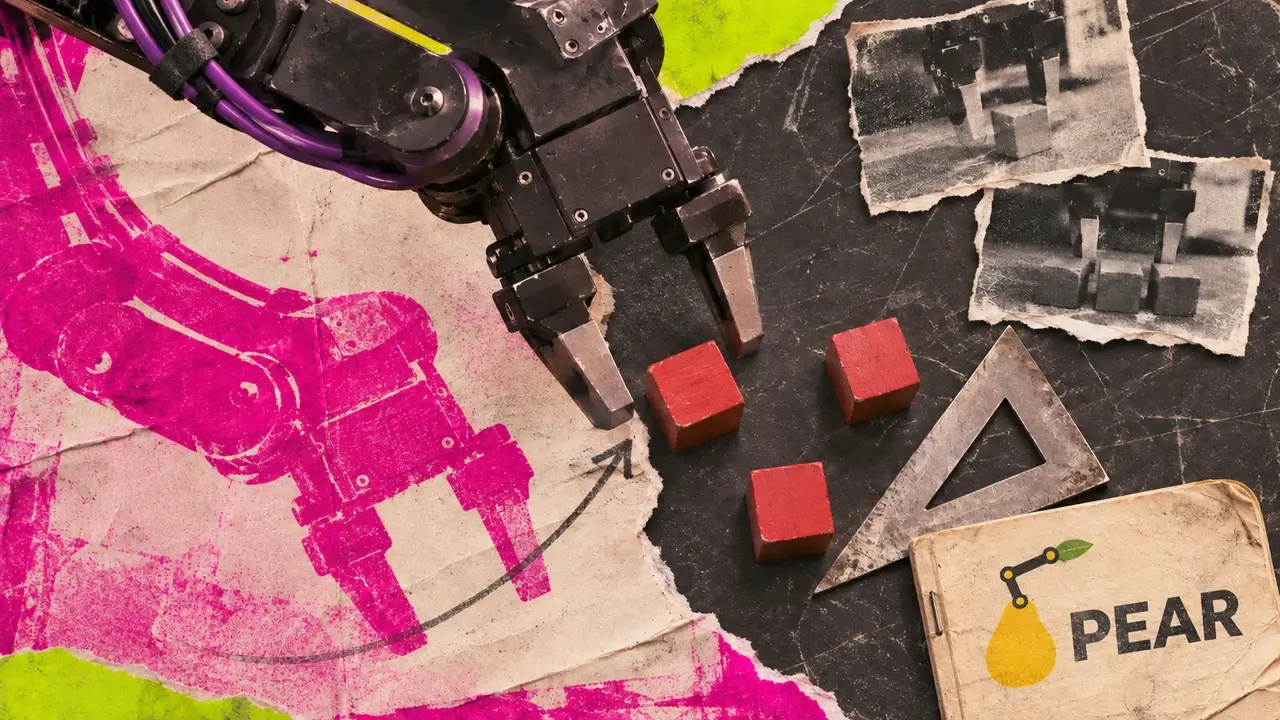
The researchers demonstrated that a robot trained entirely in a virtual environment could perform complex tasks on hardware it had never "seen" before. They focused on pickup tasks and block alignment—the kind of boring, repetitive labor that makes up the bulk of industrial work. This is a massive win for the democratization of robotics. If you can iterate on your software in a cloud environment without worrying about a $50,000 arm snapping a joint, the cost of entry for startups drops significantly.
The Reasoning Delay Problem
It isn't all sunshine and automated warehouses, though. The report highlights a massive hurdle: latency. While the robots gained the skills, they suffered from significant reasoning delays. In the demo environments, the robots would pause, sometimes for seconds at a time, to process the sensor data and decide on the next micro-movement.
In a controlled lab, a three-second delay is an academic curiosity. In a real-world factory or a kitchen, it's a non-starter. This is where the intersection of AI and edge computing becomes critical. We have models that are smart enough to do the work, but our current hardware-to-software pipelines aren't fast enough to make those decisions in real-time. For founders, the opportunity isn't just in the AI model itself; it's in the optimization of the stack to eliminate this lag.
Why Transferable Skills Matter
The most impressive part of this research is the hardware agnosticism. Usually, a model trained for a specific robotic arm is useless if you switch to a different brand or even a different model from the same manufacturer. PEAR's work suggests a future where we have a "foundation model" for movement.
- Cross-platform utility: Training once and deploying across different hardware sets.
- Reduced compute costs: Simulation is significantly cheaper than physical trials.
- Safety: Training a robot to handle dangerous materials or heavy loads in a sim first avoids catastrophic real-world failures.
This mimics what we saw with Large Language Models. We didn't need a new GPT for every different type of computer; we just needed a model that understood the underlying structure of language. These researchers are trying to do the same for the physics of movement.
The Founder Perspective
If you are building in this space, stop obsessing over the hardware. The hardware is becoming a commodity. The value is moving to the simulation environments and the transfer layers. The companies that win will be the ones that can take a generic robotic arm from a factory in China and turn it into a precision instrument using nothing but a cloud-trained model.
We also need to look at the crypto angle here, specifically regarding decentralized compute. Training these high-fidelity simulations requires massive GPU power. As these simulations become more complex to close the "reality gap," the demand for on-demand, scalable compute will only grow. Projects building decentralized physical infrastructure (DePIN) for compute are the silent partners in this robotics revolution.
The real world is messy, but our digital shadows are finally getting detailed enough to teach us how to navigate it.
We are moving away from the era of "scripted" robots that just follow a set of coordinates. We are entering the era of "perceptive" robots that can feel their way through a task. The latency issues are a temporary engineering hurdle, not a fundamental flaw in the logic. Once we solve the processing delay, the transition from the screen to the street will happen faster than most people are prepared for.
The Takeaway
Sim-to-Real is no longer a theory; it is becoming a functional workflow. If you can prove a skill in a simulated environment, the path to physical implementation is now a matter of optimization, not reinvention. Watch the latency space—whoever fixes the reasoning delay wins the market.
Read the original at CryptoSlate →