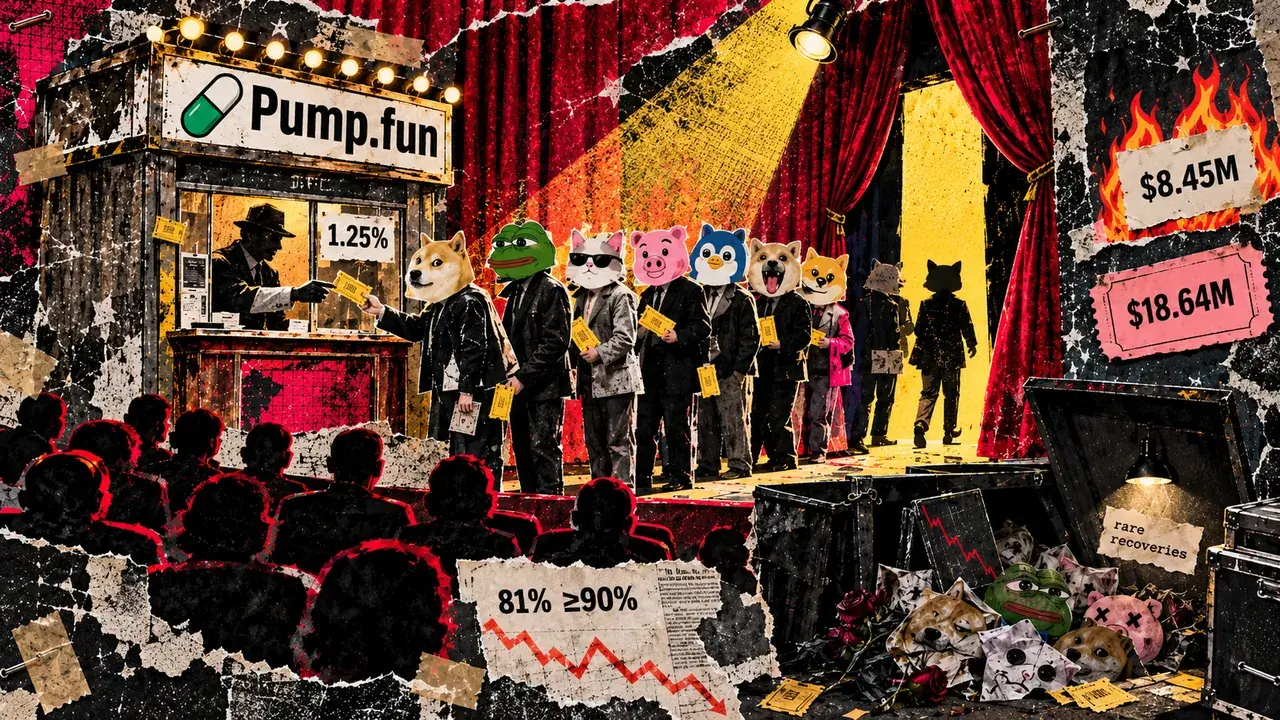
The Casino Always Wins
If you have spent any time on social media lately, you have seen the screenshots. A developer turns a few hundred dollars into a life-changing windfall by launching a token with a funny name. These stories are the fuel for the PumpFun engine. But new data suggests that for every person buying a luxury car with memecoin gains, there are thousands of builders and investors staring at a screen full of red candles.
Recent market analysis shows a staggering trend: roughly 81% of tokens launched through this specific ecosystem have crashed by 90% or more. While the tokens themselves are failing, the platform facilitating them is generating millions of dollars in fees. It is a classic gold rush dynamic. The miners are mostly going broke, but the people selling the shovels are building empires.
The Reality of the 90% Drop
We often talk about volatility in crypto, but what we are seeing here is not just volatility—it is a total wipeout. When a project drops 90%, it requires a 900% gain just to get back to the break-even point. According to researchers at Talos, the recovery rate for these projects is incredibly low. Once a memecoin loses its initial momentum, the gravity of sell pressure almost always wins.
This should not come as a surprise to anyone who understands liquidity. These tokens are designed for rapid, speculative bursts. They lack utility, roadmap, or any fundamental reason for existing beyond the initial joke. When the joke stops being funny, the money leaves. The problem is that the platform keeps the entry and exit fees regardless of whether the token survives the week.
Building for Sustainability vs. Building for Exit
From a founder's perspective, this trend is a cautionary tale about the type of ecosystem you choose to build in. If you are a builder looking to create something with longevity, launching in a space defined by a 90% failure rate is a massive uphill battle. You are competing with thousands of low-effort projects that dilute the attention of your potential users.
The current state of memecoin launches is essentially a high-frequency slot machine. The platform provides the infrastructure to spin the reels, but it bears none of the risk. This creates a disconnect. Usually, in a healthy tech ecosystem, the platform succeeds when its participants succeed. Here, the platform succeeds through sheer volume, even if the individual participants are losing their shirts.
The Burn Myth
There is a lot of talk about token burns and how they are supposed to help price action. When tokens are removed from circulation, the remaining supply is theoretically more valuable. However, the data indicates that these burns are not the magic bullet people hope they are. No amount of supply reduction can compensate for a total lack of demand.
For builders, this is a critical lesson: do not rely on tokenomics gimmicks to save a project that has no underlying community or purpose. If 81% of your peers are hitting the floor, a burn mechanism is just rearranging the deck chairs on the Titanic. Real value comes from retention, not just creation.
The Cost of Cheap Entry
One reason we see such high failure rates is the low barrier to entry. It has never been easier to launch a token. This is a double-edged sword. Democratizing access to finance is a core tenet of crypto, but when the cost of launching is near zero, the quality of the average project tends to follow suit.
We are seeing a market flooded with "disposable code." These are projects meant to last four hours, not four years. While this generates massive fee revenue for the infrastructure providers, it creates a toxic environment for serious builders who are trying to solve real problems. You have to ask yourself: are you building a product, or are you just providing liquidity for the house?
Survival is the Exception
The Talos report highlights that recoveries are "rarely observed." This is a polite way of saying that once these tokens die, they stay dead. Unlike established assets like Bitcoin or Ethereum, which have institutional backing and deep utility, memecoins have no floor. They can always go lower.
This creates a predatory environment. The platform earns its millions from the friction of these thousands of failures. Every time a new token is created, and every time someone tries to trade their way out of a losing position, the house takes a cut. It is a highly efficient business model for the platform owners, but it is a graveyard for the average participant.
Takeaways for the Founder Community
If you are building in the AI or crypto space, there are three things to learn from the current state of the memecoin market. First, ignore the hype of the outliers. For every screenshot of a million-dollar gain, there are thousands of silent losers. Second, focus on building something that people want to hold for reasons other than a quick flip. If your project's only value is the possibility of a pump, you are competing in a market where 81% of people lose nearly everything.
Third, and most importantly, be careful about the platforms you align yourself with. If a platform's incentives are purely volume-driven and they don't care about the success rate of the projects they host, they are not your partner. They are your landlord. And as we can see from the millions of dollars in fees being collected while tokens crash, the landlord always gets paid first.
The current market is a loud, chaotic mess of speculation. As a builder, your job is to look past that noise. Real innovation is not found in a 90% drawdown; it is found in the projects that manage to build something that lasts after the initial excitement has faded. Stop chasing the pump and start building the foundation.
Read the original at CryptoSlate →