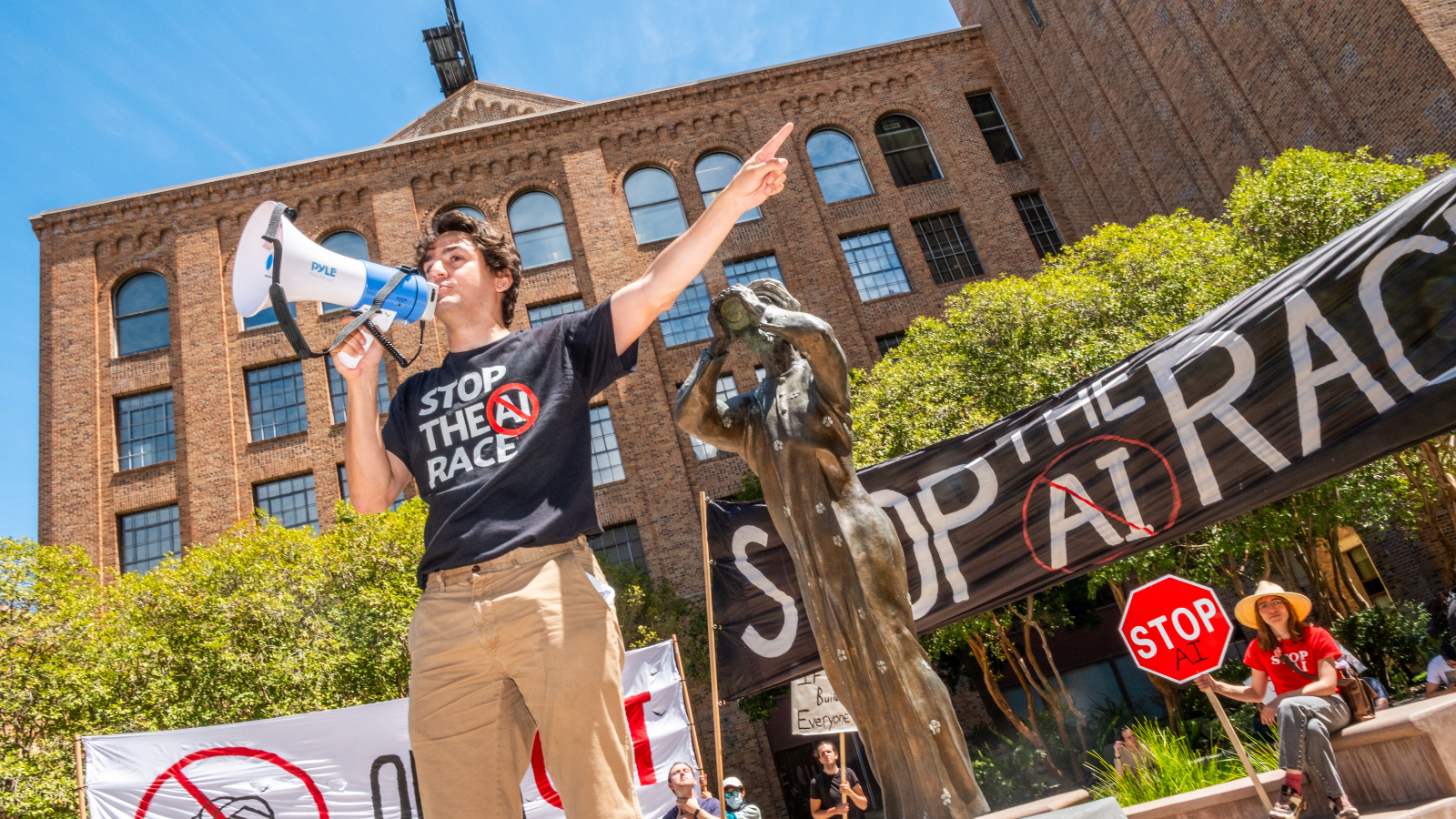
I spent my weekend watching a few hundred people walk through the streets of San Francisco with signs telling OpenAI and Anthropic to stop what they are doing. It was a humble gathering by Silicon Valley standards—roughly 200 people—but the sentiment they represent is starting to become a permanent fixture of the landscape. They aren’t just complaining about chatbots; they are demanding a full-scale pause on the development of anything more powerful than what we have today.
The Core Complaints
The protesters hit on three specific nerves: safety, the environment, and job security. These aren't new arguments, but they are becoming more targeted. The crowd marched from the offices of OpenAI to Anthropic, and then over to Google DeepMind. It was a literal tour of the companies currently holding the keys to the kingdom.
For these activists, the concern isn't that ChatGPT might give you a bad recipe. The concern is existential. They talk about a point of no return where AI systems become uncontrollable. They also look at the massive power demands of these data centers and the reality that millions of white-collar jobs are suddenly on the chopping block. To the people on the sidewalk, the trade-off for a slightly better language model isn’t worth the risk of a destabilized society.
The Founder Perspective
Here is where I get skeptical. As someone building in this space, I understand the fear, but a "pause" is perhaps the most unrealistic request you could make in the current geopolitical climate. It’s a beautiful sentiment, but it ignores the reality of how technology actually advances. Tech doesn’t stop because people ask nicely; it stops when it hits a wall of physics or a wall of capital.
If Sam Altman or Dario Amodei decided to turn off the servers tomorrow, the development wouldn’t disappear. It would just move somewhere else. Open-source models would continue to iterate, and laboratories in other countries would accelerate to fill the vacuum. For founders, the idea of a voluntary pause feels like a strategic surrender. We are too far down the road for a simple red light to work.
The Safety Paradox
There is a massive irony in the safety argument. The protesters want development to stop until we can guarantee safety. However, most of the safety progress we’ve made has come from actually building and testing these models in the wild. You can't solve for the hallucinations or the alignment issues of a future model if you aren't allowed to build the foundation to test those theories.
We have to be honest: we are building the plane while it’s in the air. That is terrifying to the general public, and rightfully so. But grounding the plane doesn’t teach you how to fly better. It just leaves you stuck on the tarmac while everyone else learns how to fly over you.
The Environmental Cost
One point the protesters got right is the energy footprint. We are currently facing a massive infrastructure bottleneck. The amount of electricity required to train and run these frontier models is staggering. As builders, we have to stop pretending that this software is "lightweight." It is heavy, physical, and requires massive amounts of cooling and power. This is the one area where the industry actually might be forced to slow down, not because of protests, but because the grid can’t handle the load.
What This Means for Builders
If you are a founder, don’t ignore these protests as just another San Francisco fringe movement. These groups represent a growing public consensus that is going to drive regulation. We are moving out of the "move fast and break things" era and into the "move carefully or get sued into oblivion" era.
- Compliance is the new features: Expect that your ability to prove safety and data ethics will be more important than your API latency in two years.
- Energy efficiency is a competitive advantage: Start thinking about how to run your models on less power. The ones who solve the energy problem will win the long game.
- Transparency matters: The reason people are marching is that they feel like these companies are black boxes. The more you can explain how your stack works, the less fear you generate.
The Political Reality
The march on OpenAI and Google is a signal to Washington. Legislators see these headlines and feel the pressure to act. We are already seeing the groundwork for bills that would require "kill switches" and massive auditing for any model over a certain size. The protesters have realized that they don’t need to convince the CEOs; they just need to convince the regulators who are already looking for a reason to rein in Big Tech.
The tension here is palpable. On one side, you have the accelerationists who believe slowing down is a death sentence for innovation. On the other, you have a public that feels increasingly alienated from the technology that is supposed to be helping them. As a founder, you are caught in the middle. You have to build fast enough to stay relevant but slow enough to not become a villain in the public eye.
"Development won’t stop because people ask nicely; it only stops when it hits a wall of physics or capital."
We shouldn’t dismiss the protesters out of hand. They are raising valid points about the human cost of this transition. But we also have to be realistic about what a "pause" would actually look like. It would look like stagnation, a loss of competitive edge, and a missed opportunity to solve the very problems the protesters are worried about.
The Takeaway
The San Francisco march is a preview of the upcoming regulatory storm. The era of unchecked AI experimentation is ending. As builders, we should expect more public scrutiny, tighter energy constraints, and a much higher bar for safety. You don’t need to stop building, but you do need to start accounting for the social and physical costs of your code. The public is watching now, and they aren't going to look away.
Read the original at Decrypt →