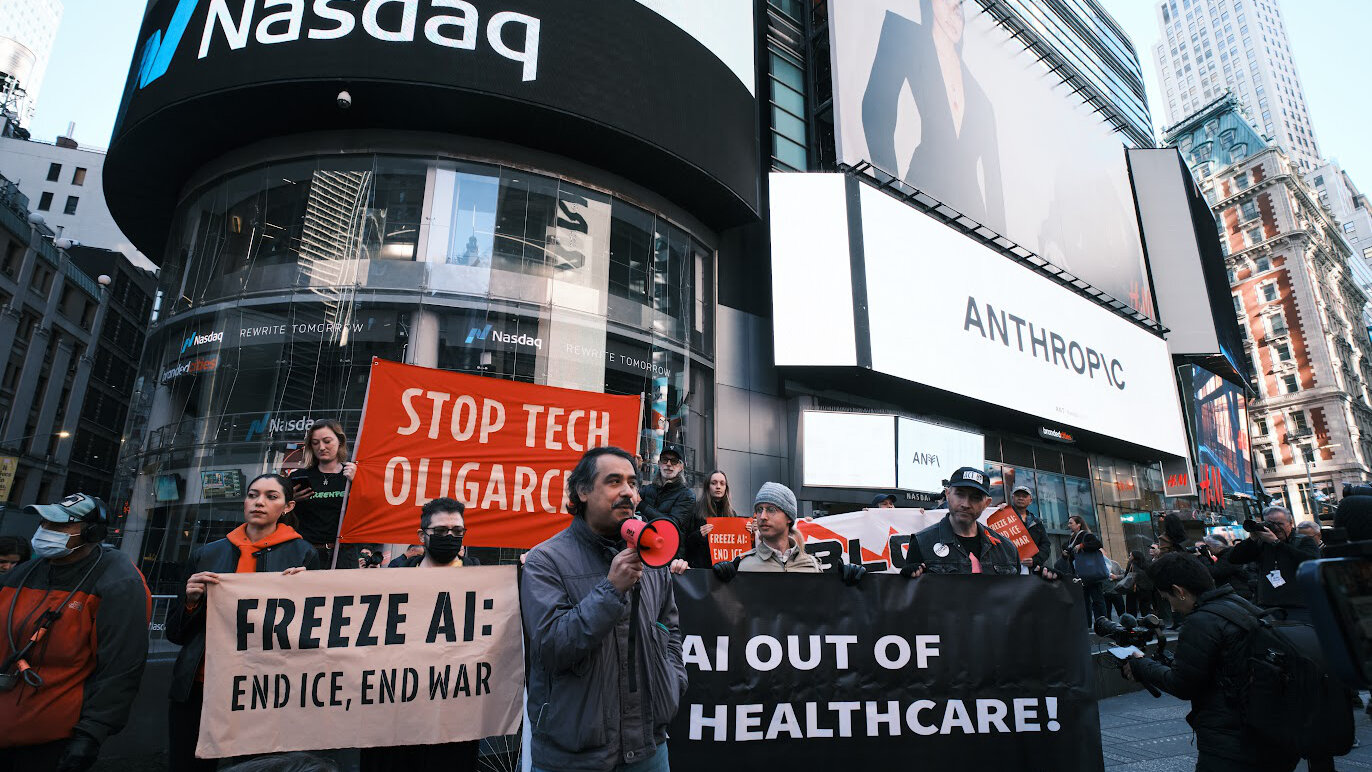
We just watched something happen outside the Nasdaq that doesn't usually happen for a cloud software play. As Anthropic made its public debut, the typical fanfare was interrupted by handcuffs and picket lines. At least four activists were arrested for trying to block the entrance, shouting about bubble risks and retirement funds.
It is easy for those of us in the building phase to dismiss protesters as luddites or doomsday preppers. But if you look past the slogans, there is a technical and economic argument being made that every AI founder should be paying attention to. We are currently navigating a valuation environment that feels disconnected from the underlying utility of the technology, and the public is starting to notice.
The Valuation Gap
Anthropic is a powerhouse. They have built Claude, which many of us consider the most "human" feeling LLM on the market. They have raised billions from Google and Amazon. On paper, they are the success story of the decade. However, the protesters aren't upset about the code; they are upset about the multiplier.
When a company goes public at these levels, they aren't just selling shares; they are selling a promise that AI will fundamentally rewrite the global economy in the next 24 months. If that rewrite takes ten years instead of two, the people buying in today at the top of the hype cycle are going to get crushed. The activists outside the Nasdaq were specifically highlighting retirement savers—regular people whose 401ks are tied up in index funds that are now heavily weighted toward these massive AI valuations.
As a builder, you have to ask yourself: is your product delivering enough real-world margin to justify the cost of the compute? If the answer is no, you are part of the bubble they are talking about.
Why the Public is Getting Nervous
There is a growing sentiment that AI is following the path of the dot-com era or the 2008 housing crisis. While those comparisons are a bit lazy, they aren't entirely wrong. We have seen a massive influx of capital into companies that are burning cash faster than they can find a repeatable business model. Anthropic, despite its brilliance, is still in the heavy R&D phase where every token generated costs real money.
The protesters are worried that when the music stops—when investors demand actual profits instead of just growth—the fallout won't just hit the VCs in Menlo Park. It will hit the broader economy. This is the first time we've seen this kind of physical resistance to an AI IPO, and it signals a shift in the cultural narrative. AI is no longer the shiny new toy; it's being viewed as a systemic risk.
What This Means for Founders
If you are building in the AI space right now, you need to understand that the "growth at all costs" era is hitting a wall of public skepticism. Here is how I’m looking at this from a founder's perspective:
- Sustainable Unit Economics: If your business only works because venture capital is subsidizing your API costs, you are in danger. You need to find a way to make your AI workflows profitable on their own merits.
- Transparency Over Hype: Avoid the temptation to over-promise. The public is looking for reasons to distrust AI right now. Being honest about what your models can and cannot do is a long-term competitive advantage.
- Resilience to Market Swings: If the AI bubble does pop, the companies that survive will be the ones solving boring, essential problems. Flashy demos won't keep the lights on during a market correction.
The Real Risk of Over-Saturation
The activists mentioned the risk to retirement savers, and that is a point we shouldn't ignore. When a sector becomes "too big to fail" in the eyes of the market, the pressure to maintain growth leads to bad decision-making. We've seen this in crypto, and we've seen it in fintech. AI is currently the only thing keeping the S&P 500 afloat. That is a lot of weight to put on the shoulders of a technology that still hallucinates basic facts.
For those of us actually writing code and deploying agents, the noise at the Nasdaq is a reminder to keep our heads down. The best way to prove the protesters wrong is to build something that actually creates value, rather than just shifting it from one pocket to another. We need to move from the "hype phase" to the "utility phase" as quickly as possible.
The market can stay irrational longer than you can stay solvent, but the market also eventually demands a return on reality.
The Road Ahead
Anthropic’s IPO will likely be remembered as a turning point, one way or the other. Either it validates the massive capital requirements of frontier models, or it marks the high-water mark of a speculative frenzy. The arrests outside the building are a symptom of a larger anxiety that we, as a community, have to address.
We can't just build in a vacuum. We have to consider the economic footprint of these technologies. If the transition to an AI-driven economy is handled poorly, the backlash won't just be a few people with signs; it will be regulatory hurdles that could stifle innovation for a generation.
The Takeaway
Stop chasing the highest valuation and start chasing the highest utility. The public is increasingly skeptical of the AI gold rush, and the "bubble" narrative is gaining mainstream traction. To survive a potential correction, focus on building products that solve real problems with sustainable margins. The era of free money for AI experiments is coming to an end, and only the builders with a solid foundation will be left standing.
Read the original at Decrypt →