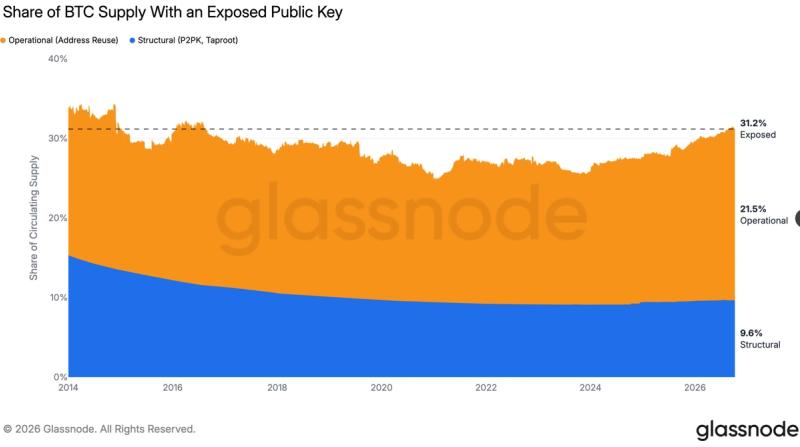
We have a massive math problem sitting in plain sight. According to recent data from Glassnode, more than 6 million Bitcoin are currently sitting behind exposed public keys. For those who don't spend their days staring at blockchain architecture, that is roughly one-third of the entire circulating supply. It is a ticking clock that most people are ignoring because, until now, the threat felt like science fiction.
The Vulnerability of Visibility
To understand why this matters, you have to look at how Bitcoin handles privacy and security. Usually, your public key is hashed. It stays hidden until you actually send a transaction. Once you hit 'send,' that public key is revealed to the network to prove you own the coins. In the early days of Bitcoin, however, this wasn't always the standard, and many legacy addresses have their public keys just sitting there, fully visible to anyone with an internet connection.
For years, the consensus was that this didn't matter. Even if an attacker knows your public key, they still need your private key to move funds. Finding that private key involves solving a mathematical puzzle so complex it would take a traditional supercomputer longer than the age of the universe to crack. But the rules of the game are changing. The rise of sophisticated AI and the looming shadow of quantum computing are shortening that timeline faster than the industry wants to admit.
The Founder's Dilemma
If you are building in this space, this isn't just a fun fact for a newsletter. It is a fundamental infrastructure risk. We talk a lot about 'unstoppable code,' but code is only as strong as the cryptography it rests on. If 6 million BTC—worth hundreds of billions of dollars—can be drained because of a shift in computing power, the entire narrative of Bitcoin as a long-term store of value gets hit with a sledgehammer.
Justin Drake and other researchers have been sounding the alarm on this for a while. The concern isn't just that someone will build a giant quantum computer tomorrow. It is that AI-driven optimization might find shortcuts in the underlying Elliptic Curve Digital Signature Algorithm (ECDSA) that we haven't seen yet. AI is exceptionally good at finding patterns in large datasets and optimizing brute-force attacks. We are essentially giving these models a $400 billion bounty to practice on.
Why Builders Should Care
As a founder, your first instinct might be to say, 'that is a Layer 1 problem.' Technically, you are right. But if you are building wallets, custody solutions, or DeFi protocols, you are the front line. If a significant portion of the network's liquidity is vulnerable, your users are vulnerable. We need to start thinking about post-quantum cryptography and migration paths now, not when the first major wallet gets drained on a Tuesday morning.
The current suggestion is a process called 'forced rotation' or encouraging users to move funds to new, non-exposed addresses. The problem is that a large chunk of that 6 million BTC belongs to 'lost' coins or satoshis held by people who have passed away or lost their seed phrases. These coins can't move themselves. They are sitting ducks.
The Skeptic's View on AI Threats
I tend to be skeptical of the 'AI will destroy everything' hype cycles, but cryptography is the one area where I pay attention. Why? Because cryptography relies on the assumption that certain problems are hard to solve. AI is a tool specifically designed to make hard problems easier. We are already seeing AI used to optimize code and find vulnerabilities in smart contracts in seconds that used to take human auditors weeks to find. Applying that same logic to public key derivation isn't a leap; it is the next logical step.
We are essentially in a race between two groups of developers. On one side, you have the builders trying to harden the network and implement taproot-style upgrades that keep keys hidden. On the other, you have researchers (and eventually bad actors) using AI to see if there is a back door through the math. The 6 million BTC currently exposed represents the ultimate prize for the latter.
What Happens Next
The industry needs to move away from the 'set it and forget it' mentality. If you have been holding Bitcoin in the same address since 2012, you are likely part of this 6-million-coin statistic. The solution is relatively simple for active users: move your funds to a new address. This generates a new public-private key pair where the public key remains hashed and hidden from the public ledger until you decide to move it again.
But for the network as a whole, this is a PR and security nightmare waiting to happen. If a high-profile, 'dormant' wallet from the Satoshi era gets cracked, the market won't wait to find out how it happened. Panic will set in, and the 'digital gold' thesis will be tested like never before. We need to stop treating cryptographic standards as static laws of nature. They are tools, and tools get dull over time.
The Takeaway for the Ecosystem
Building in crypto means building for the long haul. You cannot claim to be building the future of finance while ignoring the fact that a third of your foundation is visible to the very technology—AI—that is evolving at an exponential rate. Founders should be looking at integrating warnings into their UI for legacy addresses and supporting the development of quantum-resistant standards.
The math that protects Bitcoin is only as strong as the machines trying to break it. Right now, the machines are getting a lot smarter, and 6 million Bitcoin are just sitting there waiting for them to catch up.
We don't need to panic, but we do need to be honest. The era of 'safe enough' cryptography is ending. If you are building the next generation of financial tools, start looking at the math. The exposed keys are a warning shot. We should probably start listening before someone actually pulls the trigger.
Read the original at CoinDesk →