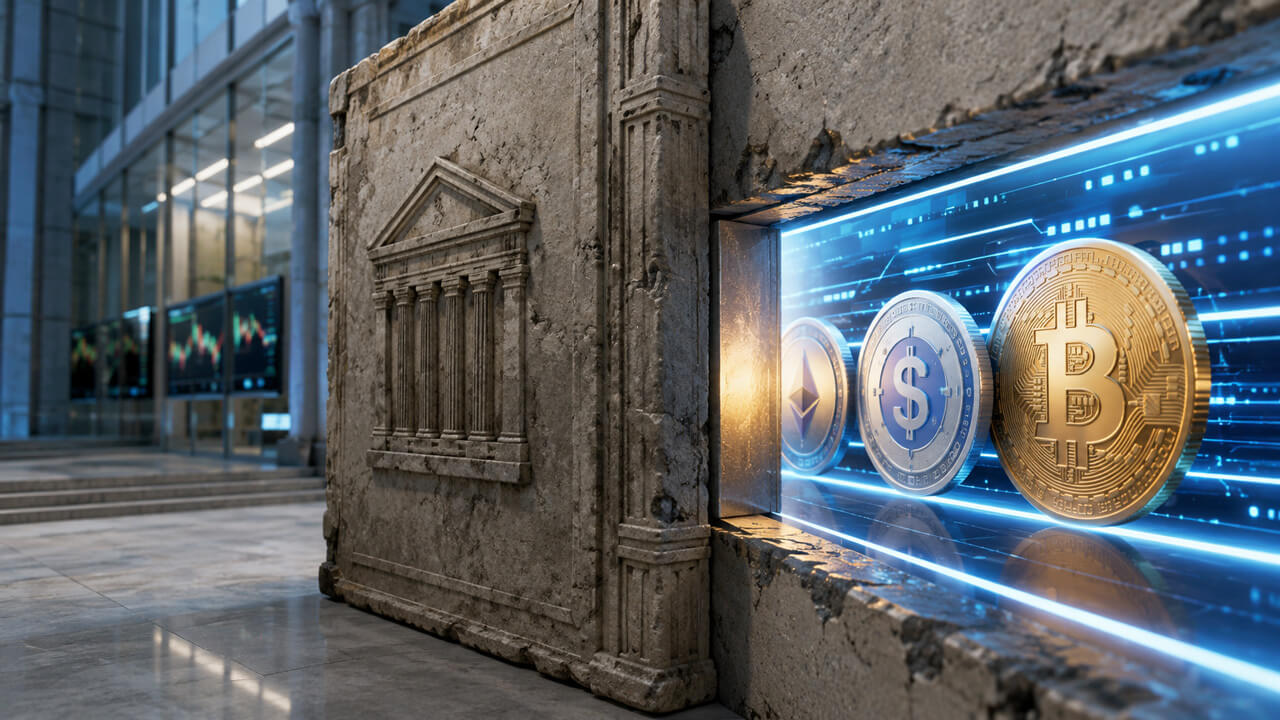
Regulators just handed banks the keys to the crypto vault, but they locked the door from the inside with a hundred pound weight. The law says banks can finally hold Bitcoin and issue stablecoins, but the underlying capital rules ensure they probably won't. If you are waiting for a legacy bank to be the catalyst for your next build, you are waiting for a ghost.
The Illusion Of Permission
According to reporting from CryptoSlate, banks across the US, UK, and Europe now have the legal green light to custody digital assets and settle tokenized funds. On paper, the hurdle is gone. In reality, the Basel Committee on Banking Supervision has designed a framework where Bitcoin positions are treated as high risk assets that require banks to hold a dollar of capital for every dollar of crypto exposure. This is a one to one capital charge. In the world of fractional reserve banking, that is a death sentence for profitability. A bank makes money by lending against its reserves at a multiple. If they cannot leverage the asset, they have no incentive to hold it.
We are seeing a classic bureaucratic feint. The regulators grant the "right" to participate while keeping the "ability" to participate economically impossible. For the founder or investor, this signals a massive gap between institutional rhetoric and institutional action. Large banks will put out press releases about their innovation labs and pilot programs, but their balance sheets will remain empty of the very assets they claim to support. They are playing a game of compliance theater while the capital rules keep them sidelined.
The High Cost Of Safety
The deeper problem is that the global banking system is built on a 20th century definition of risk. To a regulator in 2024, Bitcoin is still categorized alongside the most volatile, unrated junk bonds. They do not see a decentralized network with 15 years of uptime. They see a threat to the stability of the traditional ledger. By forcing banks to hold 1,000 percent risk weighting on crypto assets, they are effectively banning the activity without having to pass a law that says so. It is regulation by spreadsheet.
This creates a two tier market. On one side, you have the native crypto firms that are built to handle these assets but lack the massive consumer trust of a centuries old bank. On the other side, you have the banks that have the trust but are financially prohibited from using the technology. This friction is where startups die. If you are building a product that requires a Tier 1 bank to act as a custodian, your go to market strategy is currently at the mercy of a capital rulebook that does not care about your roadmap.
Real adoption does not happen when a bank says they are allowed to hold Bitcoin. Real adoption happens when the cost of holding Bitcoin is lower than the cost of holding fiat.
The Yield Trap And The Building Gap
If you have been around this space since 2007, you know that capital flows to the path of least resistance. Currently, the path of least resistance for a bank is to continue buying Treasury bills and charging fees on legacy rails. The infrastructure for tokenization and stablecoin issuance is ready, but the business case is broken. This is not a technical problem. It is a structural one. We are currently in a period of "phantom integration" where the pipes are laid but no water is allowed to flow through them.
Builders need to stop designing for the bank of today and start building for the non bank entities that are eating the banks' lunch. We have seen this pattern before in fintech. The banks lagged on mobile payments, so PayPal and Square took the market. The banks lagged on cross border transfers, so TransferWise took the market. The current capital rules are giving a massive head start to the institutional grade crypto firms like Coinbase or Fidelity, who operate under different constraints than a traditional commercial bank.
- Native Custody: Focus on specialized providers who are not subject to Basel III capital requirements for their primary business model.
- Stablecoin Alternatives: If banks cannot issue stablecoins profitably, the liquidity will continue to aggregate in decentralized or non bank offshore entities.
- Risk Re-weighting: Watch for the first jurisdiction to break ranks and lower the capital requirements to attract liquidity. That is where the real move starts.
The Framework For Modern Custody
For a serious investor, the play here is not to wait for the banks to change. The play is to identify the service providers that can bridge the gap without the capital drag. The system for the next five years will look like a hybrid. It involves regulated, non bank custodians who provide the security of a bank without the suffocating oversight of the Basel Committee. You should be looking for execution speed over institutional brand names. A brand like JPMorgan is powerful, but if their capital rules prevent them from actually executing a trade or holding a token, that brand is a lead weight, not an anchor.
Proof of this can be found in the current ETF landscape. While Bitcoin ETFs have been a massive success, the underlying assets are largely held by crypto native firms, not the big commercial banks. The banks are acting as brokers and distributors, but they are not the ones securing the private keys. They are staying at the edge of the pool because the water is too expensive for them to swim in. This pattern will repeat for tokenized real world assets and corporate stablecoins until the capital rules are modernized, which could take a decade.
The Takeaway
Legacy banks are legally allowed to hold your Bitcoin, but the cost of doing so makes it a losing trade for them. Do not build your product or your investment thesis on the assumption that a traditional bank will provide the liquidity or custody you need. Look for the nimbler, crypto native institutions that are winning the battle of execution while the banks remain paralyzed by their own rulebooks. Go audit your current partners and ensure they have the capital flexibility to grow with the market, not just the legal permission to exist.