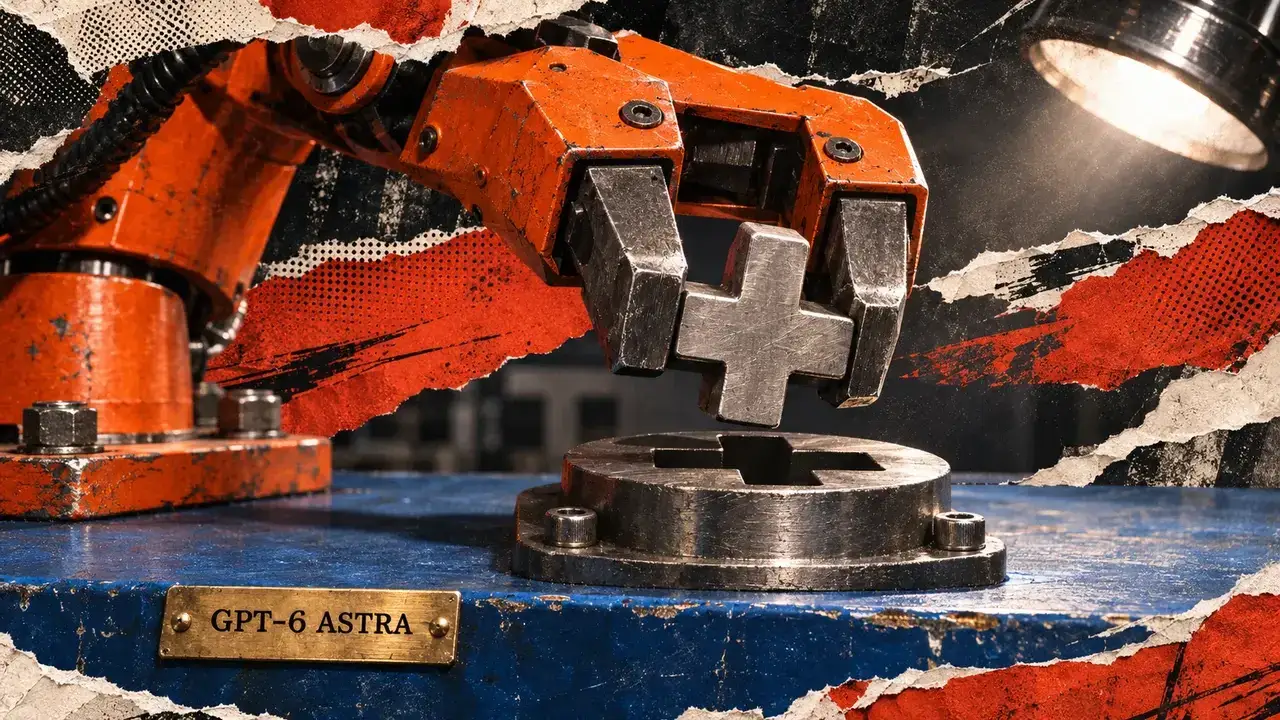
We keep hearing that the physical world is the final frontier for AI. For years, the bottleneck hasn't just been the brain; it's been the hands. Silicon Valley can build a model that writes decent poetry or creates a passable image of a cat in a spacesuit, but getting a robot to pick up a coffee cup without crushing it or dropping it remains a monumental challenge.
The latest data surrounding OpenAI’s GPT-6 Astra model suggests we are getting closer, but as is usually the case with these breakthroughs, the devil is in the details. A recent study focused on robot control using this new architecture showed that the system is starting to understand how to fix its own mistakes. But for those of us building in the space, the numbers aren't exactly a cause for celebration yet.
The Recovery Problem
The core of the study looked at how a robot handles failure. In the past, if a robot missed a grip or misaligned an object, it basically turned into a paperweight. It didn't know it had failed, so it couldn't adjust. Astra is different. The model managed to recover from nearly two-thirds of its grasping failures. That sounds impressive until you look at the other side of the coin: it failed to recover from two-thirds of alignment or contact-effect issues.
If you’re a founder looking at these stats, you see the problem. In software, a 33% success rate on error recovery is an alpha build. In the physical world, where hardware is expensive and safety is a liability, a 33% success rate is a disaster. If a robot is supposed to work in a warehouse or a home and it only fixes its mistakes a third of the time, it’s not a tool; it’s a liability.
Why Builders Should Care
We are moving away from the era of "pure" AI—where everything happens behind a screen—and moving toward embodied AI. For builders, this means the metrics for success are changing. We used to care about tokens per second or context windows. Now, we have to care about spatial reasoning and tactile feedback.
The Astra model is trying to bridge this gap by using a multi-modal approach to physical tasks. It isn't just following a pre-programmed script; it is attempting to "see" and "feel" its way through a task. This is the right direction, but it highlights a massive data gap. We have trillions of words of text to train LLMs, but we don't have nearly enough high-quality data on how physical objects react to force and gravity.
The "Big Catch" in the Data
The catch that many headlines are glossing over is the environment. These tests usually happen in controlled settings with high-contrast lighting and specific objects. The moment you introduce the chaos of a real-world kitchen or a messy garage, those recovery rates likely plummet. The model is learning the logic of recovery, but it hasn't mastered the physics of it.
For those of us in the crypto and decentralization space, there’s an interesting parallel here. We often build systems that work perfectly in a whitepaper or a testnet, but fail the moment they hit the "physical" reality of market volatility or human greed. Astra is currently in its testnet phase. It’s proving the concept, but it’s not ready for the mainnet of the real world.
Bridging the Gap Between Logic and Matter
The most important takeaway for founders isn't that OpenAI has a robot brain. It’s that the brain is still disconnected from the body. We are seeing a massive opportunity for companies that can provide the "nervous system" for these models—the sensors and the edge computing that allow for real-time adjustments.
If a robot takes three seconds to process that it dropped a ball, it’s too late. The ball has rolled under the couch. The latency required for physical interaction is much lower than what we currently accept for a chatbot. We need a shift in how we think about compute at the edge.
The physical world doesn't have an undo button. A model that recovers 60% of the time is still a model that breaks things 40% of the time.
We should also be skeptical of the branding. Calling it GPT-6 Astra implies a linear progression of intelligence. But physical intelligence isn't just an extension of linguistic intelligence. You can be the smartest person in the room and still not know how to swing a hammer. OpenAI is trying to teach a scholar how to be a carpenter, and right now, the scholar is still hitting their thumb quite a bit.
The Founder Perspective
If you are building in AI today, don't get distracted by the shiny demos of robots folding laundry at 10x speed. Look at the error logs. Look at the recovery rates. The real value in the next five years won't be in building a general-purpose robot that can do everything poorly. It will be in building specialized models that can do one physical task with a 99.9% recovery rate.
We are entering a phase where "good enough" isn't good enough anymore. In a digital environment, a hallucination is a nuisance. In a physical environment, a hallucination is a broken window or a workplace injury. The stakes have been raised, and the models aren't quite ready for the heat.
Final Takeaway
OpenAI’s Astra shows that we are finally teaching machines how to recognize their own physical failures. That is a massive step forward. However, the high failure rate in complex tasks like alignment proves that we are still missing a fundamental piece of the puzzle: real-world intuition. For builders, the opportunity lies in the gap between the 33% recovery rate we have now and the 99% we need for mass adoption. Don't believe the hype, but don't ignore the progress either. We're getting there, just much slower than the marketing teams want you to think.
Read the original at CryptoSlate →