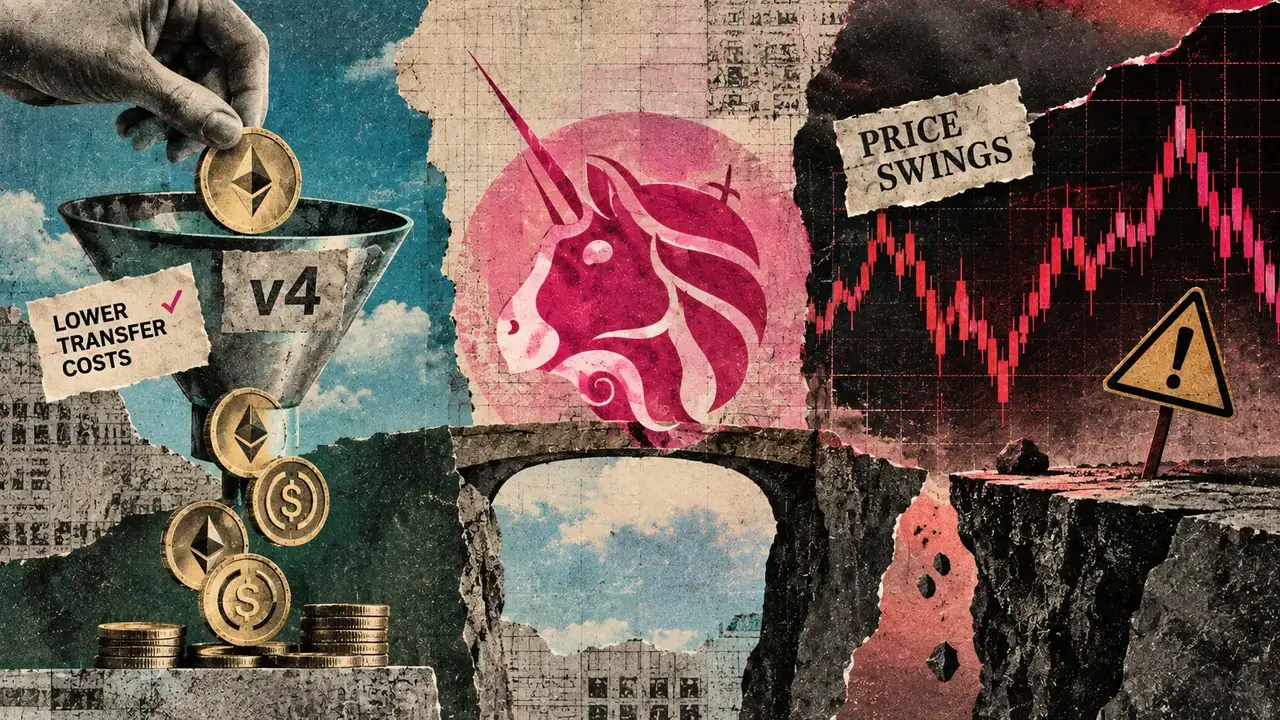
Liquidity provision used to be the dream for the small-scale crypto builder. The idea was simple: put your idle assets to work, earn a slice of the trading volume, and watch your stack grow. But recent data on Uniswap v3 paints a much bleaker picture for the average user. If you aren't playing with significant capital, you aren't just losing to the market; you're losing to the infrastructure itself.
The Math of the Small Player
A recent deep dive into Uniswap v3 positions reveals a sobering reality. For positions under $1,000, only about 18% actually outperformed a simple buy-and-hold strategy once you factor in gas costs. This is a massive wake-up call. We talk a lot about decentralizing finance, but if the cost of entry and operation eats 80% of the potential profit for the little guy, we haven't built a democratic system. We've just built a more transparent version of the old one where the whales get fed and the retail fish get gutted by network fees.
When you look at concentrated liquidity, it requires active management. You have to move your ranges as the price fluctuates. Every time you move those ranges, you trigger a transaction. On Ethereum, those transactions aren't cheap. For a $500 position, a few range adjustments can easily wipe out a month's worth of accrued fees. The builders who designed v3 were focused on capital efficiency, which they achieved, but they did so at the expense of the passive, smaller participant.
The v4 Shift: Hooks and Efficiency
This is where Uniswap v4 enters the conversation. The community is looking at v4 as the potential savior for these compressed margins. The big shift here isn't just about the math of the swap; it's about the architecture of the pools. By moving to a singleton contract—where all pools live in one place rather than being separate smart contracts—the gas cost for multi-hop swaps and pool creation drops significantly.
For builders, the real gold is in the hooks. Hooks allow developers to bake custom logic directly into the lifecycle of a pool. You can have dynamic fees that adjust based on volatility, or automated limit orders that don't require external bots. This creates a playground for founders to build more sustainable yield products. But even with these efficiencies, the fundamental risk of being a liquidity provider remains: price swings.
The Persistent Threat of LVR
We often talk about impermanent loss, but the more accurate term for what's killing LPs is Loss Versus Rebalancing (LVR). This is the cost of providing liquidity to informed traders who know the price has moved elsewhere before the AMM does. Uniswap v4's data suggests that while transfer costs are coming down, the exposure to price swings hasn't magically disappeared. You can have the most efficient gas structure in the world, but if your pool is being picked clean by arbitrageurs every time the market moves, you're still going to end up in the red.
As a founder, you need to realize that gas efficiency is only half the battle. The other half is protecting your users from toxic flow. If you're building on top of v4, your focus should be on how to use hooks to mitigate LVR. Can you build a hook that delays executions or uses an oracle to ensure the pool price stays closer to the global market rate? That’s the kind of innovation that will actually save the 18% of successful small LPs and turn them into 50% or 60%.
What This Means for Founders
If you are building a DeFi protocol today, you cannot ignore the fact that the "passive income" narrative is largely dead for small-time users. You have to be honest with your community. If your protocol requires frequent rebalancing on-chain, you are excluding everyone who isn't a whale. The data from v3 proves that small positions are essentially donations to the network's validators.
The opportunity in v4 is to build the middle layer. We need vault strategies that aggregate small positions into larger ones to share the gas burden, or hooks that automate the rebalancing logic so the user doesn't have to manually sign transactions every time Bitcoin moves $500. We are moving away from the era of "set it and forget it" and into an era of "algorithmic guardianship."
The goal shouldn't just be to make trading cheaper; it should be to make participating viable for the people who actually provide the backbone of the ecosystem.
A Skeptical Look at the Future
I’m hopeful about v4, but I’m also skeptical. We’ve seen this cycle before. A new version promises to fix the flaws of the old one, only for high-frequency traders and MEV bots to find a new way to extract value from the system. Lowering gas costs is great, but it also makes it cheaper for bots to front-run and manipulate the pools. It’s a double-edged sword.
For the builders out there, don't just chase the hype of a new version number. Look at the raw data. If 82% of small users are losing money on the current gold standard of DEXs, there is a fundamental flaw in the UX and the economics of liquidity provision. Your job is to find the bridge between the high-efficiency whales and the retail participants who just want a fair shake.
The takeaway is simple: efficiency does not equal profitability. Uniswap v4 is a tool, not a guarantee. If you're building in this space, stop selling the dream of easy yield and start building the tools that protect the small player from the harsh reality of the chain.
Read the original at CryptoSlate →