We are officially one year out from the 10/10 flash crash. For those of you who weren't in the trenches that day, it was a brutal reminder of how fragile these markets actually are. Prices didn't just dip; they evaporated because there were no buyers left on the books to catch the falling knife. Since then, we have seen a recovery, but it is not the kind of broad recovery the hype cycles might lead you to believe.
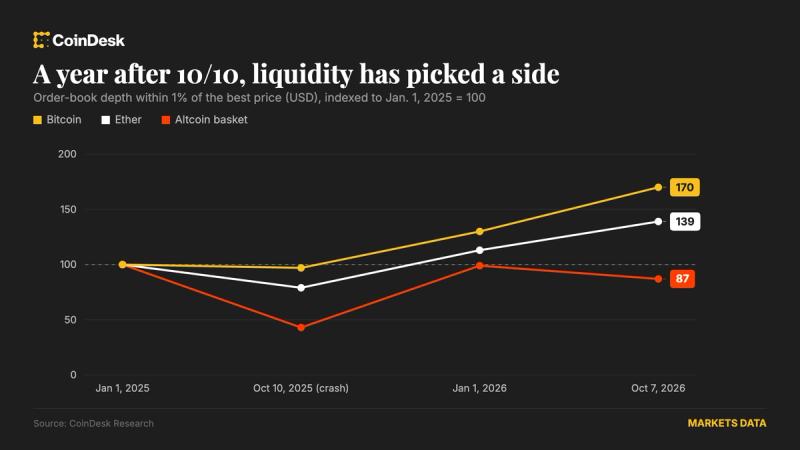
Looking at the data, Bitcoin and Ether have managed to rebuild their liquidity moats. The order books for the two majors are actually deeper now than they were before the crash happened. If you are building on top of BTC or ETH, that is a signal of stability. But for the rest of the market—the thousands of altcoins and infrastructure plays—the story is much darker. We are seeing a widening gap between the haves and the have-nots, and it is changing the way founders need to think about their runway and their listings.
The Two-Tiered Liquidity Reality
Liquidity is the oxygen of this industry. When it’s there, you don’t notice it. When it’s gone, everything dies. The recent numbers show that market makers have returned to the big two. There is enough depth in the BTC and ETH spot markets to absorb significant selling pressure without the kind of vertical drops we saw last October. This is partly due to institutional players settling in and the maturation of exchange-traded products that demand a certain level of underlying market depth.
However, spot trading volume across the board is still significantly lower than the peaks we saw in 2025. People are holding, or they are out of the game entirely. The problem is that while BTC and ETH have regained their footing, altcoin liquidity has continued to erode. If you look at the middle-market coins, the ones that were supposed to be the "next big thing" two years ago, their order books look like ghost towns. Even a relatively small sell order can move the price 5% or 10% in minutes.
Why Builders Should Care About Order Depth
As a founder, it is easy to get hyper-focused on your product and your community. But if your token or your ecosystem’s primary assets lack liquidity, you are building on sand. Low liquidity means high volatility, and high volatility is the enemy of actual utility. It is hard to convince a user to use a decentralized service if the underlying asset they need to hold might lose a quarter of its value because one whale decided to exit on a Sunday night.
The 10/10 crash taught us that exchanges are not a safety net. Market makers are not your friends; they are profit-seeking entities that will pull their bids the moment the risk-reward ratio shifts against them. In the current environment, builders need to stop chasing every exchange listing and start focusing on the quality of the markets they do have. One deep pool is worth ten shallow ones.
The Risk of the Long Tail
The erosion of altcoin liquidity isn't just a market phase; it’s a systemic risk. When liquidity dries up, the cost of doing business goes up. Slippage becomes a tax on every user. For DeFi protocols, thin liquidity in collateral assets is a ticking time bomb for liquidations. We are seeing a consolidation where capital is retreating to safety, and that safety is increasingly just Bitcoin and Ethereum.
This creates a massive hurdle for new projects. A year ago, you could launch a token and expect a certain level of baseline market-making participation. Today, you are fighting for a shrinking pool of active liquidity. If you aren't providing a clear, fundamental reason for people to hold and trade your asset, the market makers won't bother staying on the books. They’ve seen what happens when the floor drops out, and they aren't interested in being the ones holding the bag next time.
The Founder Strategy for a Low-Liquidity World
If you are building in this environment, you have to be more conservative than your predecessors. You cannot rely on a rising tide to lift your boat because the tide is only coming in for a couple of specific harbors. Here is how I’m looking at it from a founder perspective:
- Focus on organic volume: Wash trading is a vanity metric that doesn't provide actual depth. You need real users doing real transactions.
- Prioritize liquidity over price: A higher price on zero volume is a lie. A stable price with deep bids is a foundation.
- Watch the majors: Since BTC and ETH are where the liquidity lives, your project's health is more tethered to their stability than ever before.
The market has become smarter and more cynical since the crash. The era of 'list it and they will come' is over. If you don't bring the liquidity with you, you are just waiting for the next flash crash to finish you off.
A Skeptical Look at the Recovery
We shouldn't mistake the recovery of BTC and ETH liquidity for a healthy market. It is a consolidated market. The fact that the rest of the altcoin space is still struggling to attract buyers tells me that the retail investor hasn't really come back—or if they have, they’ve been burned enough times to stay away from anything that isn't a blue chip. This lack of broad participation is a headwind for innovation. It makes it harder to fund new ideas and harder to exit old ones.
We are essentially in a defensive posture. The infrastructure is being rebuilt, but it's being built for a narrower, more professionalized version of crypto. That’s good for preventing another 10/10 style meltdown in the majors, but it’s tough for the builder who is trying to disrupt the status quo with a new tokenized model.
What This Means for the Next Year
Looking ahead, I expect the liquidity gap to widen further before it narrows. We will likely see more delistings of low-volume assets as exchanges try to minimize their own risk. For builders, this is the time to be lean. If your project depends on high-velocity trading and deep altcoin markets to function, you need to rethink your mechanics. The liquidity isn't coming back to the long tail anytime soon.
Success in the post-crash era isn't about how high your token can go during a pump; it's about how well it holds up when everyone else is running for the exit. The majors have passed that test for now. The rest of the market is still waiting for its results.
Read the original at CoinDesk →