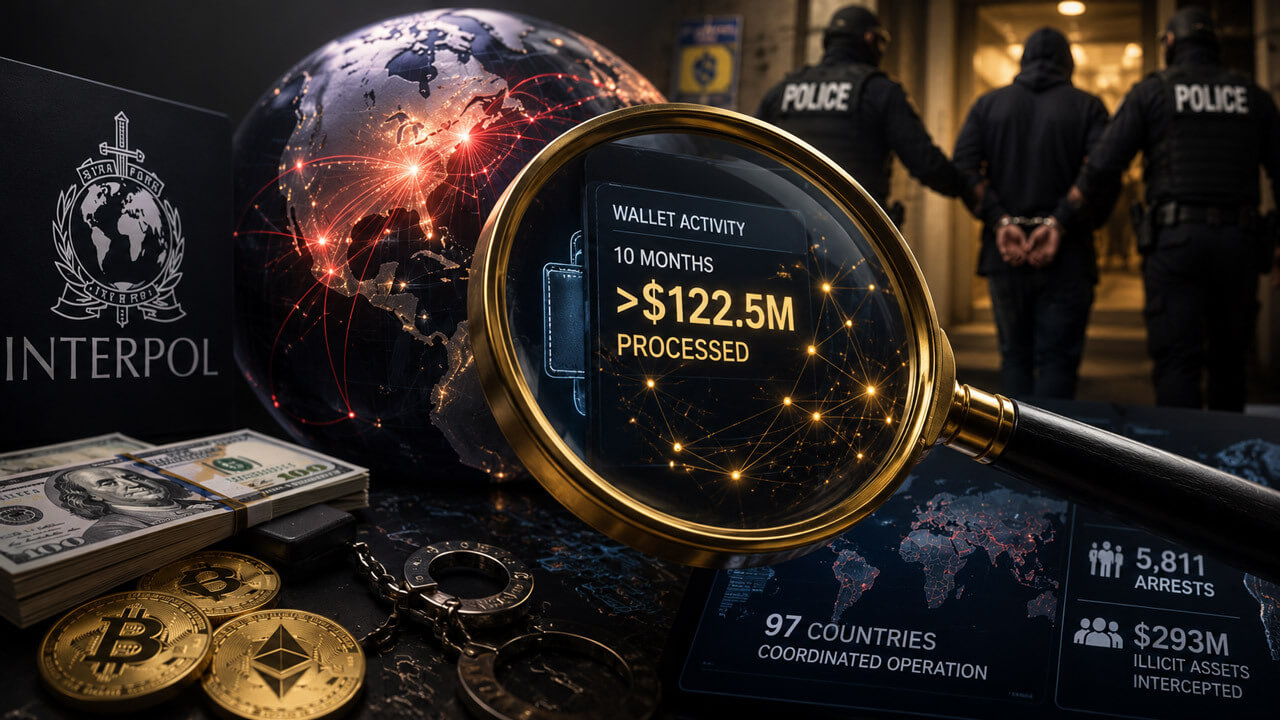
Interpol just wrapped up a massive global enforcement action dubbed Operation First Light 2024. The numbers are eye-watering: over 2,500 people arrested and nearly $250 million in assets frozen across dozens of countries. But for those of us building in the crypto space, there is one specific case out of Thailand that hits different. A single wallet, managed by a 20-year-old, allegedly processed more than $122 million in illicit funds.
Think about that for a second. We are not talking about a major institutional desk or a long-standing money laundering syndicate. This was a young individual facilitating an enormous amount of liquidity for various scams, ranging from investment fraud to e-commerce schemes. It serves as a stark reminder that while the blockchain is transparent, the layers of complexity we are building are being weaponized faster than we can secure them.
The Cross-Chain Complication
The Interpol report highlights something that founders and developers need to pay attention to: the ease of obfuscation using cross-chain swaps. This particular fraudster didn't just sit on a pile of Bitcoin. They moved value across multiple services, assets, and borders, exploiting the fragmentation of the current ecosystem.
As builders, we talk a lot about bridge security from a technical standpoint—how to prevent hacks or exploits. What we don't talk about enough is the regulatory and forensic side of these bridges. When you create a seamless way to swap value between different chains, you are also creating a pipeline for bad actors to break the trail of traditional on-chain analysis. Interpol noted that these cross-border movements made it significantly harder to trace the funds until they could coordinate with local Thai authorities.
Why This Matters for Founders
If you are building a DeFi protocol, a bridge, or a liquidity aggregator, you cannot ignore the growing pressure from global law enforcement. For years, the industry operated under the assumption that "code is law" and that the decentralized nature of the tech would provide a permanent shield. That shield is thinning. Operation First Light involved 61 different countries working together. The coordination between banks and law enforcement is reaching a level of efficiency that matches the speed of the transactions themselves.
We have to be honest with ourselves: if our tools make it easier for a 20-year-old to launder $122 million than it is for a legitimate small business to move capital across borders, the regulators are going to come for the infrastructure, not just the users. We are seeing a shift where the "neutrality" of the tech is being challenged by the reality of its usage.
The Business of Fraud Infrastructure
The Thailand case is a perfect example of what I call "Fraud-as-a-Service." The suspect wasn't necessarily the mastermind behind every scam that fed that wallet. Instead, they acted as a high-capacity node in a larger network of criminal activity. They provided the rails. This is a business model that mirrors our own legitimate startups, just with different moral incentives.
The sheer volume processed by a single individual suggests that the tools we are building are working exactly as intended—they are frictionless. But that friction was originally there for a reason in the traditional world. Now that we have removed it, we have to decide what replaces it. Is it more robust KYC? Is it decentralized identity? Or is it a middle ground that keeps the builder-first ethos while preventing the ecosystem from becoming a haven for massive-scale fraud?
The Global Scope of Enforcement
Operation First Light wasn't just about crypto; it. covered a massive spectrum of online fraud. However, the crypto component is what grabbed the headlines because of the scale and the speed. Interpol reported that the average victim of these schemes isn't a sophisticated whale; it’s everyday people getting caught in phishing scams or fake investment platforms.
When these victims lose money, they don't blame the fraudster—they blame the medium. Every headline about a $122 million illicit wallet is a setback for mass adoption. It hardens the stance of central banks and makes it harder for legitimate projects to get banking partners. For those of us in the trenches building actual utility, these individuals are the biggest threat to our runway.
Taking the High Ground
So, where does this leave us? We shouldn't be cheering for more government surveillance, but we also can't pretend that this isn't a problem. If the industry doesn't start self-policing or building better compliance primitives into the stack, the solutions will be forced upon us by people who don't understand how a smart contract works.
- Transparency isn't enough: Just because you can see a transaction on Etherscan doesn't mean you can stop the crime. We need better attribution tools that don't compromise privacy for legitimate users.
- Cross-chain is the new frontier: This is where the most heat will be. If your project facilitates the movement of value between chains, expect to be under the microscope.
- The age of the "isolated founder" is over: You can't just build in a vacuum. You need to understand the global regulatory landscape because organizations like Interpol are now moving at the speed of the internet.
The arrest of this individual in Thailand is a win for the victims, but it’s a warning shot for the industry. The tech is being tested. We are seeing what happens when the infrastructure we build is used for the wrong things on a massive scale. It’s time to start thinking about the long-term sustainability of decentralized systems in a world where global law enforcement is finally catching up.
The Final Word for Builders
The takeaway here is simple: if you are building an exit for capital, make sure you aren't unintentionally building a highway for crime. The $122 million processed by a single kid in Thailand shows that the scale is already here. Now we need the maturity to match it. Don't wait for a subpoena to think about how your protocol handles illicit flow. Design with the reality of the world in mind, or the world will design your protocol for you.
Read the original at CryptoSlate →