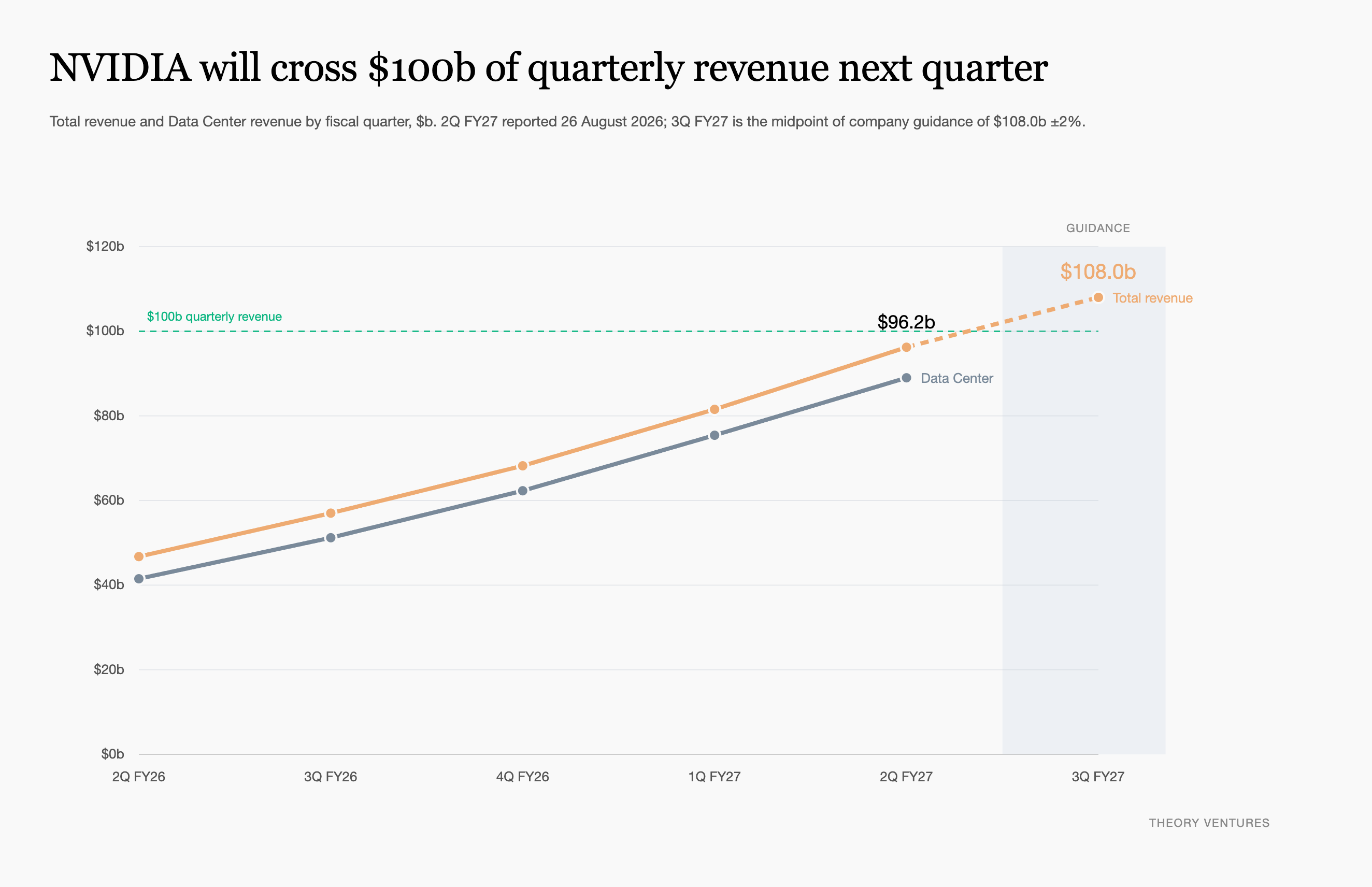
Jensen Huang is currently orchestrating the most expensive game of musical chairs in technological history. Nvidia just reported a quarterly revenue of $96 billion, with a forecast of $108 billion for the next quarter. On paper, these numbers are so large they feel abstract. But when you peel back the layers of the financial statements, you see a business that is fundamentally changing how it operates to keep the momentum alive.
The Hyperscale Ceiling
For the last two years, the bull case for Nvidia was simple: Microsoft, Google, and Amazon had bottomless pockets and an insatiable need for H100s. That story is starting to hit a wall. Revenue from these hyperscalers grew by only 13% this quarter. While double-digit growth is usually nothing to sneeze at, it pales in comparison to the 25% growth coming from the rest of the market.
This is the first sign of a transition. The massive cloud providers are starting to optimize what they have, or perhaps they are reaching the limits of how fast they can build data centers. Either way, Nvidia has had to look elsewhere to find the growth that justifies its trillion-dollar valuation. That elsewhere is the world of neoclouds and AI startups.
The Vendor Financing Playbook
Here is where it gets interesting for those of us building in the trenches. To keep the sales moving at this velocity, Nvidia has essentially become a bank. Their Days Sales Outstanding (DSO)—a metric that tracks how long it takes to get paid after a sale—jumped from 45 days to 60 days. Their accounts receivable now sit at a staggering $63 billion.
In plain English, Nvidia is shipping chips now and letting customers pay later. They are extending payment terms to buyers who likely couldn't afford the hardware upfront. This isn't necessarily a sign of weakness, but it is a sign of aggressive market saturation. When the biggest customers slow down, you have to offer better terms to the smaller ones to keep the factory lines humming.
A $581 Billion Bet on the Future
The scale of Nvidia’s commitment to its own ecosystem is unprecedented. They have assembled a $581 billion stack that includes supply commitments, power guarantees, and long-term leases. They aren't just selling chips; they are physically securing the future of the infrastructure those chips live in.
Perhaps the most controversial part of this stack is the $101 billion in equity Nvidia holds in the very startups and neoclouds that are buying their hardware. We are seeing a circular economy in real-time. Nvidia invests in a startup, that startup uses the cash to buy Nvidia chips, and Nvidia books the revenue. As a founder, you have to ask yourself: is this sustainable demand, or is it a high-stakes version of accounting gymnastics?
What This Means for Builders
If you are building an AI-native company right now, this macro environment matters for three specific reasons:
- Compute Liquidity: The rise of neoclouds—fueled by Nvidia's own investments—means that access to compute is becoming easier to find, even if the price remains high. The bottleneck is moving from hardware availability to power and cooling.
- The Subsidy Trap: A lot of the current AI activity is being subsidized by Nvidia’s willingness to carry debt and invest in its own customers. If Nvidia ever decides to tighten its belt or demand faster payment, the secondary cloud market will contract instantly.
- Valuation Reality: If the hyperscalers are slowing their spend, they are signaling that the immediate ROI on AI services isn't scaling as fast as the infrastructure cost. Builders need to focus on revenue-generating applications rather than just model training.
The Power and the Risks
Nvidia has secured power guarantees that make most small nations look underpowered. By locking down the energy and the physical space for data centers, they are trying to build a moat that no competitor—not AMD, not even the in-house silicon projects at Apple or Google—can cross. They are trying to own the physical reality of computing, not just the intellectual property.
However, the risk is concentrated. When one company owns the chips, the customers, and the buildings the chips sit in, any systemic shock to the AI market is magnified. If a major AI lab fails to produce a model that justifies its next $10 billion compute round, the ripples will hit Nvidia’s balance sheet directly through those $63 billion in receivables and $101 billion in equity stakes.
The Skeptic's View
I’ve seen plenty of cycles where vendors financed their own growth to keep Wall Street happy. It usually ends with a massive write-down. The difference here is the sheer utility of the product. An H100 isn't a speculative asset; it’s a tool that generates value. But the price of that tool is being propped up by financial engineering that feels a bit too close to the sun.
For founders, the takeaway is clear: don't get intoxicated by the massive numbers. The infrastructure layer is being forced open by Nvidia’s checkbook. Use the available compute to build something that doesn't rely on a subsidized cloud, because eventually, the bill comes due, and Nvidia will want their 60 days of receivables paid in full.
The circularity of Nvidia investing in its own customers to drive sales is the ultimate 'fake it till you make it' at a sovereign scale. It works until the end-user utility fails to materialize.
We are currently in the most productive arms race in history, but Nvidia is acting as both the arms dealer and the primary financier for the soldiers. It’s a brilliant strategy for dominance, but it creates a single point of failure for the entire AI economy. As builders, our job is to make sure we aren't just another line item in Nvidia's receivables folder.
Read the original at Tomasz Tunguz →