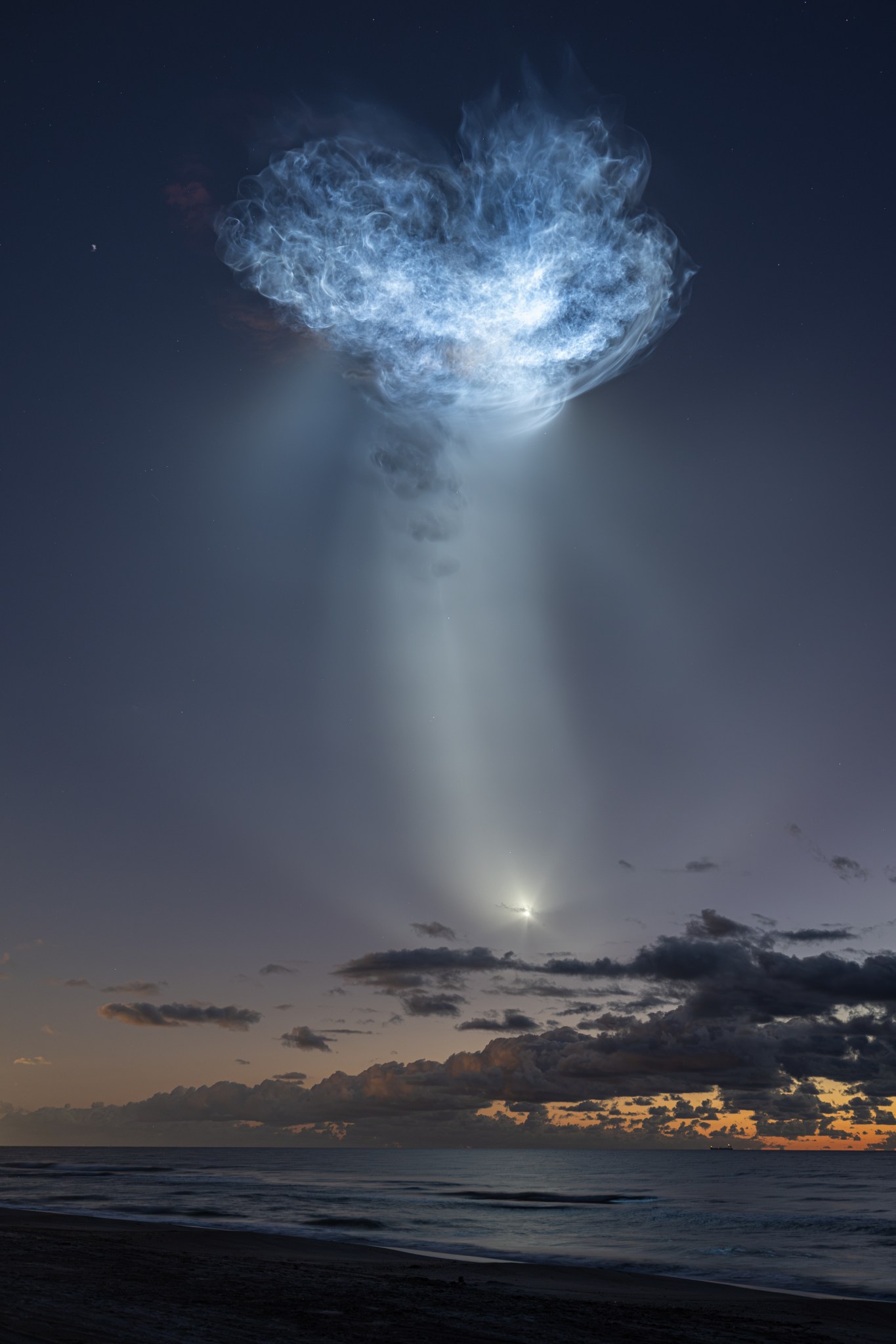
Visibility and the New Space Standard
Last night, the sky lit up with what NASA calls the jellyfish effect. A SpaceX Falcon 9, carrying the Dragon spacecraft on the CRS-35 mission, hit that perfect atmospheric sweet spot where the sun, tucked just below the horizon, illuminates the expanding exhaust plumes against a dark sky. It is a striking visual, but for those of us building in the tech and crypto sectors, it is a reminder of something more practical: infrastructure is finally becoming routine.
We talk a lot about moonshots in the blockchain and AI space. Most of the time, those moonshots are metaphors for high-risk venture bets or theoretical software upgrades. But watching a Falcon 9 pierce the atmosphere is a literal moonshot. It represents a level of operational consistency that our industries should be studying. When the launch of a resupply mission becomes a photo opportunity rather than a high-stress gamble, you know the platform has matured.
The Physics of the Jellyfish
The science behind the glow is simple but profound. As the rocket ascends into the thinner upper atmosphere, the pressure drops, allowing the exhaust gases to expand significantly. When this happens during the transition between day and night, the sunlight hits those gas particles, scattering the light and creating that translucent, glowing bulb. It looks like high-end CGI, but it is pure physics.
For builders, this is a metaphor for scale. When you start a project, your impact is narrow and contained. As you move into higher tiers of the market—the upper atmosphere of your industry—your footprint naturally expands. If you have the right light hitting your project, your reach becomes massive. The challenge is ensuring that the core engine, the Falcon 9 of your business, is stable enough to handle that expansion without breaking apart.
Building for Resupply, Not Just Hype
The CRS-35 mission is a cargo resupply mission. It is not a flashy exploration to a new planet; it is the logistics work required to keep the International Space Station functioning. In the crypto world, we often get distracted by the flashy launches and ignore the resupply missions. We want the new token, the new L1, or the new generative model, but we forget the boring infrastructure that keeps the lights on.
SpaceX has succeeded because they turned rocket science into a logistics business. They treated space like a supply chain problem. If you are building in AI right now, you are likely dealing with the same thing. The flashy part is the prompt window, but the real work is in the data pipelines, the GPU orchestration, and the latency management. That is the exhaust plume that eventually creates the visible success.
The Cost of Reusability
One reason these launches are happening so frequently is the shift toward reusability. The Falcon 9 is the workhorse because it can come back home. In the software world, we call this modularity and technical debt management. If you build a system that is one-and-done, you are burning capital for a single result. If you build a system that can be refueled and sent back up, you change the economics of your entire sector.
I see too many founders building disposable tech. They build for the current trend, hoping to catch a quick exit, and when the trend shifts, their infrastructure is useless. SpaceX built a platform that could adapt. Whether they are carrying satellites, astronauts, or cargo to the ISS, the core stack remains the same. That is the kind of engineering discipline we need in the decentralized space.
Transparency and Public Perception
The jellyfish effect is a public relations gift, but it is also a form of unintentional transparency. You can see the work happening from hundreds of miles away. In an era where much of tech is hidden behind proprietary black boxes or opaque smart contracts, there is something refreshing about a company whose progress is visible to anyone looking at the sky.
Transparency is a word that gets thrown around a lot in blockchain circles, but true transparency is functional. It is the ability for an outsider to look at what you are doing and understand the trajectory. When the exhaust plume glows, it shows the path the rocket took and where it is headed. Builders should strive for that level of clarity in their roadmaps. If people cannot see where your energy is going, they will stop watching.
The Skeptic’s View on the High-Altitude Glow
While the jellyfish is beautiful, we have to acknowledge that it represents a crowded sky. As launch costs drop, the volume of traffic increases. This brings up questions about space debris and atmospheric impact that the industry is still grappling with. Just like how a crowded L2 ecosystem creates fragmentation and noise, a crowded low-earth orbit creates physical risks.
We have to be careful not to mistake the glow for the goal. The glow is a byproduct. The goal is the delivery. If the Dragon spacecraft fails to dock, the jellyfish effect was just a pretty distraction. In your own company, do not get so caught up in the marketing and the visual 'glow' of your launch that you forget to deliver the actual payload to the customer.
The Founder’s Takeaway
Success in complex industries like aerospace or AI is built on the back of repetitive, boring excellence. The visual spectacles are just the byproduct of doing the hard work at the right time. If you want your project to be the one lighting up the sky, you need to stop focusing on the light and start focusing on the engine.
- Infrastructure first: Build tools that can be reused and repurposed.
- Logistics over hype: Focus on the resupply missions that keep your ecosystem alive.
- Scale creates visibility: The higher you go, the more people will see your exhaust, so make sure your path is straight.
- Don't fear the glow: When your work becomes visible, lean into the transparency.
The SpaceX CRS-35 launch is a win for consistency. It shows that even the most difficult tasks can become routine if you build the right systems. For those of us on the ground building the next generation of digital infrastructure, that is the only standard that matters.
Read the original at NASA Breaking News →