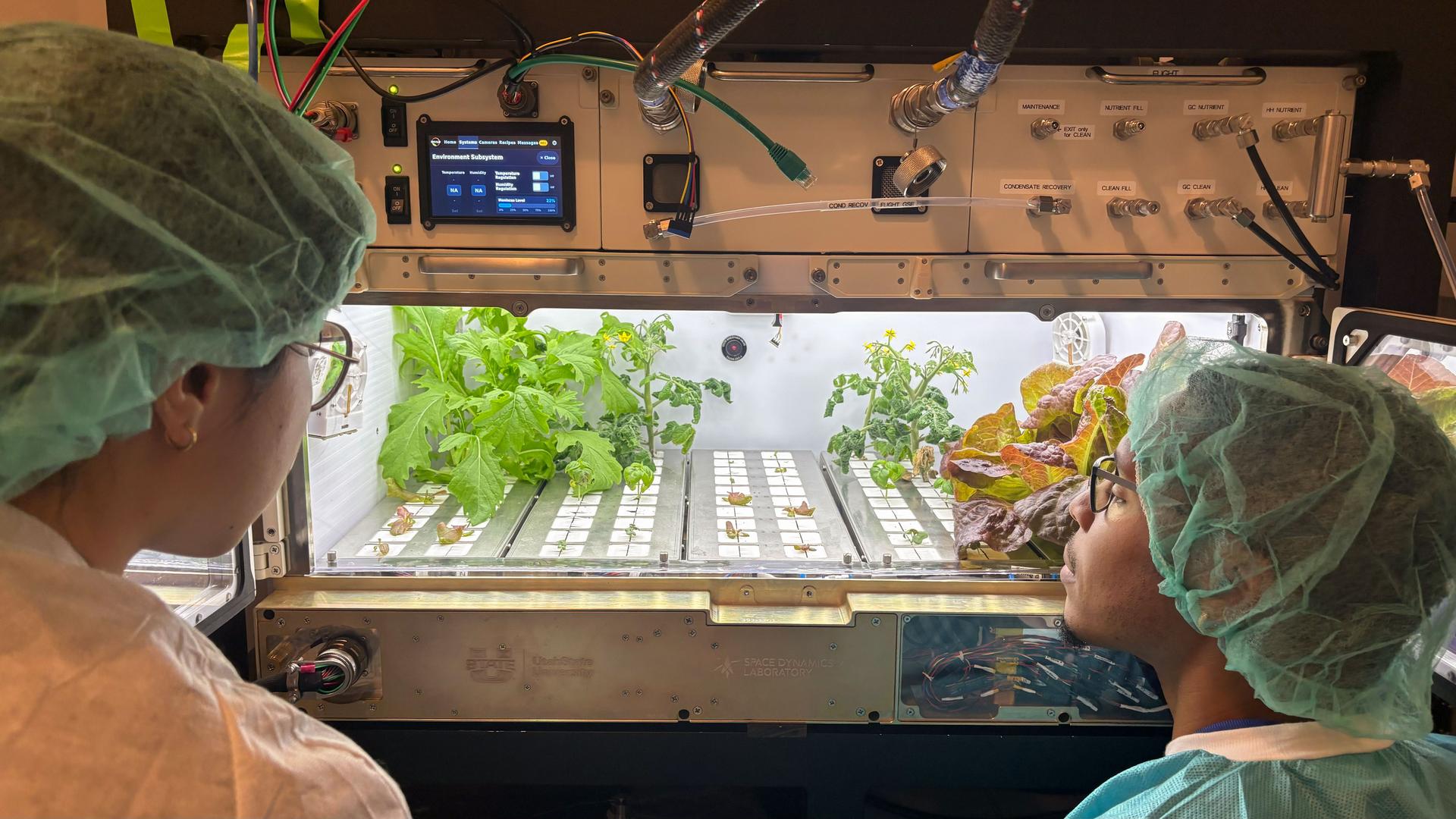
NASA is prepping for the Northrop Grumman 25th Commercial Resupply Services mission, and while the headlines are mostly focused on rocket logistics, the real story for builders is in the cargo. We are seeing a major shift from reactive experimentation to proactive infrastructure in space agriculture. This mission, NG-25, is carrying a specialized crop production system designed to push past the limits of growing a few lonely lettuce leaves in a cabinet.
The Logistics of Long-Term Survival
Most crypto founders talk about sovereign states and digital nomads, but the ultimate version of that is space colonization. The problem is that currently, space is a logistical nightmare. Every calorie consumed on the International Space Station has to be launched from Earth at a massive cost. If we want to move beyond low Earth orbit, we need systems that aren't just sustainable, but automated and resilient. NASA's Biological and Physical Sciences Division is finally moving toward a scale that resembles a viable utility layer for space life.
The mission focuses on a first-of-its-kind crop production system. This isn't just about dirt and seeds; it's about sensor arrays, nutrient delivery systems, and atmospheric controls that can function in microgravity without constant human intervention. For those of us in the tech and AI space, this is basically an IoT problem on steroids.
Why Builders Should Care About Space Crops
You might be wondering why a newsletter focused on AI and crypto is covering space gardening. It’s because the constraints of space are the ultimate forcing function for efficiency. When you build for the ISS, you have zero margin for error. You have limited power, limited space, and no hardware store nearby if a pump breaks. The innovations happening here—specifically in automated monitoring and biological feedback loops—are going to trickle down to terrestrial vertical farming and automated greenhouses.
- Automation: Systems that can sense plant health and adjust nutrients without a human in the loop.
- Resource Efficiency: Doing more with less water and energy than any farm on Earth.
- Resilience: Hardware that can survive the vibration of launch and the radiation of space.
If you are building sensor networks or edge computing solutions, the requirements NASA is setting for these crop systems are the gold standard. Solving for the ISS means your tech is likely robust enough for any harsh environment on Earth.
The Intersection of Bio and Hardware
We are seeing a convergence between biological sciences and hardware engineering. The NG-25 mission isn't just sending plants; it's sending a laboratory. These experiments are looking at how spaceflight stressors affect plant biology at a cellular level. From a founder's perspective, this is a massive data play. The datasets generated from these missions are goldmines for anyone working on synthetic biology or climate-resilient crops.
The agency is looking at how to optimize the growth cycles and nutritional density of these crops. In a closed loop like a space station, the plants aren't just food—they are part of the life support system, scrubbing CO2 and providing psychological benefits to the crew. This is systems thinking at its most extreme.
The Skeptic's View: Is it Scaling?
I’m always a bit skeptical when I hear "first of its kind." Usually, that means it's a prototype that's years away from being a product. NASA has been growing plants in space for decades, but the progress has been slow. The bottleneck has always been the "production" side of the equation. We’ve proven we can grow a plant; we haven't proven we can feed a crew indefinitely.
However, the NG-25 mission seems to be addressing the scale issue. By integrating more advanced robotics and more sophisticated biological monitoring, they are moving away from "science projects" and toward "food utilities." This is a necessary evolution if we are ever going to see private space stations or lunar bases become more than just expensive camping trips.
The move from experimentation to production is the hardest leap for any technology. In space, that difficulty is multiplied by a thousand.
What This Means for the Future
For founders in the AI space, the opportunity here is in the data processing and predictive modeling. Biology is noisy. Microgravity biology is even noisier. We need better models to predict how these systems will behave over months of operation. If you can build an AI that can diagnose a nutrient deficiency from a camera feed before the plant shows visible signs of stress, you have a product that every vertical farm on Earth will buy.
For the crypto and decentralization crowd, think about the supply chain. If we can't decentralize food production—meaning, making it local to the consumer even if that consumer is in orbit—we aren't truly sovereign. Space crops are the ultimate local-first movement.
Final Takeaway
NASA’s NG-25 mission is a signal that the infrastructure for off-world living is getting serious. We are moving past the era of simply surviving in space and entering the era of sustaining in space. For builders, the takeaway is clear: the constraints of the space environment are producing the most efficient, automated, and resilient hardware and software on the planet. Keep an eye on these "space crops." The tech keeping them alive will likely be the tech that powers the next generation of automated agriculture here on the ground.
Read the original at NASA Breaking News →