The Brutal Efficiency of Stellar Feedback
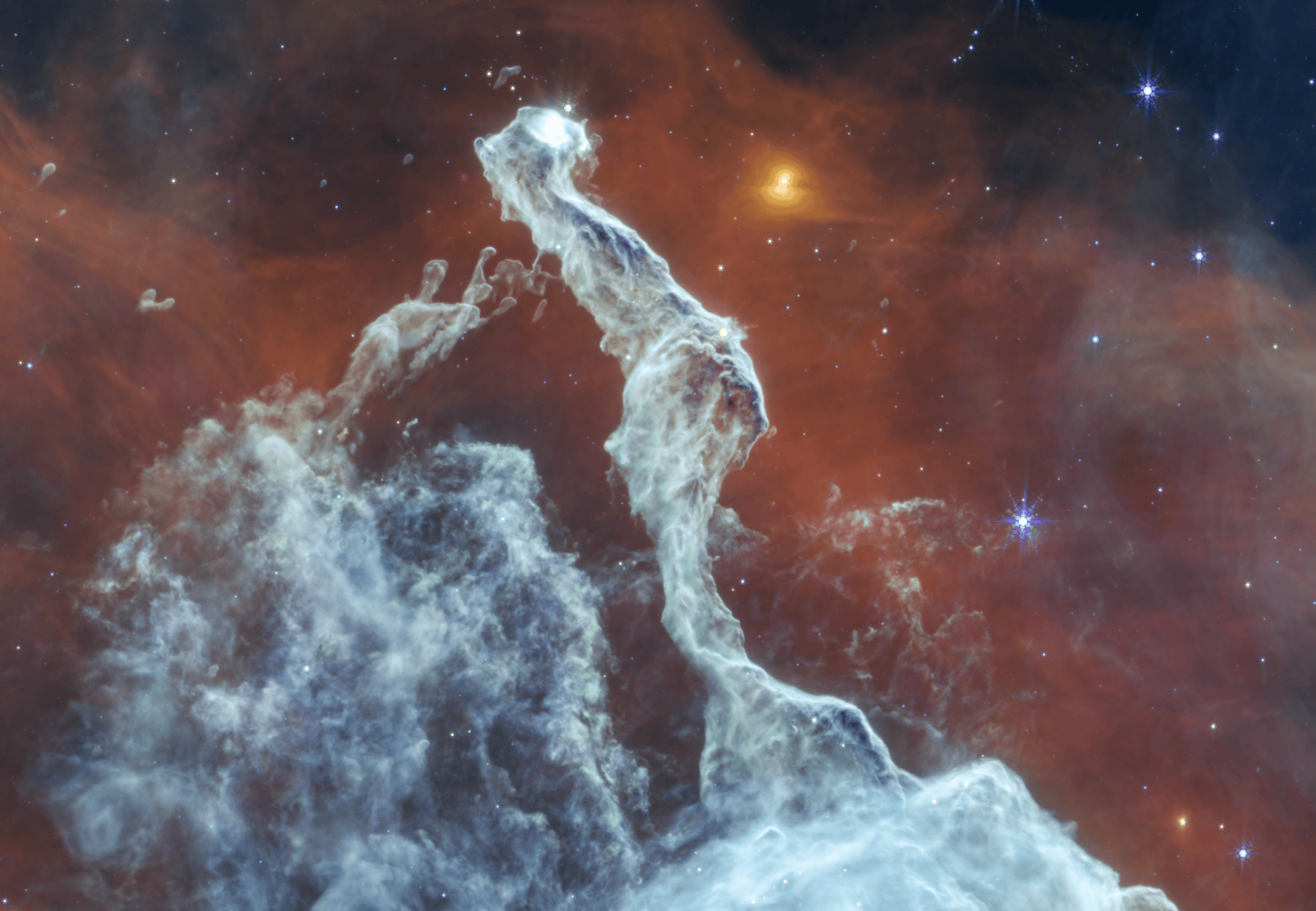
NASA just dropped a new mid-infrared look at the Cat's Head Nebula, captured by the James Webb Space Telescope. To the average observer, it looks like an eerie cosmic silhouette. To those of us building in tech and crypto, it looks like a masterclass in feedback loops. This structure, sitting within the larger Carina Nebula, wasn't designed by a central architect. It was sculpted by the violent, persistent radiation and solar winds of massive stars nearby.
We talk a lot about 'ecosystems' in the builder world, but we usually mean a Slack channel and a shared treasury. The Cat's Head is a true ecosystem. It is the physical result of energy output hitting resistance. The massive stars in its vicinity aren't just sitting there; they are actively pushing against the surrounding dust and gas. That pressure creates the shape. If the stars were weaker, we wouldn't see the definition. If the gas weren't dense enough to resist, it would have just blown away into nothingness.
The Data Behind the Aesthetics
The JWST uses mid-infrared instruments to see through the haze that usually blocks our view. In the crypto space, we call this transparency. In astronomy, it's just physics. The image released in late 2026 shows intricate filaments and ridges that were previously hidden. These structures are where the interstellar medium is being compressed. When you compress gas at this scale, you get star formation. The 'cat's head' is essentially a factory under construction, fueled by the very radiation that seems to be destroying it.
This is the part most people miss. Stellar feedback is often framed as destructive. It's hot, it's radioactive, and it strips away material. But without that push, the nebula would just be a stagnant cloud. The friction creates the beauty. When I look at a new L1 or a decentralized AI protocol, I look for this same kind of friction. If there is no pushback from the market or the technology, you aren't building a nebula; you're just floating in a vacuum.
Why Builders Should Care About 7,500 Light Years Away
It is easy to dismiss space news as 'shiny object syndrome.' But the way the JWST functions is a lesson in precision engineering and high-stakes deployment. You don't get to patch a telescope that is a million miles away. You build it right the first time, or you lose $10 billion. That's a level of accountability we rarely see in the 'move fast and break things' culture of software.
The Cat's Head Nebula illustrates the concept of localized environments. While the Carina Nebula is a massive, chaotic region, the Cat's Head maintains a distinct identity because of its specific density and its distance from the radiation source. For founders, this is the 'niche' strategy visualized. You can exist within a massive, competitive market (the Carina) and still carve out a unique, recognizable structure (the Cat's Head) if you understand the forces acting upon you.
The Myth of the Static Environment
One of the biggest mistakes a founder can make is assuming their market is static. The Cat's Head is constantly changing. The mid-infrared view shows us a snapshot of a process, not a finished product. Those winds from the massive stars are eroding the nebula even as they shape it. Eventually, the cat's head will disappear, replaced by new stars or different structures.
We see this in AI right now. The 'radiation' is the influx of capital and the speed of model iterations. It is shaping the landscape so fast that if you stop moving, you get eroded. The companies that survive aren't the ones trying to stay the same; they are the ones dense enough to handle the pressure and turn it into something new. The nebula isn't trying to 'be' a cat's head. It is simply reacting to physics. Your project shouldn't try to 'be' a unicorn; it should be a high-density reaction to a real-world problem.
The Skeptic's Lens on Space Imagery
I have to be honest: there is a lot of PR fluff around these releases. NASA knows that 'eerie cat' sells better than 'mid-infrared observations of compressed hydrogen.' We do the same thing in crypto with 'community' and 'decentralization.' We wrap the raw, technical reality in a narrative that people can digest. The reality of the Cat's Head is harsh, cold, and radioactive. The narrative is that it's a beautiful cosmic curiosity.
As a builder, you need to be able to see both. You need the narrative to get people to look at what you're doing, but you need the technical density to ensure that when they look, there is actually something there. If the Cat's Head were just a thin mist, the JWST wouldn't have found anything to photograph. It is the density of the dust—the actual 'work' of the nebula—that makes the image possible.
Takeaways for the Modern Founder
- Feedback is a sculptor: Don't avoid the 'winds' of market criticism or technical hurdles. They are the only things that will give your project a recognizable shape.
- Transparency is a tool: The JWST's infrared capability is a reminder that the most interesting data is often hidden behind the noise. Build tools that reveal, rather than obscure.
- Stability is temporary: The Cat's Head is a transitional state. Your current product-market fit is likely transitional, too. Prepare for the next phase of erosion and creation.
The Cat's Head Nebula is a reminder that even in the vacuum of space, nothing happens in isolation. Everything is a reaction. The massive stars push, the nebula resists, and the result is something that captures the world's attention. If you're building something right now, ask yourself: what are the massive stars in your industry, and is your project dense enough to turn their energy into a structure that lasts?
Read the original at NASA Breaking News →