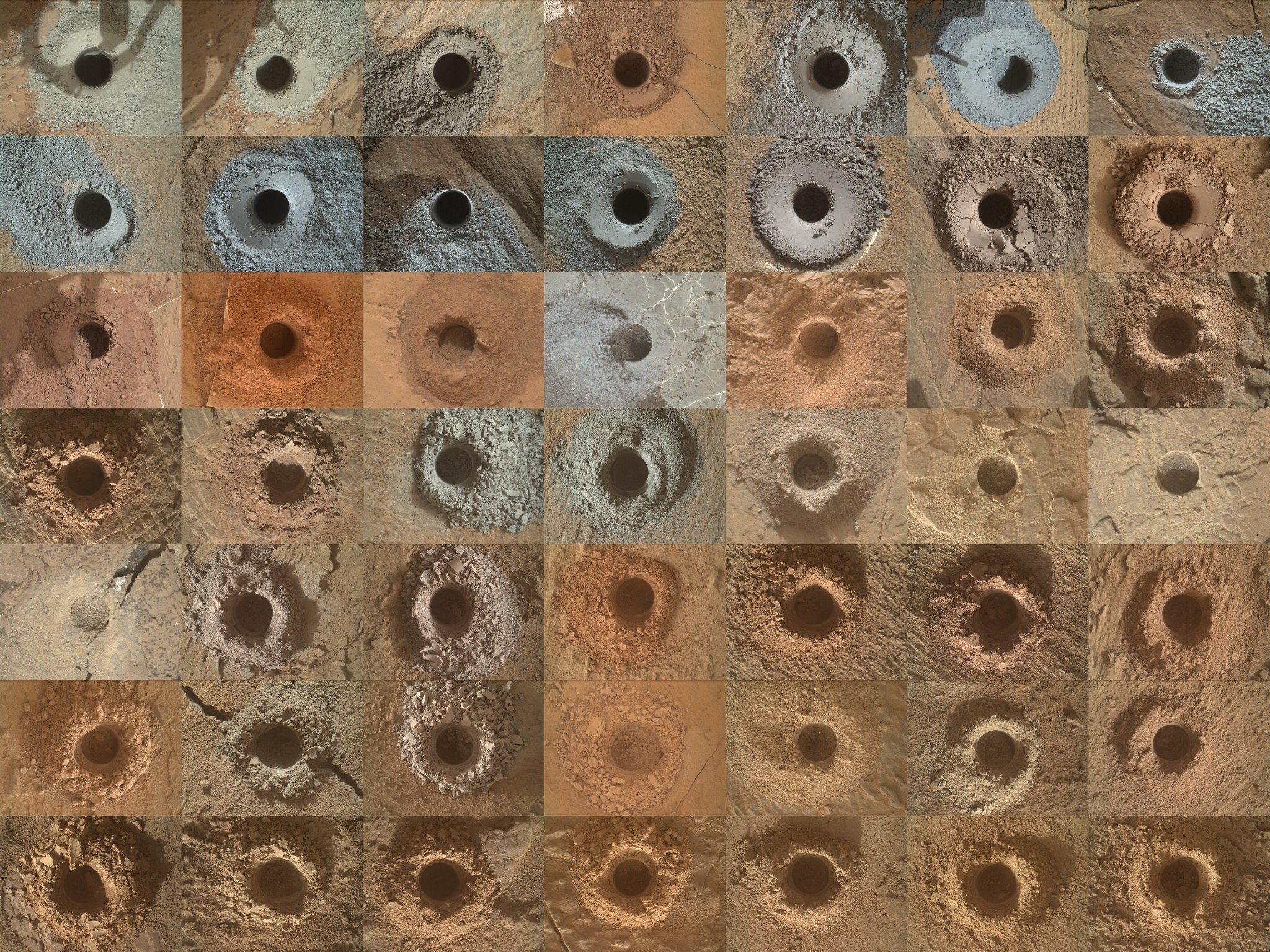
NASA just shared a visual retrospective of the Curiosity rover’s work on Mars, and it is a masterclass in hardware endurance. The image shows a grid of 49 distinct drill holes, each one a literal scar on the Martian surface representing a successful sampling mission. For those of us building in AI and robotics, this isn't just space photography. It is a benchmark for what happens when you build systems meant to survive environments that want to kill them.
The Longevity Loop
Curiosity has been on Mars since 2012. Think about the hardware you were using in 2012. Most of it is in a landfill or a drawer collecting dust. Meanwhile, this machine is still deploying a robotic arm, spinning up a drill, and pulverizing rock to drop into its internal laboratory. This 49th hole is a testament to engineering that prioritizes reliability over rapid iteration.
In the current tech climate, we are obsessed with the 'move fast and break things' ethos. That works for a SaaS product where a bug means a 404 error. It doesn't work when your hardware is 140 million miles away. If Curiosity breaks, there is no field technician. There is no remote patch for a snapped drill bit. This forces a different kind of builder mindset: one where every mechanical stress point is modeled a thousand times before the first prototype is ever cut.
Data Over Hype
What I find interesting as an editor in the crypto and AI space is the sheer volume of data Curiosity generates. Each of those 49 holes is a data point in a decade-long study of Martian composition. It isn't chasing a trend. It is performing the slow, grinding work of empirical science. This is exactly how we should be looking at blockchain infrastructure or large language models. We should be asking: what does this look like after ten years of constant stress?
The rover's drill mechanism is essentially a miniaturized chemical plant. It pulverizes rock, sifts it, and delivers it to the Sample Analysis at Mars (SAM) instrument suite inside its 'belly.' This is automation at its most extreme. It’s a reminder that the real value in robotics isn't just the movement; it’s the ability to translate physical matter into digital insights without human intervention.
The Builder Perspective: Redundancy is King
If you are building a startup right now, you can learn a lot from the Curiosity drill assembly. NASA engineers didn't just build a drill; they built a system with immense redundancy. When the drill's motor started showing signs of wear years ago, they didn't give up. They rewrote the software to change how the drill interacts with the surface. They found a workaround because the hardware was robust enough to handle a different operating logic.
As builders, we often fail because we build 'happy path' products. We assume the user has a fast connection, the latest iPhone, and a clear head. Curiosity was built for the 'unhappy path.' It was built for dust storms, extreme temperature swings, and mechanical degradation. If your dApp or AI agent can't handle a 'dust storm' of bad data or network congestion, it isn't ready for the real world.
The Cumulative Effect of Small Wins
Looking at the collage of 49 holes, you realize that none of them alone 'solved' Mars. It is the cumulative effect of these small extractions that builds the map of the planet's history. We see this in open-source development all the time. One commit doesn't change the world, but 49,000 commits over a decade create something like Linux or Bitcoin.
We need more 'rover energy' in the tech sector. Less talking about what we might do in 2030 and more focus on making sure the current 'drill' works every single time it hits the rock. The reliability of the tool defines the quality of the data.
Real innovation isn't always a new shiny feature; often, it is the ability to keep a legacy system performing at a high level in a hostile environment.
Final Takeaway
NASA’s 49 holes on Mars are a reminder that the most successful projects are the ones that stay in the game the longest. Whether you are building a decentralized protocol or an autonomous robot, your primary goal is to avoid 'extinction.' Curiosity stayed alive, stayed functional, and kept drilling. That persistence is why we now have a library of Martian geology that would have been impossible with a 'fast-burn' mission.
For the builders reading this: stop worrying about the next big thing for a second. Look at your core mechanism. Is it reliable? Can it survive a decade of use? If the answer is no, you aren't building a legacy; you're building a prototype. Be the rover.
Read the original at NASA Breaking News →