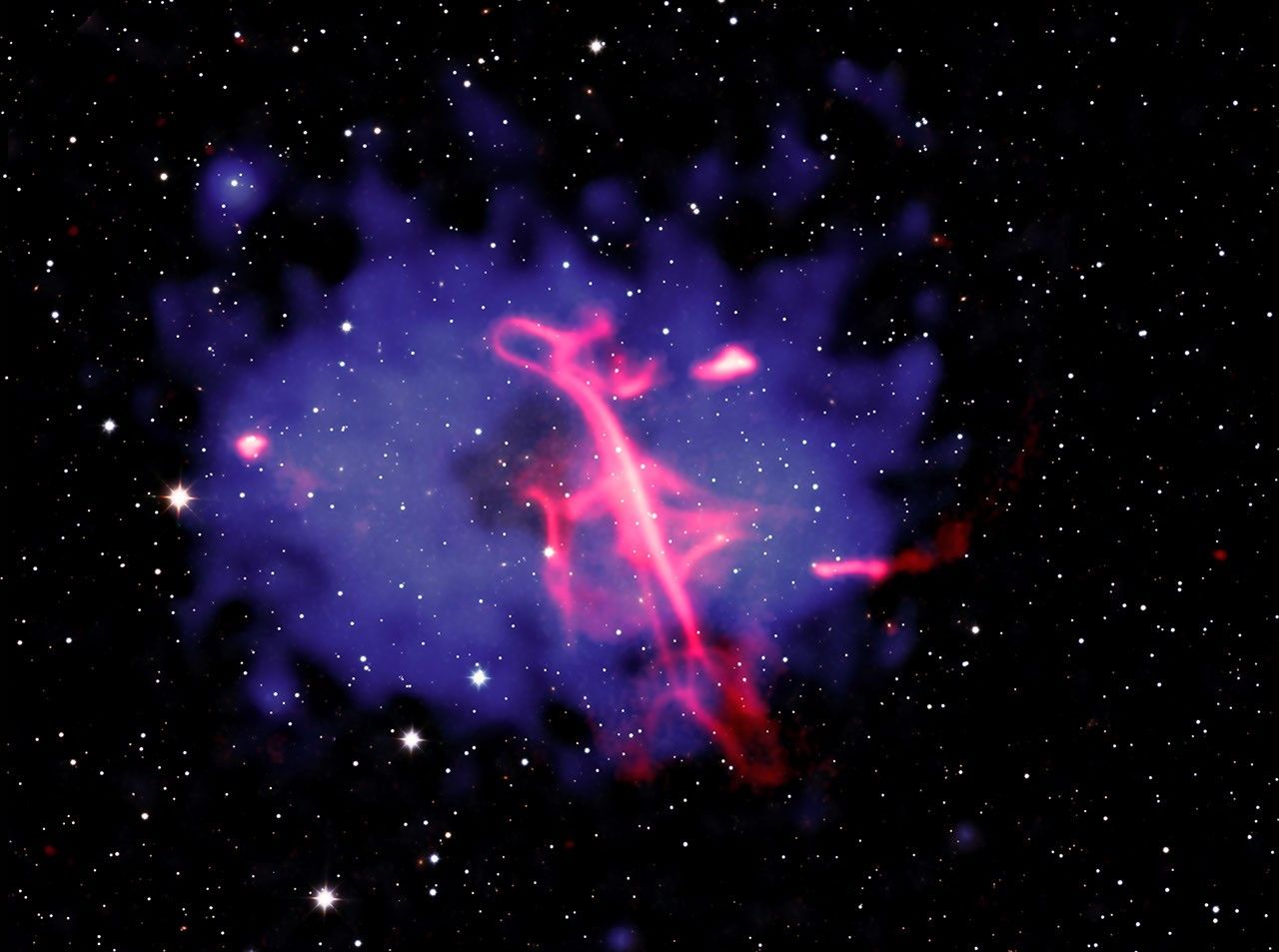
When NASA releases images of cosmic structures with nicknames like the Treble Clef, the internet usually jumps straight to the aesthetics. It looks like a musical note floating in a void of dark matter, and that makes for a great screensaver. But for those of us building in tech, specifically in high-stakes fields like AI and decentralized networks, there is a much deeper lesson hidden in this discovery by the Chandra X-ray Observatory team.
The Treble Clef is not just a pretty shape. It is the result of a violent, multi-stage collision within a galaxy cluster known as Abell 2485. What astronomers found was a sequence of events: an outburst from a supermassive black hole, followed by a massive collision of galaxy clusters, and finally, the slow-motion stretching of radio waves into that iconic curve. It is a case study in how energy, direction, and interference create complex architecture out of chaos.
The Anatomy of an Outburst
In the world of crypto and software development, we talk a lot about scaling and throughput. We think we have problems when a network gets congested or a server farm overheats. Then you look at the Treble Clef. This structure was formed when a supermassive black hole basically burped. It released a jet of high-energy particles that traveled vast distances, creating a trail of radio emission. That was the raw material.
However, the shape we see today—the curve that mimics musical notation—wasn't there originally. That happened because of a secondary event: a merger. Two massive galaxy clusters collided, creating shockwaves that acted like a celestial wind. This wind pushed against the existing radio trails, bending them into the treble clef shape. This is a perfect metaphor for what happens when a powerful new technology meets the hard reality of a market or a competing ecosystem.
Why Builders Should Care About Cosmic Collisions
If you are building a startup, you are the black hole in this scenario. You are creating an outburst of energy, talent, and capital. You have a direction. But you are never operating in a vacuum. Just like the radio waves in Abell 2485, your project is eventually going to collide with another cluster—be it a competitor, a regulatory shift, or a massive change in user behavior.
The Chandra data shows us that the Treble Clef survived the collision not by resisting it, but by being reshaped by it. In the founder world, we call this a pivot, but it is actually just physics. The radio waves were flexible enough to be moved by the shockwaves without being completely dissipated. If those jets had been too rigid or lacked the initial velocity, they would have just been scattered into noise. Because they had sufficient energy, they became a landmark.
The Data Behind the Music
Chandra’s role here is vital because it sees what we can’t. While radio telescopes saw the shape, Chandra’s X-ray vision saw the heat. It saw the gas heated to millions of degrees, which provided the context for why the shape was bending. Without the X-ray data, scientists would just be guessing at the mechanism.
This is a major lesson in observability. In crypto, we often look at price action or TVL (Total Value Locked) and think we understand what is happening. That is like looking at the radio waves and seeing a treble clef. But the X-ray data is the underlying protocol health, the developer activity, and the actual utility. You can’t understand the visible result unless you can see the invisible forces acting upon it. If you aren't building deep observability into your tech stack, you are just looking at pretty shapes and calling it a strategy.
Managing High-Energy Outputs
One of the most interesting aspects of the Treble Clef discovery is the sheer scale of the black hole outburst. It reminds us that concentrated energy is the only thing that leaves a mark on a cosmic—or global—scale. If the black hole had leaked energy slowly and evenly in all directions, there would be no treble clef. It was the focused jet that created the structure.
- Focus creates visibility: Distributed efforts often lead to background noise. Concentrated efforts create signatures.
- Environment matters: The shape of your success is often determined by the friction you encounter, not just your initial launch.
- Longevity is about resilience: These radio structures last for millions of years because they are part of a larger, interconnected system of gas and gravity.
Building something that lasts isn't about avoiding the collision; it's about having enough momentum to let the collision turn you into something recognizable.
A Skeptical Look at Cosmic Narratives
As much as I love the science, I have to stay skeptical of how these stories are packaged. NASA loves a good hook, and the "Treble Clef" name is brilliant marketing. But let’s be real: this is a story about destruction and chaotic reorganization. The universe didn't try to make a musical symbol. It just happened because of specific gravitational and thermal pressures.
In the AI space, we see this all the time. A new model comes out, and the marketing team gives it a human-like name and a friendly face. But underneath, it’s just a mathematical outburst hitting a wall of data. We need to be careful not to fall in love with the shape and forget the physics. The Treble Clef is beautiful, but it is also a graveyard of galactic forces. When you see a "perfect" new project in the crypto space, ask yourself what kind of collision it had to survive to look that good.
The Founder’s Takeaway
The discovery in Abell 2485 teaches us that the most interesting structures are formed at the intersection of energy and interference. If you are a builder and you feel like you are being pushed around by market forces, remember the Treble Clef. The very thing that is bending your trajectory might be the thing that makes your project iconic.
Stop trying to fight the vacuum. Focus on the intensity of your initial outburst and make sure you have the observability tools to understand the shockwaves when they hit. You don't get to choose the shape the world gives you, but you do get to choose how much energy you put into the jet. That is the only part of the physics you actually control.
Read the original at NASA Breaking News →