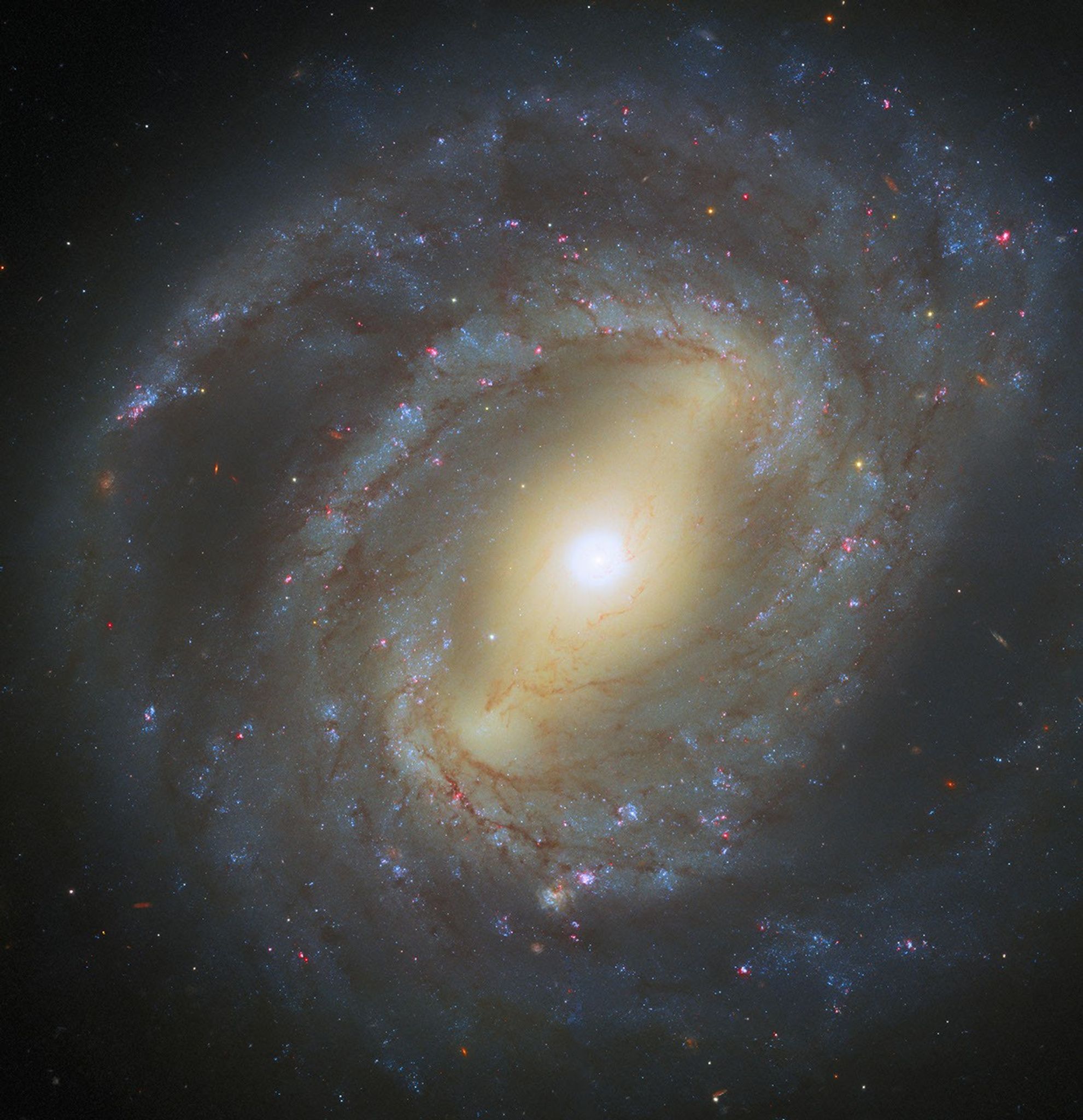
NASA recently released a new image of NGC 4394 captured by the Hubble Space Telescope. At first glance, it looks like another desktop wallpaper for space nerds. But for those of us building systems—whether they are software protocols or hardware networks—there is a structural lesson here that is worth more than the aesthetic. This galaxy is a textbook example of a barred spiral, and that central bar is essentially a high-capacity data bus for the universe.
The Mechanics of the Bar
Located about 55 million light-years away in the Coma Berenices constellation, NGC 4394 is not just floating there. It is a part of the Virgo Cluster. The defining feature of this galaxy is the bar of stars, gas, and dust cutting through its center. From a builder's perspective, this isn't just a pretty shape. It is a delivery mechanism. These bars act as a funnel, dragging gas from the outer reaches of the spiral arms inward toward the core.
Think of it like a load balancer. In a standard spiral, energy distribution can be chaotic. A barred spiral has found a way to optimize flow. That gas being pulled in serves as the raw material for new star formation and, eventually, fuels the central black hole. It is a closed-loop system that manages resources with incredible efficiency. When I look at Hubble's latest data on this, I don't see a miracle; I see a massive piece of infrastructure that has been running for billions of years without a single reboot.
Why Builders Should Care About Deep Space Data
You might wonder what a galaxy 55 million light-years away has to do with your next dev cycle. It comes down to structural integrity and the evolution of systems. Early in the universe, these bars were rare. As galaxies matured and reached a state of relative stability, these bars started appearing more frequently. They are a sign of a system reaching its peak operational state.
In the crypto space, we talk a lot about "liveness" and "efficiency." We build protocols that try to move liquidity or data from point A to point B without losing too much in gas fees or latency. NGC 4394 is doing the same thing on a scale we can barely fathom. The bar is a stabilizing force. It prevents the galaxy from collapsing in on itself while ensuring the core stays powered. If your protocol design lacks a central stabilizing mechanism that facilitates flow, you aren't building a barred spiral; you are building a cloud of dust that will eventually dissipate.
Hubble vs. The New Guard
It is also worth noting that Hubble is still putting in work. In an era where the James Webb Space Telescope (JWST) gets all the headlines for its infrared capabilities, Hubble's view in the ultraviolet, visible, and near-infrared spectrums remains the gold standard for mapping the visible structure of these galaxies. This new view of NGC 4394 reminds us that sometimes the older, battle-tested tools are the ones that provide the clearest insights into foundational structures.
In tech, we are often guilty of chasing the newest shiny object. We want the latest L2 or the newest AI model, often forgetting that the foundational layers—the Hubbles of our stack—are what actually keep the lights on. Hubble has been operational since 1990. It has outlasted thousands of tech startups and dozens of market cycles. The longevity of the tool is as impressive as the data it collects.
Infrastructure as Destiny
When you look at the arms of NGC 4394, they are vibrant and full of young, blue stars. This is where the "work" is happening. But those stars wouldn't exist without the bar providing the feed. This is a lesson in back-end development. Your UI (the spiral arms) can be as beautiful as you want, but if your back-end (the galactic bar) isn't moving data to where it needs to go, the whole thing goes dark.
Builders often ignore the "unsexy" parts of their projects—the database optimizations, the internal documentation, the governance structures. But those are the bars of your project. They are the structures that allow for growth. Without them, you just have a collection of features floating in a void.
The Takeaway for the Founder Perspective
The universe is indifferent to our timelines, but it is very strict about its physics. NGC 4394 exists because it follows a set of rules regarding gravity and angular momentum. It has built an internal highway system to survive. As founders, we need to be just as disciplined. We need to look at our organizations and ask: Do we have a bar? Do we have a mechanism that takes our resources and funnels them toward the core mission, or are we just spinning our wheels in the outer arms?
- Stability is earned: Galactic bars don't appear overnight; they are a sign of a mature, stable system.
- Flow is everything: If resources aren't moving from the periphery to the center, the system dies.
- Legacy tools matter: Don't discount the tools that have been working for decades just because something newer exists.
The new view of NGC 4394 isn't just a win for NASA; it's a reminder that structure dictates survival. Whether you are managing a cluster of stars or a cluster of nodes, the physics of flow remain the same. Keep your systems lean, make sure your data has a clear path to the core, and don't be afraid to rely on the hardware that has proven it can go the distance.
Read the original at NASA Breaking News →