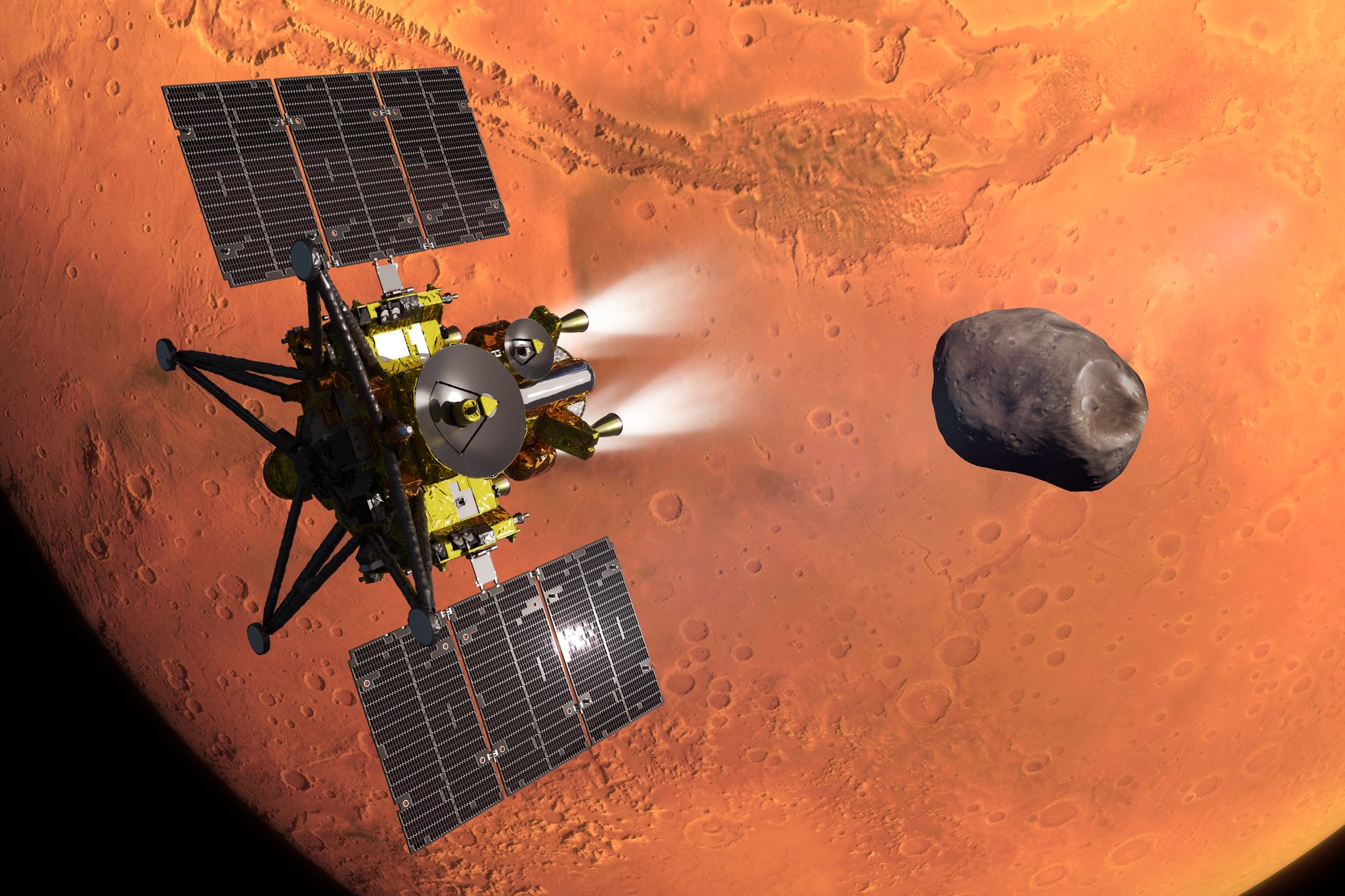
We have spent decades obsessing over the surface of Mars, but we have largely ignored the two lumpy, irregular rocks orbiting it. That is changing. The Japan Aerospace Exploration Agency, or JAXA, is gearing up for the Martian Moons eXploration mission, better known as MMX. NASA is stepping in to provide critical hardware, and for anyone building in the space or deep-tech sectors, this is a mission worth tracking.
The goal is simple to state but brutally hard to execute: land on Phobos, the larger of the two moons, grab a piece of it, and bring it back to Earth. This is not just a scientific curiosity project. It is a fundamental test of how we handle logistics in a multi-body planetary system. If you are a founder looking at the future of orbital infrastructure, Phobos and Deimos are the prime real estate you should be watching.
The Logistics of Small Bodies
Phobos and Deimos are weird. They do not look like our Moon. They look like captured asteroids—pockmarked, irregular, and small. Scientists are split on whether they were snatched up by Mars' gravity or formed from the debris of a massive impact. Knowing the answer tells us everything about the early history of our solar system, but for builders, the composition is what matters.
If these moons are carbon-rich asteroids, they are effectively gas stations in the sky. If you are building a startup focused on in-situ resource utilization, the MMX mission is your first real look at the supply chain. Bringing a sample back to Earth allows us to verify if the materials we think are there—like water ice or organic compounds—actually exist in a usable form.
NASA as the Strategic Partner
NASA is not leading this show; JAXA is. But NASA is providing the MEGANE instrument—a gamma-ray and neutron spectroscope. This piece of kit is designed to map the elemental composition of the moons from orbit. They are also helping with the pneumatic sampling system that will actually touch the surface. This is a classic example of collaborative R&D. Instead of duplicating the entire mission architecture, NASA is plugging into an existing framework to get the data they need at a fraction of the cost.
For founders, there is a lesson here in lean operations. You do not always need to build the whole rocket. Sometimes, building the best sensor for someone else's rocket gives you all the leverage and all the data you need to prove your thesis.
Why Phobos is the Better Target
Everyone talks about landing on Mars, but the gravity well of a planet is a nightmare for logistics. Phobos has negligible gravity. It orbits Mars three times a day. It is essentially a natural space station already in orbit. If you can master operations on a body like Phobos, you have a staging ground for everything else in the Martian system.
The MMX mission will spend three years in the Martian system. It is not a quick flyby. It is a sustained presence. During that time, it will observe Deimos and perform multiple maneuvers around Phobos. This kind of long-duration orbital work is exactly what we need to master before we even think about sending humans to the surface of the Red Planet.
The Skeptic's Corner: Sample Return Risks
We should be realistic. Sample return is the hardest thing to do in space. You have to launch, travel, navigate a complex orbital dance, land on a low-gravity surface that might behave like liquid or dust, launch back off that surface, and survive a re-entry into Earth’s atmosphere. We have seen plenty of missions fail at the final hurdle. JAXA has a decent track record with their Hayabusa missions, but Phobos is a different beast.
From a founder’s perspective, the risk here is data latency. We are waiting years for these samples to return. If your business model relies on the results of MMX, you are playing a very long game. You need to be building for the infrastructure needs that exist regardless of what the dirt on Phobos is made of.
What This Means for the Space Industry
The MMX mission signals a shift from exploration to characterization. We are no longer just asking "what is there?" We are asking "how can we use what is there?" This is the transition point for any industry. NASA’s involvement validates that the Martian moons are not just side-shows; they are strategic assets.
- Material Science: The samples will tell us how radiation affects regolith over millions of years, crucial for building long-term habitats.
- Navigation Tech: Operating around irregular bodies requires better autonomous navigation software—a huge growth area for AI startups.
- Robotics: The sampling mechanism has to work in environments we can't fully simulate on Earth.
The Founder's Takeaway
Do not get distracted by the hype of "colonizing Mars." The real work is being done in the orbital mechanics and the small-body logistics that MMX is tackling. If you are building in the space sector, look at the gaps in JAXA and NASA's partnership. Look at the data they need but aren't getting. That is where the opportunity lies.
Success in space isn't about the biggest rocket; it's about who owns the most accurate data about the destination.
The MMX mission is a bold move by Japan, and NASA's support shows they are serious about a long-term presence in the Martian system. It is time to start thinking about the moons of Mars as more than just points of light in a telescope. They are the future hubs of the inner solar system.
Read the original at NASA Breaking News →