NASA just passed a quiet milestone for the LISA mission, short for Laser Interferometer Space Antenna. They have started work on the Engineering Test Unit, a high-precision telescope prototype that is basically the nervous system for what will be the first space-based gravitational wave detector. L3Harris Technologies is handling the design and assembly of this unit.
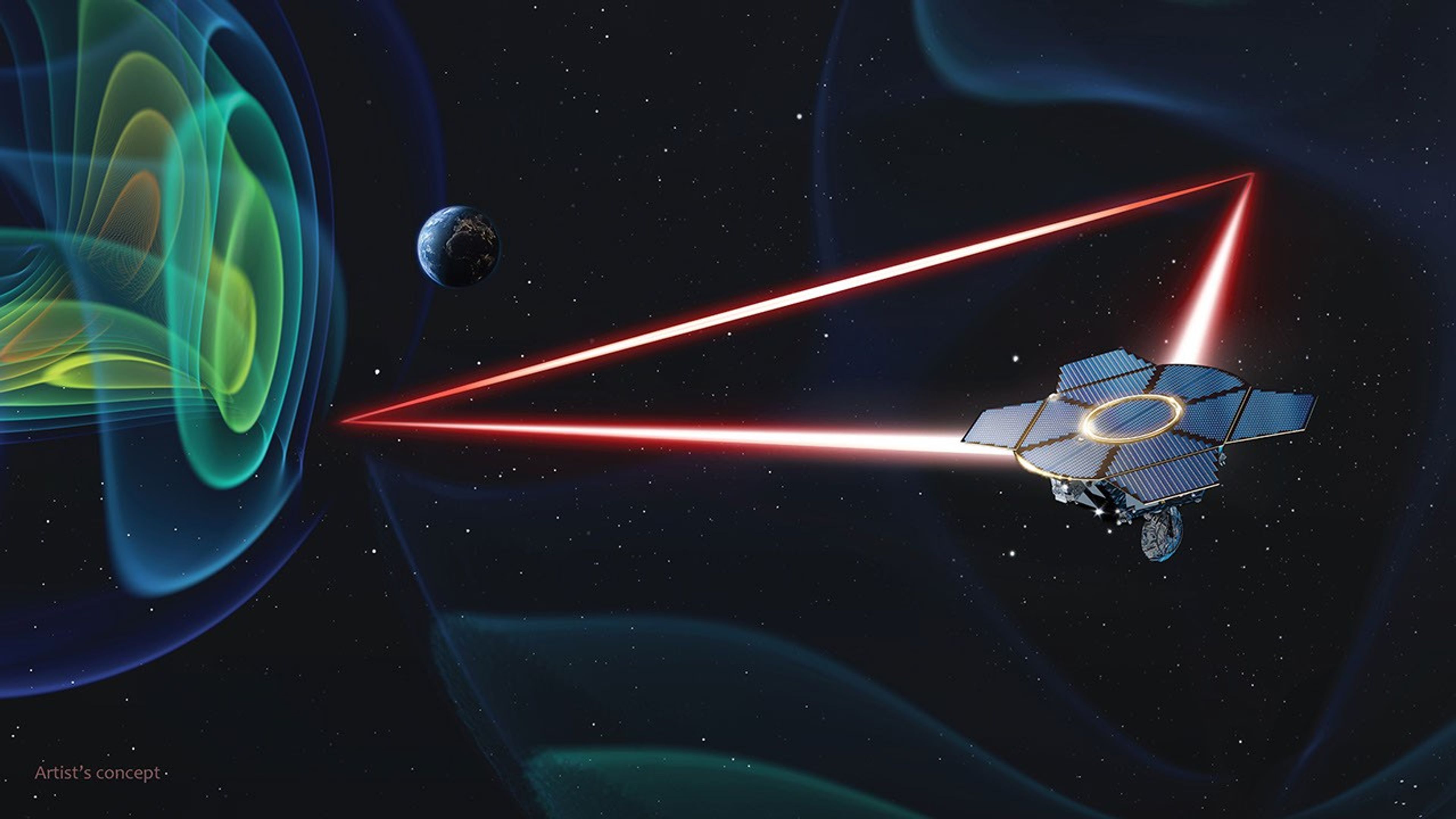
For those outside the aerospace bubble, this might look like just another government contract. But for those of us building in crypto and AI, there is a lot to learn from how NASA approaches a problem this big. LISA is not just a telescope; it is a three-spacecraft constellation that will sit millions of miles apart, firing lasers at each other to measure distortions in space-time. If you think scaling a layer-2 network is hard, imagine trying to maintain sub-atomic precision across 1.5 million miles of vacuum.
Precision at the Edge of Physics
The LISA mission is designed to detect gravitational waves, the ripples caused by massive cosmic events like black hole collisions. We have detected these from Earth before, but ground-based sensors are limited. They get too much interference from, well, being on Earth. Seismic activity and local gravity noise drown out the lower frequencies.
NASA's new telescope is the bridge between these spacecraft. It has to be built entirely of specialized glass that will not expand or contract when temperatures fluctuate. In the hardware world, we call this thermal stability. In the builder world, we call it building a foundation that does not move when the market gets volatile. The telescope's job is to send and receive infrared laser beams between the three probes. If the alignment is off by even a fraction of a hair, the whole $4 billion mission is just expensive space junk.
What Builders Can Learn from NASA's Long Game
I talk a lot about the "founder-perspective," and NASA is the ultimate founder here. They are solving a problem that won't show results for a decade. The LISA mission is currently slated for a mid-2030s launch. That is a timeframe most crypto projects can't even fathom. Most founders are looking at a six-month roadmap and a three-month token unlock. NASA is looking at a twenty-year engineering cycle.
Building the Engineering Test Unit (ETU) first is a move every tech founder should study. It is not a Minimum Viable Product in the way we usually think about it. It is a high-fidelity stress test. NASA isn't shipping a beta to see if people like it; they are building a perfect replica to see if the laws of physics will break it. They are validating the most difficult parts of the tech stack—the optical bench and the structural integrity of the glass—before they even think about the final build.
High Stakes and Low Tolerance
In the AI space, we see a lot of "move fast and break things." That works when you are iterating on a chatbot. It does not work when you are launching hardware into a stable orbit around the sun. The LISA telescope requires a level of manufacturing precision that is almost alien. The mirrors have to be polished to a point where the imperfections are measured in atoms.
This is a reminder that some things cannot be disrupted by software alone. We talk about Decentralized Physical Infrastructure Networks (DePIN) and how they will revolutionize hardware. But when you look at what L3Harris and NASA are doing, you realize there is a massive gap between "crowdsourced hardware" and "mission-critical hardware." If we want the decentralized world to actually compete with legacy systems, we need to stop settling for "good enough" and start looking at the rigorous verification processes used in aerospace.
The Data Challenge
Once LISA is live, it will generate a massive stream of data about the history of the universe. This is where the AI crossover happens. Analyzing gravitational wave data is essentially a pattern recognition problem. We are looking for tiny signals buried under massive amounts of noise. The signal processing required is exactly what modern machine learning is built for.
I expect that by the time LISA launches in the 2030s, the backend for processing this data will be almost entirely AI-driven. The builders who are currently working on specialized AI agents for scientific research are the ones who will be ready for this. You can't just throw a general-purpose LLM at gravitational wave data. You need bespoke, high-performance models that understand the physics of the signals.
Takeaway for the Founders
The takeaway here is simple: stop rushing the foundation. NASA is spending years just on the telescope prototype because they know that if the foundation is flawed, the mission is doomed. Whether you are building a new DeFi primitive, a decentralized AI network, or a physical piece of hardware, the "Engineering Test Unit" phase is where the real value is created.
We spend too much time worrying about the launch and not enough time worrying about the integrity of the mirrors. LISA is a reminder that the most ambitious projects require the most disciplined engineering. It is not about being first to market; it is about being the one whose lasers actually hit the target when it matters most.
Building for the long term isn't about ignoring the present; it's about ensuring your present efforts are precise enough to survive the future.
NASA is playing the long game. If you want to build something that lasts longer than a market cycle, you should probably start looking at your project through the lens of a LISA engineer. If your code, your hardware, or your economic model can't handle the "thermal expansion" of a volatile market, it's time to go back to the drawing board.
Read the original at NASA Breaking News →