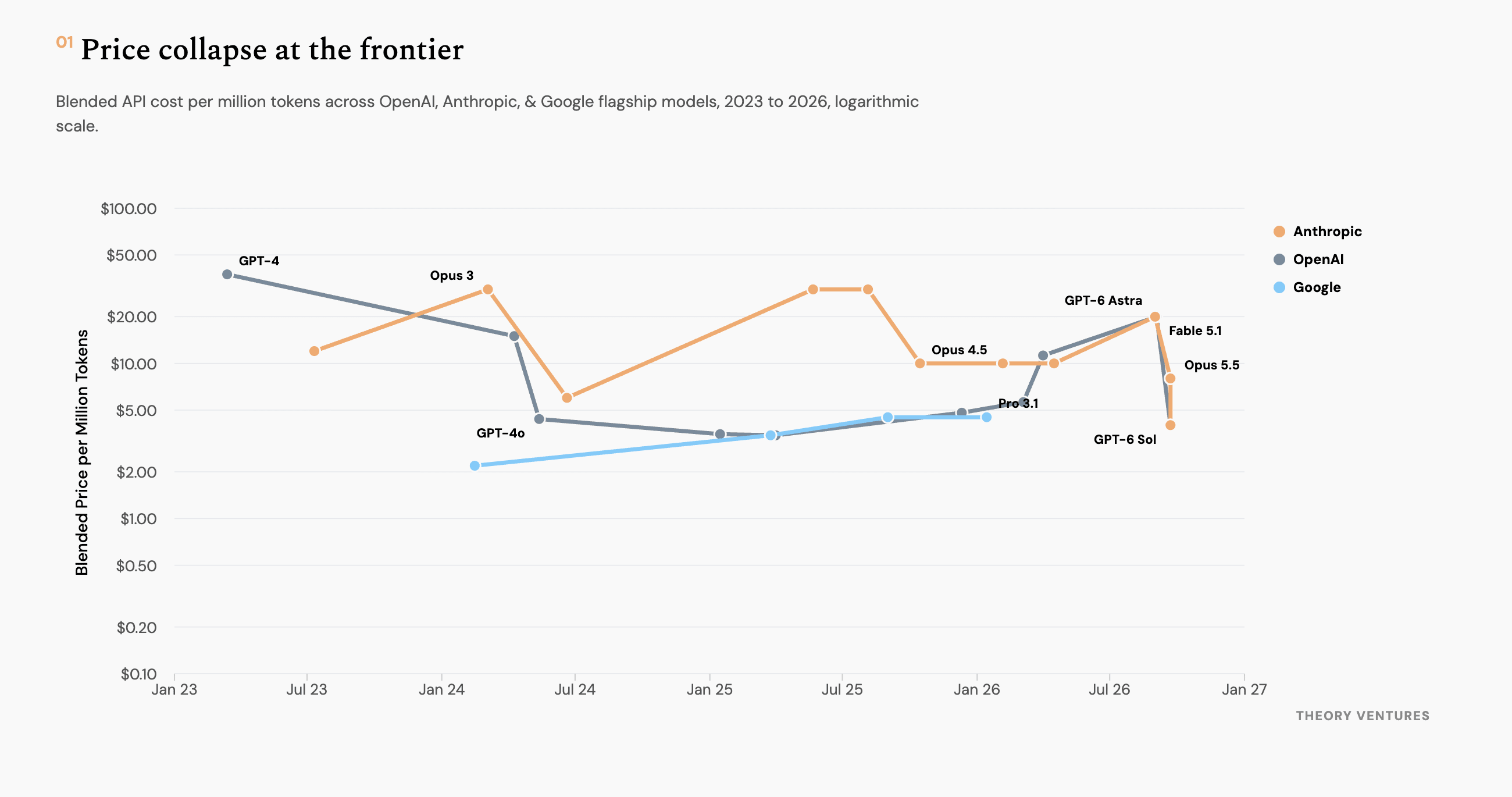
We have entered the phase of the AI cycle where the shiny object syndrome is finally wearing off. For the last two years, the narrative was driven by the quest for the 'God Model'—that one singular, massive LLM that could do everything. Builders were told to wait for the next frontier release, assuming that higher intelligence would always command a higher premium. That assumption is currently being shredded by market reality.
If you look at the recent data on token spending and model adoption, a very different picture emerges. The frontier isn't where the volume is. The frontier isn't even where the growth is. Instead, we are seeing a massive migration toward the middle. In any mature industry, the middle is where the money is made, and AI is proving to be no exception.
The Race to the Bottom is Accelerating
The pricing dynamics of the last few months tell a story of desperation and commoditization. We have seen OpenAI slash prices for their flagship models by 80%, only to follow that up with another 50% cut shortly after. This isn't just about efficiency gains or Moore's Law applied to silicon; it is a defensive reaction to a market that is refusing to pay a premium for incremental intelligence gains.
Meanwhile, companies like Anthropic have attempted to hold the line. They have kept their pricing for top-tier models like Opus relatively stable across multiple releases. But holding the line on price while your competitors are cutting theirs is a risky bet when the performance gap is narrowing. When the 'good enough' model is 90% as capable but costs 90% less, the choice for a founder building a scalable product is obvious.
Open-source models are the primary catalysts here. We are seeing open models capture a dominant share of token volume, often running at an 86% discount compared to their closed-source counterparts. For a builder, this means the 'intelligence per dollar' metric is exploding. It also means that the moat for closed-source labs is shrinking to a tiny sliver of specialized use cases.
The Illusion of Frontier Dominance
There is a persistent myth that the most capable model will always win the most market share. The data suggests otherwise. Look at the launch of high-end models like Fable 5.1. Despite being touted as a high-water mark for capability, it only managed to capture less than 4% of gateway spending in its first two weeks. If the market were truly hungry for raw power at any cost, that number would be ten times higher.
The reality is that demand for AI follows a normal distribution—a fat bell curve. The thin edges of that curve represent the extremes: the hobbyists using free, tiny models on one side, and the high-end researchers using the most expensive frontier models on the other. But the vast majority of the volume—the 'fat middle'—is comprised of developers building real-world applications like RAG systems, customer support bots, and data extraction tools.
These middle-market use cases don't need a model that can write a symphony or solve unsolved physics equations. They need a model that follows instructions reliably, has low latency, and doesn't eat their entire margin. As intelligence becomes a commodity, the value shifts from the model itself to how that model is integrated into a workflow.
What This Means for Founders
If you are a founder, this shift is the best news you've had all year. It means you are no longer beholden to the pricing whims of one or two labs. The power has shifted from the model providers to the builders. However, it also means your competitors have the same access to cheap intelligence that you do.
Stop over-engineering for the frontier. Many startups are burning runway by using the most expensive API calls available because they think it makes their product 'better.' In reality, your users probably can't tell the difference between a response from a $25/million token model and a $0.50/million token model for 90% of tasks. If you can move your workload to the middle, your unit economics will transform overnight.
Focus on the orchestration, not the LLM. Since the model is becoming a commodity, your moat has to be elsewhere. It’s in your data pipeline, your user experience, and your ability to chain smaller, cheaper models together to achieve a complex result. The builders who win won't be the ones with the 'smartest' bot; they’ll be the ones with the most sustainable business model.
The Commodity Trap
The big question hanging over the industry is whether the entire AI market will eventually collapse into a pure commodity play. If intelligence follows the path of electricity or cloud storage, the labs are in trouble, but the builders are in heaven. When the cost of a resource drops toward zero, the consumption of that resource tends to trend toward infinity.
We are seeing this play out in real-time. As token prices drop, developers are finding ways to use more of them—longer contexts, more frequent calls, and more complex agentic workflows. But even as volume increases, the total spend is concentrating in that middle tier of 'efficient' models rather than the 'frontier' models.
For the labs, this is a nightmare. They are spending billions to train models that the market is increasingly unwilling to pay a premium for. They are caught in a cycle where they must innovate to stay relevant, but each innovation is immediately commoditized by open-source alternatives or aggressive price cuts from competitors.
The Takeaway
The era of paying a 'frontier tax' is ending. The middle market is now the primary theater of war for AI, and that is where the most sustainable businesses will be built. As a founder, your job isn't to chase the highest benchmark; it's to find the most efficient intersection of capability and cost. The 'fat middle' isn't just a market segment—it's the only place where the math actually works for a growing startup.
Read the original at Tomasz Tunguz →