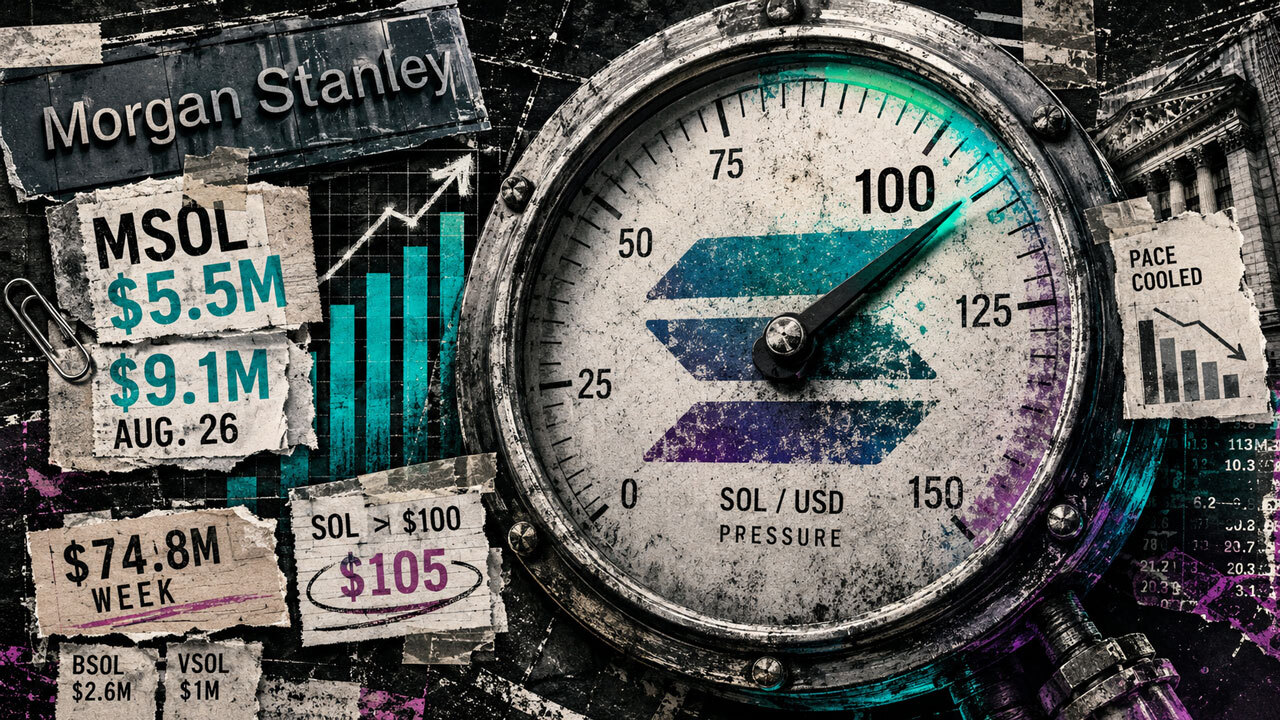
We have spent the last two years listening to people argue about whether Solana is a legitimate enterprise-grade network or just a high-speed casino for retail traders. The data coming out of the traditional finance sector this week suggests the scale is finally tipping toward the former. While the broader market remains choppy, the capital flows into Solana-based exchange-traded products are starting to look deliberate, not accidental.
The Institutional Entry Point
For those of us building in the space, we usually ignore daily price action. But we shouldn't ignore where the money is coming from. Recent data from Farside Investors shows a distinct uptick in interest for Solana investment vehicles. Specifically, products like 21Shares’ ASOL and the VanEck Solana Trust are beginning to see the kind of consistent activity that usually precedes a broader institutional adoption cycle.
Morgan Stanley, a name that usually moves with the speed of a glacier, has been identified as a key driver in these inflows. They aren't just betting on a coin; they are betting on an ecosystem. When a firm of that size starts allocating client capital into SOL, it changes the conversation for founders. It makes it easier to pitch to non-crypto VCs, and it legitimizes the stack we are building on.
What These Inflows Actually Represent
The numbers themselves—roughly $9 million in a recent stretch—might look like a rounding error compared to Bitcoin's billions, but the context matters. We are seeing positive net flows into specific Solana trackers like BSOL and VSOL at a time when other altcoins are seeing stagnation. This tells me that the market is beginning to differentiate between generic crypto and functional infrastructure.
For a long time, Solana was the underdog that kept going down during peak congestion. But the network has matured. The developers stuck around through the FTX collapse, and now, the institutional gatekeepers are realizing that the uptime and throughput are actually holding up under pressure. If you are a founder, this is your green light. The infrastructure risk is being re-priced by the smartest (or at least the richest) people in the room.
The Founder Perspective: Infrastructure vs. Speculation
I have always been a bit skeptical of the 'ETF will save us' narrative. Usually, an ETF just means more liquidity for whales to exit. However, Solana is different because it is a developer-heavy chain. Unlike Ethereum, which is currently wrestling with its own scaling identity crisis via Layer 2s, Solana offers a unified experience. Institutional investors like that simplicity. They can understand a single, fast ledger easier than a fragmented map of bridges and rollups.
If you are building an application right now, you need to understand that the people providing this $9 million in liquidity aren't looking for the next meme coin. They are looking for yield, real-world asset tokenization, and decentralized physical infrastructure (DePIN). The Morgan Stanley crowd wants to know how Solana can make traditional financial rails more efficient.
- Scalability: The ability to handle thousands of transactions without breaking the bank.
- Settlement: Instant finality that rivals or beats traditional wire transfers.
- User Experience: A wallet ecosystem that doesn't require a PhD to navigate.
A Reality Check on the $100 Floor
As SOL pushes back above the $100 mark, there is a lot of cheering on social media. I’d caution against getting too comfortable. Price is a lagging indicator of utility. The real story isn't that the token is worth triple digits again; it's that it stayed relevant long enough for Morgan Stanley to notice. We have seen Solana at $200 and we have seen it at $8. The building didn't stop at either extreme.
The risk here is that we let the inflow narrative distract us from the actual work. Institutional money is fickle. If the network experiences another major outage or if the regulatory environment shifts, that $9 million can flow out just as fast as it flowed in. Founders should treat this institutional interest as a tailwind, not a foundation.
The Takeaway for Builders
The most important thing to watch isn't the total dollar amount, but the diversity of the products seeing inflows. When you see multiple different tickers—ASOL, BSOL, VSOL—all moving in the same direction, it means the plumbing for institutional access is officially installed. The pipes are connected.
My advice to founders is simple: Stop worrying about the 'Ethereum Killer' labels and start focusing on the 'Morgan Stanley Client' needs. If the big banks are moving in, they are going to need enterprise-grade tools, better reporting, and robust security audits. The next wave of successful Solana startups won't be just another DEX; they will be the companies that bridge the gap between this new institutional capital and the on-chain economy.
The institutional gatekeepers are no longer just watching from the sidelines; they are actively funding the liquidity that sustains the network. This is the shift from experimental to essential.
We are moving out of the era of pure speculation and into an era where the network is judged by its ability to settle institutional-scale value. If you're building on Solana, you just got a very expensive vote of confidence. Use it wisely.
Read the original at CryptoSlate →