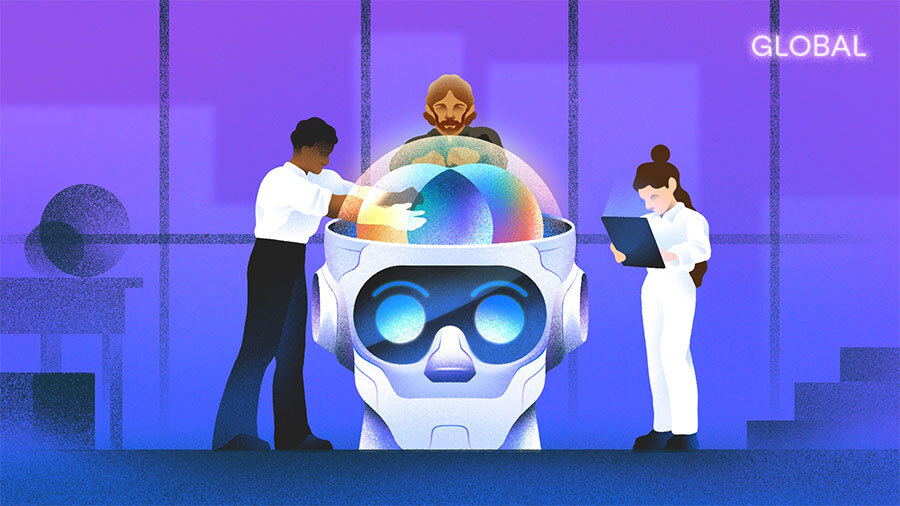
We are currently witnessing one of the most predictable arms races in tech history, and quite frankly, it is getting exhausting. Last week, the industry watched as Anthropic and OpenAI engaged in a literal hour-by-hour showdown. Anthropic pushed out Opus 5.5, aiming for the top of the leaderboard, only to have OpenAI drop GPT-6 updates ninety minutes later to reclaim the narrative. It was a classic case of pacing the frontier, but while the giants were busy fighting for a few percentage points on a spreadsheet, Meta actually stole the show.
Mark Zuckerberg’s team didn’t just drop another chatbot. They dropped Muse, a personal AI agent designed to live where you actually live: on your face. By integrating this model directly into smart glasses and social ecosystems, Meta is proving that the future of this tech isn't about who has the smartest math tutor on a desktop browser. It’s about who can become a useful, invisible part of your daily routine.
The Problem with Benchmark Theatre
For the last eighteen months, the developer community has been held hostage by the release cycle of LLM benchmarks. We get a new model, we see a chart showing it’s 4% better at Python coding than the previous version, and then we spend three weeks migration-testing. Anthropic’s Opus 5.5 and OpenAI’s GPT-6 are impressive feats of engineering, but they are increasingly suffering from the law of diminishing returns for the average builder.
If you are building an app, does a slight increase in reasoning capability change your unit economics? Usually, no. What changes your business is distribution and hardware integration. This is where the OpenAI vs. Anthropic battle feels like a distraction. They are fighting for the crown of the smartest brain in a jar. Meanwhile, Meta is building the nervous system for the physical world.
Why Muse Matters for Builders
The reported numbers for Muse are already outpacing the early adoption curves of ChatGPT. This isn't because Muse is necessarily smarter at solving quantum physics problems; it’s because Meta has solved the friction problem. When you put AI into Ray-Ban frames, you remove the need to pull out a phone, unlock it, and type a prompt. You just exist, and the AI assists.
For those of us building in the AI space, this is a massive signal. The shift is moving away from raw inference power and toward contextual awareness. Muse is designed to see what you see and hear what you hear. That is a level of data privilege that OpenAI and Anthropic can only dream of without their own proprietary hardware ecosystem.
Distribution is Still King
We often forget that Meta has billions of users already logged in. While OpenAI has to convince people to visit a specific URL or download a dedicated app, Meta can just toggle a feature in WhatsApp, Instagram, or a pair of glasses. The rollout of Muse proves that utility beats novelty. If the agent can tell me who I'm looking at at a networking event or translate a menu in real-time through my lenses, I don't care if it scores lower on a bar exam simulation than GPT-6.
The biggest mistake builders make right now is chasing the highest benchmark instead of the lowest friction.
Meta is leaning into the open-source and hardware-integrated approach, which provides a much clearer path for developers who want to build sustainable businesses. When you build on a closed frontier model that is constantly being jumped by a competitor every ninety minutes, you are building on shifting sand. Meta’s approach feels more like building on a platform.
The Smart Glasses Factor
The real reason Muse stole the spotlight is the hardware. We have reached peak screen. Most of us don't want another app; we want our lives to be easier. By tethering Muse to smart glasses, Meta is making a play for the post-smartphone era. This isn't just a voice assistant; it’s a vision assistant. It can identify objects, read signs, and provide heads-up navigation.
OpenAI and Anthropic are currently stuck in a text-box paradigm. Even their voice modes are still fundamentally tethered to a device that stays in your pocket half the time. Meta is moving the AI to the edge of our perception. For a founder, the takeaway is clear: the most valuable AI products of the next two years won't be wrappers for the smartest model; they will be integrations that bridge the gap between digital intelligence and physical action.
Final Takeaway for Founders
Stop worrying about which model is winning the leaderboard this week. The battle between Opus and GPT is a war of attrition that mostly benefits Nvidia. Instead, look at the integration play Meta is making with Muse. The real opportunity lies in context. If you can build something that utilizes the real-time, multimodal data flow that devices like smart glasses provide, you will be ahead of the curve.
The era of the chatbot is ending. The era of the ubiquitous agent has begun. While the big two were busy fighting for the spotlight, Meta changed the stage entirely. Don't get distracted by the noise of model drop week—focus on where the AI is actually going to live.
Read the original at TechCrunch AI →