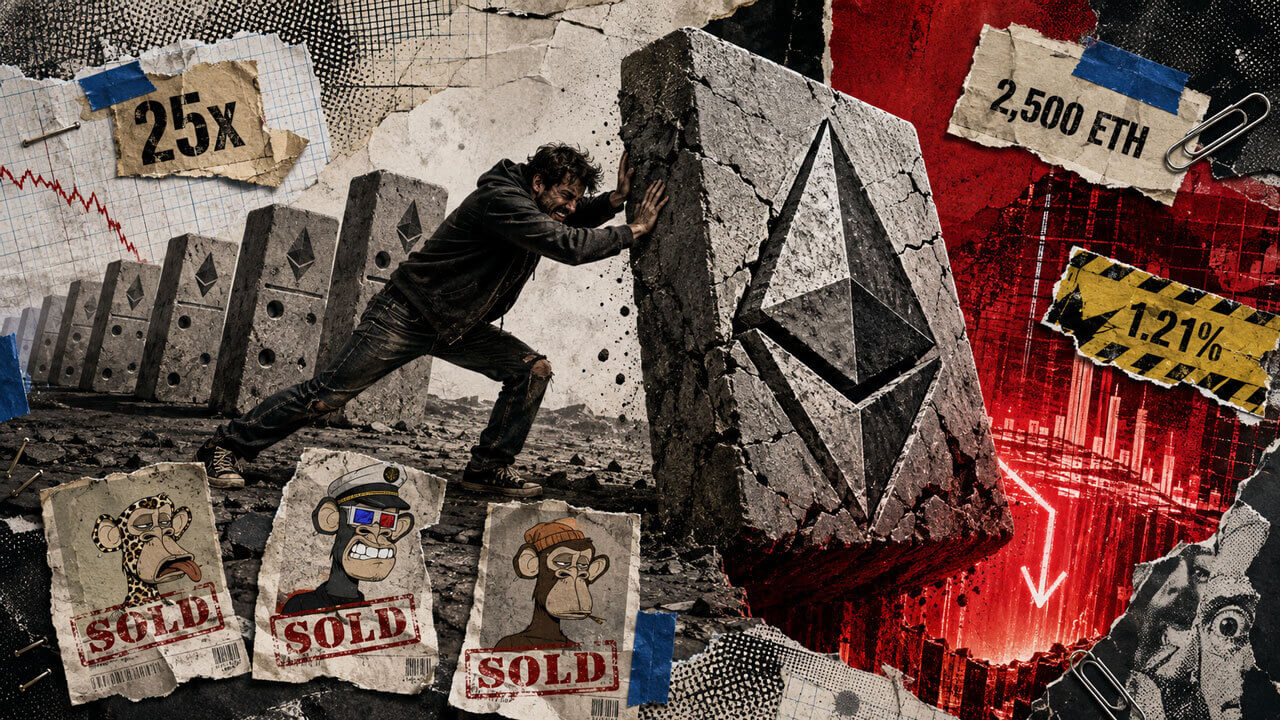
We have all seen the headlines about Jeff Huang, known in the crypto space as Machi Big Brother. He has been a fixture of the NFT market for years, often acting as a high-volume whale who can move floors with a single sweep. But recently, the narrative has shifted from opportunistic buying to what looks like a desperate scramble for liquidity.
According to recent on-chain tracking data, Huang has been offloading core assets from his Bored Ape Yacht Club collection. The goal seems simple on paper: reduce a massive leveraged long position on Ethereum. But as any founder who has managed a balance sheet knows, selling assets into a declining market to cover margin is rarely a winning strategy. It is defensive maneuvering, and in this case, it might not be enough.
The Math of a Margin Call
Leverage is a hell of a drug. When the market moves in your favor, you look like a genius. When it turns, you start cannibalizing your long-term plays to protect your immediate survival. Huang recently sold three Bored Apes, reportedly at a significant loss compared to their peak valuations. While the public record does not explicitly show the exact flow of every dollar into his margin account, the timing is too precise to be a coincidence.
By selling these NFTs, he managed to cut his total debt obligation by roughly 52%. That sounds like a major win until you look at the liquidation price. Even after clearing half the debt, the liquidation threshold for his remaining Ethereum position moved dangerously close to the current spot price. We are talking about a $22 gap between safety and total wipeout.
For a builder, this is the ultimate cautionary tale about over-extension. Whether you are leveraging ETH on Aave or over-leveraging your startup's future on a single VC bridge loan, the result is the same: you lose your agency. You no longer make decisions based on what is best for the project; you make them based on what prevents the house from burning down in the next hour.
The Problem with Illiquid Collateral
One of the biggest mistakes traders made during the NFT boom was treating JPEGs like liquid cash. Huang is finding out the hard way that when you need to exit a million-dollar position in Bored Apes to save an Ethereum long, the market knows you are bleeding. You become a forced seller.
When you are a forced seller, you do not get to set the price. You take what the bidding bots give you. This creates a downward spiral where the act of trying to save your position actually puts more pressure on the assets you hold. It is a liquidity trap that has claimed much smarter people than us.
What This Means for the NFT Ecosystem
If one of the most prominent collectors in the space is dumping his Grails just to keep a margin trade alive, it tells us two things about the current state of the market:
- Confidence is thin: The willingness to hold high-value NFTs through a downturn is evaporating among the whales.
- Capital is shifting: The money is moving back into base assets like ETH and BTC, but it is doing so under duress, not because of a new thesis.
For builders, this suggests that the NFT market is still in a cleansing phase. We are moving away from the era of "whales trading with each other" and toward a reality where utility and actual product-market fit are the only things that will sustain a floor price. If your project relies on a few big spenders to keep your volume up, you are at risk. Those big spenders are currently busy trying not to get liquidated.
Founder Perspectives: Managing Risk
I have spoken to dozens of founders who thought they were being conservative by keeping their treasury in ETH or using DeFi protocols to yield farm during development. The Machi Big Brother situation is a reminder that technical risk and market risk are two different beasts. You might have a great codebase, but if your treasury is tied up in a leveraged position that is $22 away from zero, your codebase doesn't matter.
Here is how I look at this as a builder: your primary job is to stay in the game. Leverage, by definition, increases the odds that you will be forced to leave the game prematurely. Huang is a high-stakes player who enjoys the adrenaline, but most of us are trying to build something that lasts decades, not just until the next candle closes.
Leverage is a tool for magnifying returns, but it is also a tool for accelerating failure. If your survival depends on the market staying above a specific dollar amount, you aren't a founder anymore—you're a gambler.
The Takeaway for the Rest of Us
We should stop looking at these whale movements as signals of where the market is going and start looking at them as warnings of where not to end up. The fact that a 52% debt reduction only bought a tiny bit of breathing room shows just how precarious these large-scale DeFi plays are.
If you are building in the crypto space right now, prioritize liquidity and stability. Don't use your long-term assets to chase short-term margin gains. The market is volatile enough without you adding a self-destruct button to your portfolio.
Machi Big Brother might survive this round if Ethereum bounces, but he has had to sacrifice part of his legacy collection to do it. That is a high price to pay for a trade that was supposed to be a win. As builders, we should be focused on creating value that doesn't rely on a liquidation bot's mercy.
Read the original at CryptoSlate →