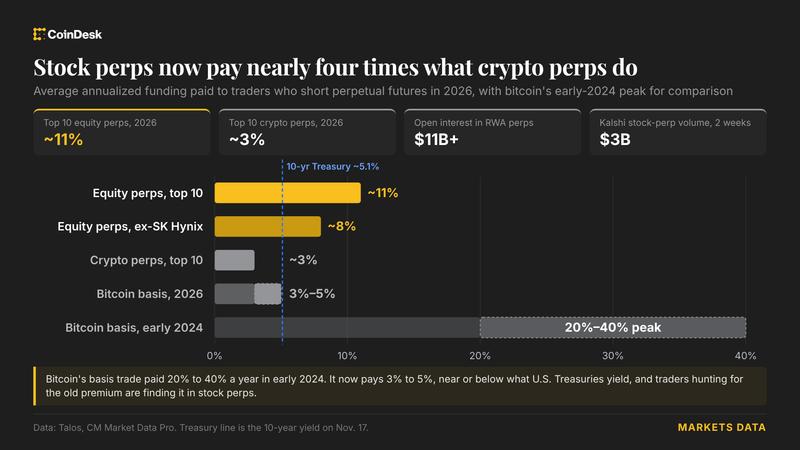
The market is hitting a wall, and for once, it is not because of a regulatory crackdown or a major exchange failure. Bitcoin is hovering around $65,000, but the real story isn't the price—it is the math happening behind the scenes. The legendary 'basis trade' that has fueled institutional appetite for years is finally drying up.
For the uninitiated, the basis trade is the ultimate 'low-risk' crypto play. You buy Bitcoin in the spot market and simultaneously sell a futures contract at a higher price. You capture the difference, or the 'basis.' During bull runs, this gap can be massive, sometimes offering 20% or 30% annualized returns. But according to the latest data from Talos, those yields have plummeted. Right now, executing a basis trade pays about the same as a U.S. Treasury bill.
The Yield Cliff
When the 'risk-free' rate of crypto matches the actual risk-free rate of the U.S. government, the incentive structure for big money changes instantly. Why deal with the custody risks, exchange counterparty hurdles, and technical overhead of crypto arbitrage if you can get the same 5% return from a government bond? This is why we are seeing Bitcoin lose momentum at the $65,000 mark. The easy, automated money is looking for the exit.
While Bitcoin sits heavy, we are seeing some rotation. XRP is pushing toward the dollar mark and Solana is showing a bit of life, up about 3%. But these are minor tremors compared to the structural shift in how liquidity is moving. The 'carry trade' was the engine. Without that engine, Bitcoin needs a new catalyst—one based on actual utility or a massive shift in macro liquidity—to break the current resistance.
What This Means for Builders
If you are building in this space, you need to understand that the era of 'cheap yield' as a user acquisition strategy is effectively over. For the last few years, many DeFi protocols and centralized lending desks survived because they could tap into this basis trade to offer users high interest. When the basis trade dries up, those 'magic' yields disappear. You can't just wrap an arbitrage trade in a fancy UI and call it a product anymore.
This is actually a healthy development for the ecosystem, even if it feels stagnant right now. It forces founders to build products that solve real problems rather than just shuffling capital around to capture a spread. If your business model relied on the delta between spot and futures being 15%, you don't have a business; you have a temporary market inefficiency that has now been corrected.
The Solana and XRP Divergence
The fact that SOL and XRP are moving independently of Bitcoin's stagnation is worth watching. It suggests that the market is beginning to decouple based on specific ecosystem news or technical upgrades rather than just following the orange line. For developers, this is a signal to double down on specific chain capabilities. Solana’s speed and cost-efficiency are starting to matter more than just being a beta play on Bitcoin’s price.
However, don't mistake this for a 'de-pegging' from the broader market. If the basis trade remains at Treasury-level yields, we will likely see a period of consolidation across the board. Capital is lazy. It goes where it is treated best with the least amount of work. Right now, that isn't necessarily crypto.
The Reality Check
I’ve talked to enough founders to know that everyone wants the 'moon' scenario, but we are currently in a 'utility' scenario. The Talos report is a wake-up call. It shows that the institutional 'basis' arbitrageurs are mostly full or bored. To get the next leg up, we need more than just financial engineering. We need apps that people actually use, AI integrations that provide tangible value, and a reason for people to hold Bitcoin that isn't just 'the gap between spot and futures is wide.'
The market is no longer paying you to simply show up with a spreadsheet and a brokerage account. It is starting to demand actual innovation.
We are seeing a transition from a trade-driven market to a product-driven market. This is the hardest phase for speculators but the most important phase for builders. If you can survive and grow your user base when the 'easy yield' is gone, you are building something that actually has a chance of lasting.
Final Takeaway
Bitcoin at $65,000 feels like a ceiling because the financial incentives that pushed it here have reached parity with traditional finance. For builders, the message is clear: stop relying on market-driven yields to prop up your metrics. Focus on the core value proposition of your protocol or product. The arbitrageurs are going back to bonds; the builders should stay in the trenches. The next move up won't be driven by the basis trade—it will be driven by the things we build while the market is quiet.
Read the original at CoinDesk →