The End of the Data Duct Tape Era
For the last couple of years, building an AI application has felt a lot like being a plumber in a house where every pipe is a different size and made of a different material. If you wanted to store images, you used a blob store. If you wanted to run analytics, you moved that data to a Parquet file. If you wanted to do a similarity search, you synced it all over again to a specialized vector database.
This fragmented approach was fine when we were all just tinkering with small demos. But as soon as you try to scale a production system to billions of rows, the synchronization overhead becomes a nightmare. You end up spending more time managing data movement than actually improving your models. LanceDB just raised $57.5 million in a Series B round, bringing their total to nearly $100 million, because they are betting that the industry is tired of the duct tape.
Why We Are Moving to Multimodal Lakehouses
The core problem for builders today is that data is no longer just text. We are dealing with video, audio, high-resolution imagery, and complex metadata all at once. Traditionally, these lived in separate silos. When you separate your vectors from your actual data, you introduce latency and consistency issues. If you update an image in your blob store but the vector index doesn't refresh for ten minutes, your application is effectively broken.
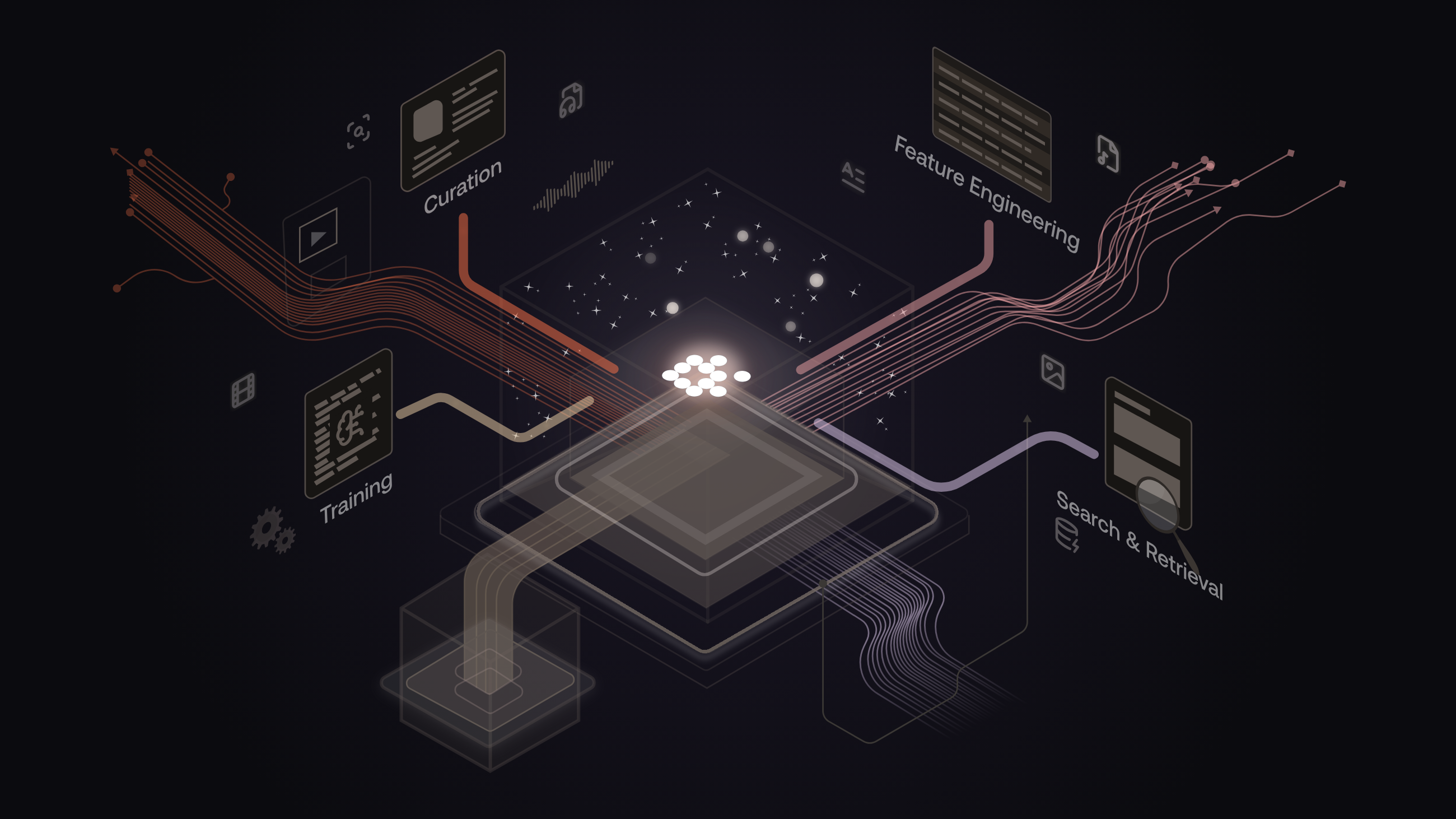
The concept of the "AI Lakehouse" is about collapsing these silos. Companies like Runway, Adobe, and NVIDIA are moving toward a model where the storage format itself—in this case, the Lance format—is optimized for both random access and analytical scans. This means you aren't making three copies of every data point. You have one source of truth that handles the vectors, the metadata, and the raw files simultaneously.
The Scale Problem is Getting Weird
It is easy to look at a 10x revenue growth or 120 million downloads and think it is just another hyped-up infrastructure play. But the numbers coming out of the actual deployments tell a different story. We are seeing clusters with over 8,000 GPUs training in parallel, hitting datasets with 100 billion rows and 40 billion vectors.
At that level, the standard tools we inherited from the web 2.0 era start to buckle. If your database takes three days to re-index after a schema change, you can't iterate. Founders need a system that treats a vector as a first-class citizen, not a bolt-on feature. The reason LanceDB is gaining traction isn't just because it's fast; it's because it's serverless and embedded. It removes the friction of managing yet another heavy server cluster.
The Shift from Specialized to Unified
A year ago, the consensus was that you needed a "Vector Database" as a standalone category. Every founder was told to go buy a dedicated tool just for embeddings. I’ve always been a bit skeptical of that. In the long run, databases tend to eat features. A vector is just another data type. If your main database can't handle vectors, you get a new database—you don't necessarily want two separate ones forever.
What we are seeing now is the maturation of that trend. The lakehouse model suggests that the storage layer should be smart enough to handle whatever you throw at it. Whether you are doing a SQL-style join on metadata or a cosine similarity search on a billion embeddings, it should happen in the same place. This reduces the "tax" that developers pay every time they want to ship a new feature.
What This Means for Founders
If you are in the early stages of building a multimodal app, the takeaway here is clear: stop over-complicating your stack. Every time you add a new database or a new sync service, you are adding a point of failure. The goal should be to keep your data as close to your compute as possible.
We are seeing a move away from the "managed service for everything" model toward high-performance, open-source formats that can run anywhere. This gives founders more control over their margins. When you are training on thousands of GPUs, the egress fees and the licensing costs of proprietary data silos can kill your unit economics. Moving to a unified format like Lance allows for better performance without the vendor lock-in that usually comes with high-scale infrastructure.
The Skeptic's Corner
While the growth here is impressive, we have to remember that infrastructure is a crowded space. Raising $100 million is a vote of confidence, but it also sets a massive bar for exit. For a lakehouse to truly win, it has to become the default standard for how AI data is stored, similar to how Parquet became the standard for data science.
The challenge for LanceDB and similar projects will be staying lean while supporting the massive demands of enterprise clients like Microsoft and Adobe. For the average builder, the benefit is the trickledown of these high-end optimizations. If a tool can handle 40 billion vectors for NVIDIA, it can probably handle your startup's workload with its eyes closed.
The Bottom Line
The era of the fragmented AI stack is ending. We are moving toward a world where data storage is unified, multimodal, and high-performance by default. If you are still managing separate silos for your blobs and your vectors, you are likely working harder than you need to. The money flowing into the lakehouse category is a signal that the plumbing is finally catching up to the models.
Read the original at Tomasz Tunguz →