In the tech world, we usually talk about things that are happening right now. We focus on the next sprint, the next patch, or the next round of funding. But in the crypto space, there is a recurring ghost that haunts every whitepaper and every security audit: the quantum threat. It is the theoretical day when computers become fast enough to tear through current encryption like a hot knife through butter.
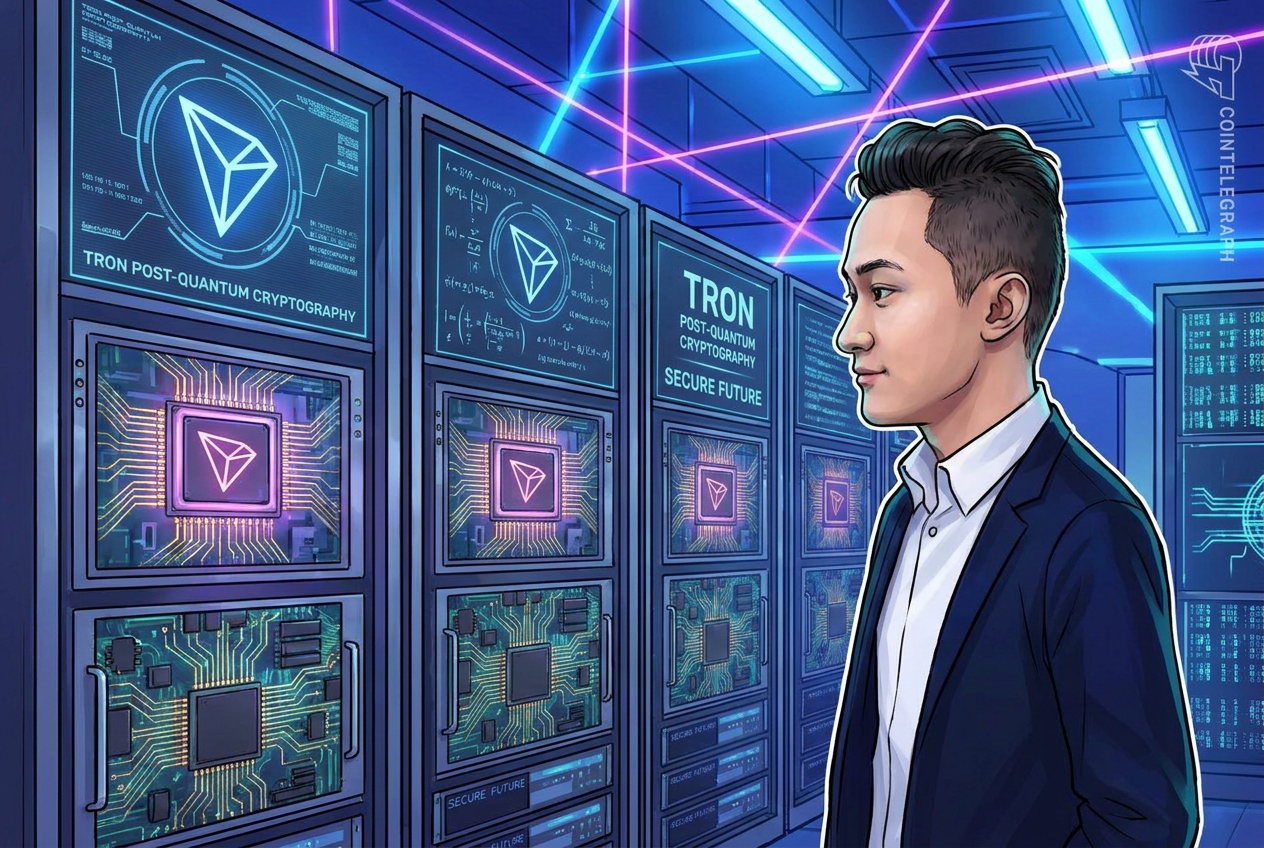
Justin Sun recently announced that Tron is moving to get ahead of this ghost. The network has officially launched its post-quantum cryptography (PQC) upgrade on the testnet. According to Sun, the system is essentially ready to go live on the mainnet whenever they decide to pull the trigger. It is a classic founder move—building a shield for a war that has not started yet, but one that could end the game for everyone if it does.
The Problem with Modern Keys
Most of the security we rely on today, whether it is Bitcoin, Ethereum, or Tron, relies on something called elliptic curve cryptography. It works because it is incredibly hard for a regular computer to work backward from a public address to find a private key. It would take a traditional supercomputer thousands of years to do it. The math is solid for today.
Quantum computers change the math. By using qubits instead of bits, these machines can process complex calculations in parallel. Shor’s algorithm, a mathematical shortcut that has been around for decades, proves that a sufficiently powerful quantum computer could crack standard crypto keys in minutes. If that happens, every wallet that hasn't migrated to a new standard becomes a sitting duck.
Right now, quantum computers that powerful do not exist. We are still in the noisy, experimental phase of quantum hardware. But the threat is what we call "harvest now, decrypt later." If someone captures encrypted data today, they can just hold onto it until the hardware catches up. For a blockchain founder, that is a massive liability hanging over the network’s longevity.
Building for the "What If"
Tron’s approach here is about future-proofing the plumbing. By putting PQC on the testnet, they are testing new signature schemes that are designed to be resistant to quantum attacks. These are usually based on lattice-based cryptography or other mathematical problems that even a quantum computer struggles to solve efficiently.
From a builder's perspective, this is not just about security; it is about infrastructure debt. Most founders wait until a problem is hitting their front door before they fix it. But when you are dealing with a protocol that secures billions in TVL, you cannot afford to be reactive. If you wait until a quantum computer is announced by a major nation-state or tech giant, it is already too late. You would be trying to migrate millions of users to new wallet addresses in a state of absolute panic.
Sun is positioning Tron as the network that does not want to have that panic. By launching on testnet, they are giving developers a chance to see how these larger, more complex keys affect transaction speeds and gas costs. Post-quantum signatures are notoriously larger than the ones we use now. That means more data on-chain, which means higher costs. Solving that trade-off is the real work happening on the testnet right now.
The Founder Skepticism
I always look at these announcements with a bit of a side-eye. Is this a critical technical milestone or a PR play to stay relevant in a fast-moving cycle? With Justin Sun, it is often a bit of both. Tron has built a massive ecosystem by being the king of stablecoin transfers, especially USDT. If people are using your network to move real value, you have to show them that their money is safe for the next decade, not just the next week.
However, we should be honest: we are nowhere near a "Quantum Apocalypse." Most experts estimate we are at least ten to twenty years away from a computer that can break a 256-bit ECDSA key. So, while Tron is "ready to bring resistance to mainnet at any time," there is no actual rush to do so. Doing it too early could actually bloat the network and make it less efficient for no immediate gain.
What This Means for Builders
If you are building on Tron, or any chain for that matter, this is a signal to start thinking about abstraction. The more your app relies on hard-coded signature logic, the harder it will be to migrate when the industry eventually moves to post-quantum standards. Modular security is going to be the name of the game.
- Key Management: Consider how your users will migrate keys in the future. Will they have to create entirely new wallets, or can your smart contracts handle a change in signature logic?
- Data Overhead: PQC signatures take up more space. If your business model relies on razor-thin margins on transaction fees, a shift to quantum-resistant standards could eat your profits.
- Long-term Trust: Using a network that is actively researching these threats is a selling point for enterprise clients who care more about 10-year security than 10-day price action.
The Takeaway
Tron’s testnet launch is a proactive step, but it is not a reason to rush out and change your entire roadmap today. It is a reminder that the underlying math of crypto is not permanent. As hardware evolves, the software must evolve faster. Sun is making sure Tron stays in the conversation of long-term viable chains by addressing a problem that is still over the horizon.
For founders, the lesson here is simple: build for today, but keep an eye on the math of tomorrow. You don't need to deploy a quantum shield this afternoon, but you should probably know where you put the blueprints for one. The networks that survive the next twenty years won't be the ones with the best marketing; they'll be the ones that didn't get their keys cracked by a machine we haven't even finished building yet.
Read the original at Cointelegraph →