The Dark Truth About Our Grid
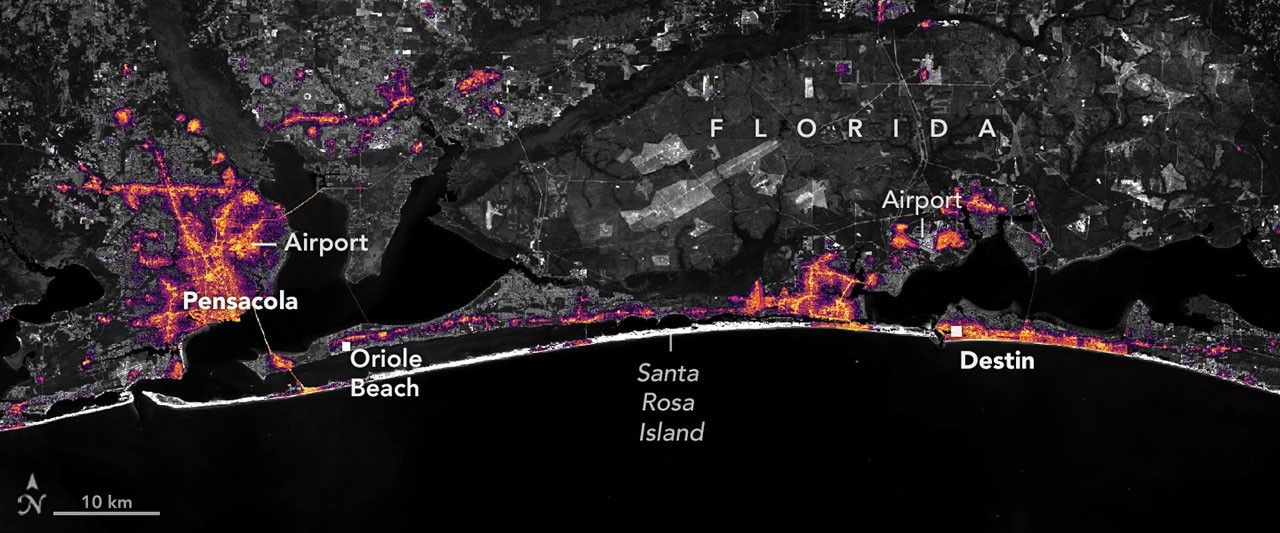
When Hurricane Isaias brushed the Florida Panhandle, the story most people saw was about wind speeds and rainfall totals. But for those of us looking at the intersection of infrastructure and technology, the real story was told in the dark. High-definition satellite imagery recently captured the literal dimming of the Gulf Coast, providing a stark visualization of power grid failure and recovery.
As a founder, I look at these images not just as disaster reports, but as a data-driven indictment of our centralized systems. When one node fails in a legacy power system, thousands of lives go dark. We talk about 'resilience' in crypto and AI all the time, but this is what the lack of resilience looks like in the physical world. It is a blackout that stays visible from space for days.
The Logistics of Recovery
The NASA data shows a rapid restoration of lights, which is a testament to the utility workers on the ground. However, the speed of recovery shouldn't distract us from the vulnerability of the initial failure. The process of getting the lights back on is still a manual, top-down operation. It involves dispatching trucks, physical inspections, and a lot of prayer that the primary substations hold up.
For builders in the AI and decentralized energy space, this is the problem statement. We are relying on 20th-century hardware to support a 21st-century digital economy. If you are building a data center or an AI training cluster in these regions, you aren't just fighting latency; you are fighting the weather and an aging wire.
Why This Matters for Decentralization
We often treat decentralization as a philosophical choice or a way to dodge regulators. But in the context of the Gulf Coast, it is a survival mechanism. Microgrids and decentralized energy resources (DERs) are the only way to ensure that a single storm doesn't wipe out the productivity of an entire region.
- Local Autonomy: Neighborhoods that can generate and store their own power don't need to wait for the state-wide grid to stabilize.
- Data Integrity: For those running nodes or hosting edge computing, power stability is the baseline. If the grid dims, your uptime dies.
- Visual Verification: The fact that we now use satellite imagery to confirm power restoration shows how little real-time data we actually have from the grid itself.
The Founder Perspective
If I am building a startup today, I am looking at this NASA data and asking: How do I make my stack weather-proof? We spend so much time worrying about cloud provider outages, yet we ignore the fact that the physical cable coming into the building is the weakest link.
There is a massive opportunity here for AI-driven load balancing. Imagine a grid that automatically reroutes power based on predictive storm tracking, or a localized AI that manages a community battery bank to keep critical infrastructure running when the main line goes dark. The technology exists; the implementation is what's lagging.
The biggest risk to our digital future isn't a bad algorithm—it's the physical reality of a fragile power line in a storm-prone world.
We need to stop looking at these satellite photos as 'interesting science' and start seeing them as a roadmap for where we need to build. Every dark patch on that map is a market opportunity for localized, resilient energy and communication tech.
The Real Cost of Downtime
In the tech world, we measure downtime in dollars per minute. In the real world, the Gulf Coast measures it in spoiled food, shuttered businesses, and safety risks. The NASA imagery from Isaias shows that while we are getting better at turning the lights back on, we are still far too good at letting them go out in the first place.
I am skeptical of any 'smart city' project that doesn't prioritize hardened, decentralized power. You can have all the 5G and AI-driven traffic lights you want, but if the grid dims every time a hurricane enters the Gulf, you have a decorative city, not a functional one.
The Takeaway for Builders
The lesson here is simple: Centralization is a single point of failure. Whether you are building an L2, an AI model, or a local business, you have to account for the physical fragility of the world. Use the data NASA provides to understand the risks of your geography. Don't wait for the utility company to modernize; build the redundancy you need into your own operations.
Isaias was a warning shot. The next one might not be so quick to flicker back to life. The builders who win in the next decade will be the ones who figure out how to keep the lights on when the rest of the world goes dark.
Read the original at NASA Breaking News →