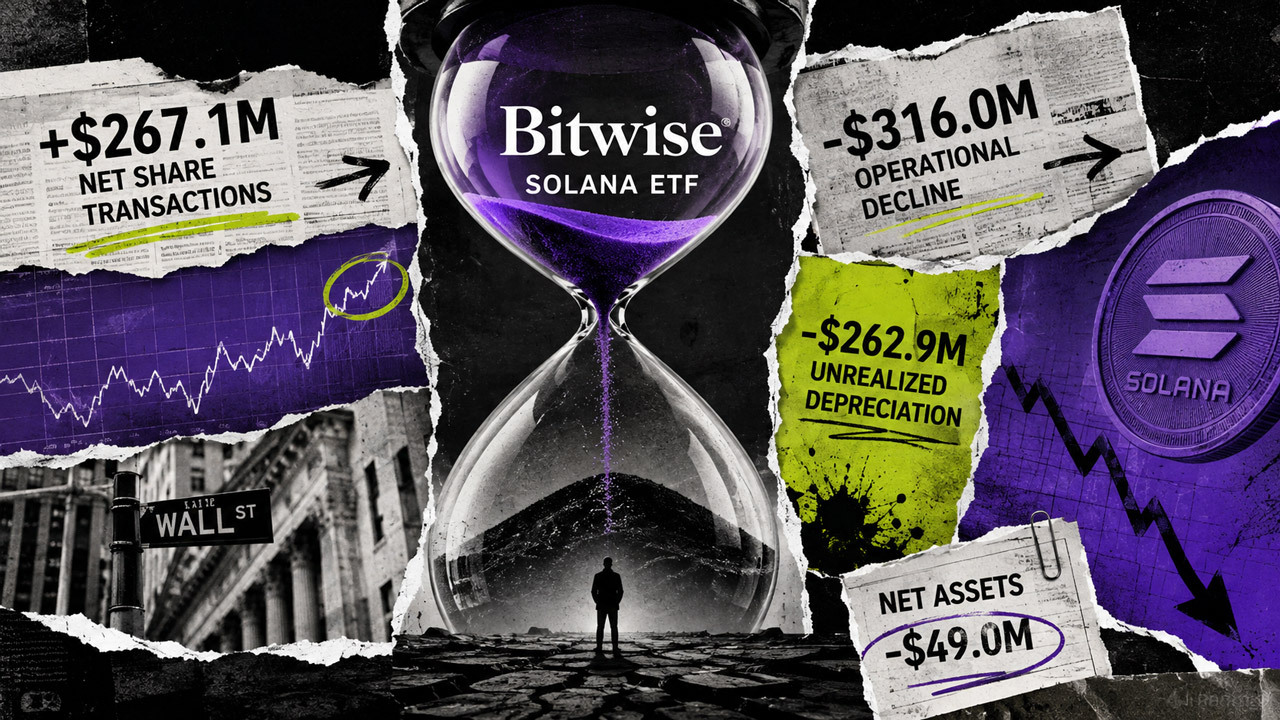
We have reached a strange inflection point in the crypto market. On one hand, institutional adoption is technically happening at a scale we couldn't have imagined three years ago. On the other hand, the numbers on the balance sheet aren't always telling a story of victory. A prime example is the Bitwise Solana ETF, which just became a case study in why inflows don't always equal growth.
The Math of a Zero-Sum Gain
Investors recently funneled $267 million into the Bitwise Solana ETF. That is a massive amount of capital by any standard. It shows that there is a genuine appetite for Solana among the Wall Street crowd. They want the exposure, they want the ticker symbol in their brokerage accounts, and they are willing to pay the fees to get it.
However, the timing was brutal. The market took a dive, and the depreciation of the underlying SOL tokens essentially wiped out the value of those inflows. We saw roughly $262.9 million in unrealized depreciation. When you add in the operational costs and the friction of managing a fund of this scale, the fund posted an operational loss of $316 million. In simple terms: people put money in, the market went down, and the fund is now worth less than the total capital contributed.
The Founder Perspective on Volatility
If you are building in this space, this shouldn't surprise you, but it should serve as a warning. We often look at "Institutional Inflows" as the holy grail of validation. We think that if the big funds buy in, the floor will rise and the volatility will subside. This data proves the opposite.
Wall Street isn't a stabilization force; it's a megaphone. When they pile into a volatile asset like Solana, they are amplifying the price action in both directions. For a founder, this means you cannot rely on ETF success as a proxy for ecosystem health. A fund can have record-breaking inflows and still be technically underwater due to the sheer velocity of crypto price swings.
Why the "Operational Loss" Matters
It is important to distinguish between a business failing and a fund losing value. Bitwise isn't going out of business because of this. These are "unrealized" losses, meaning as long as they don't sell the underlying assets at these prices, the value could theoretically bounce back. But for the builder, the takeaway is about liquidity and sentiment.
When retail investors see headlines that a fund "lost every cent" of its inflows, it triggers a specific kind of fear. It makes the asset class look like a trap. As someone who looks at the tech first, I find this frustrating. Solana's throughput, its developer activity, and its recent network upgrades are all moving in the right direction. Yet, the narrative is being driven by the P&L of a managed fund.
The Problem with Wrapped Exposure
The ETF structure is designed for convenience, not for maximizing the utility of the underlying tech. When you buy a Solana ETF, you aren't participating in the network. You aren't staking, you aren't using dApps, and you aren't contributing to the security of the chain. You are just betting on the price.
This creates a disconnect. We have $267 million in capital that is essentially sitting idle in a vault, doing nothing for the Solana economy other than providing price pressure. When the price drops, that capital provides no utility. For builders, this is the downside of the "Institutional Era." We are seeing a lot of money move into the space that has zero interest in the actual technology we are building.
What This Means for the Next 12 Months
Expect more of this. As more altcoins get the ETF treatment, we will see these massive swings where the "success" of the fund is completely detached from the amount of money coming into it. We are entering a phase of "Paper Crypto" dominance.
If you're a founder, my advice is to ignore the ETF inflow charts. They are a lagging indicator of interest and a leading indicator of nothing. The fact that $267 million was wiped out by a market correction doesn't mean Solana is failing; it means the market was overextended. Keep your head down and focus on the users who actually hold the tokens in a wallet, not the ones holding them in a 401k.
A Reality Check for Investors
For the average investor, this is a lesson in entry points. Just because a major firm like Bitwise launches a product doesn't mean it's the right time to buy. The prestige of the issuer does not protect you from the volatility of the asset.
We are seeing the institutionalization of the "buy the top" phenomenon. Large funds tend to launch products when interest is at a fever pitch, which is often exactly when the market is due for a correction. The $316 million operational loss is a loud, expensive reminder that in crypto, timing is everything, and the house doesn't always win.
Takeaway
Institutional interest is a double-edged sword. While $267 million in inflows proves that Solana is now a staple of the financial world, the subsequent losses prove that no amount of professional management can hedge against the inherent volatility of the crypto markets. Builders should focus on utility and on-chain metrics, as ETF inflows are clearly a volatile and unreliable metric for long-term ecosystem stability.
Read the original at CryptoSlate →