The Concentration Problem in DeFi Lending
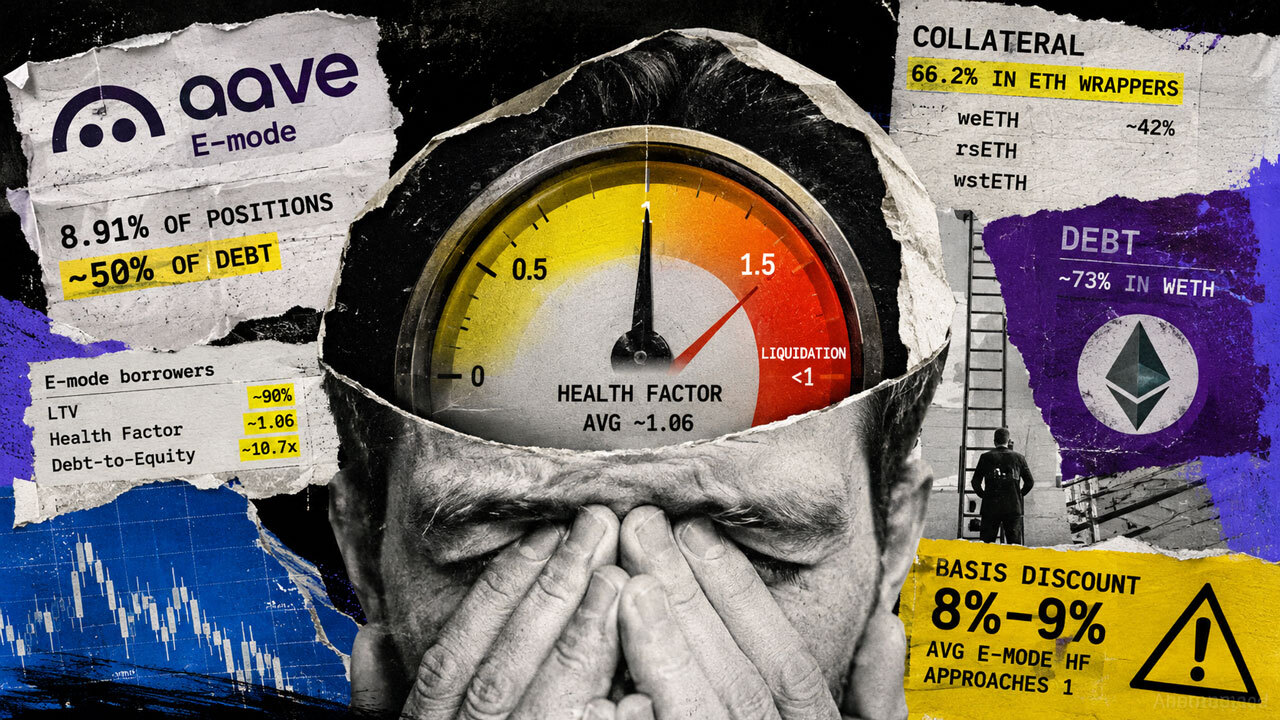
DeFi is often sold as a democratized financial landscape where thousands of small participants build a resilient, decentralized ecosystem. But a closer look at the numbers behind Aave V3 Core tells a different story. According to recent data from Galaxy, about half of the total debt on the protocol is held by less than 9% of the users. This isn't just a wealth gap; it's a structural concentration that builders need to pay attention to.
When we look at the 19,073 active loans on Aave, the vast majority are small-scale or conservative. However, the heavy lifting—the billions in capital flow that make Aave look like a titan—is coming from a very small group of traders using a very specific feature: E-mode.
Understanding the E-Mode Lever
For the uninitiated, E-mode (Efficiency Mode) allows users to borrow at much higher loan-to-value (LTV) ratios, provided the collateral and the borrowed asset are highly correlated. Think of it like a specialized lane on a highway designed for high-speed traffic. If you are depositing Lido Staked ETH (wstETH) and borrowing raw ETH, the protocol assumes the price risk is minimal because they are fundamentally the same asset.
This allows for massive leverage. The Galaxy data shows that these E-mode positions have a debt-weighted LTV of nearly 90%. In the world of traditional finance, that’s a razor-thin margin. In crypto, where volatility is the only constant, it’s a high-wire act. These 9% of positions aren't just using Aave as a savings account; they are using it as a sophisticated leverage engine for one specific trade: the Ethereum correlation play.
The Long ETH Strategy
The core of this activity revolves around liquid staking tokens (LSTs). Traders deposit their staked ETH, borrow more ETH, buy more staked ETH, and repeat. This "looping" strategy allows them to multiply the yield they get from Ethereum staking. It looks great on a spreadsheet when markets are sideways or up, but it creates a massive directional bet that the entire protocol is now carrying.
From a founder’s perspective, this is a double-edged sword. On one hand, it drives massive Total Value Locked (TVL) and fee generation. It makes the protocol look incredibly successful to outside investors. On the other hand, it creates a systemic risk where the protocol’s health is tied to the price stability of a single asset class and the performance of a few whales.
Why Builders Should Care
If you are building in the DeFi space, this concentration of debt serves as a reality check. We often talk about building for the "next billion users," but the current billion dollars is coming from a handful of sophisticated actors. This impacts how you should think about liquidity, risk management, and user interface design.
- Liquidity Depth: If these 9% of positions decide to deleverage simultaneously, the resulting liquidations could overwhelm the secondary markets for LSTs.
- Protocol Fragility: High LTV ratios mean there is very little room for error if the peg between staked ETH and ETH deviates even slightly.
- Regulatory Risk: Large, concentrated debt positions are easier targets for regulators looking to curb "systemic risk" in the crypto markets.
The Illusion of Decentralization
We need to be honest about what we are building. If half of a protocol’s utility is serving a small group of leverage-seekers, is it truly a broad-based financial utility? For Aave, the E-mode feature has successfully attracted capital, but it has also created a dependency. The protocol is effectively a giant mirror reflecting the Ethereum staking market.
This isn't necessarily a bad thing, but it is a specific thing. Founders building on top of Aave or competing with it need to realize that they aren't competing for 19,000 users. They are competing for the capital of the 9% who are actually moving the needle. It’s a B2B game played with retail branding.
Moving Toward Resilience
To move away from this concentration, DeFi protocols need to incentivize diversity in collateral and borrowing use cases. We need more "boring" use cases—people borrowing against assets to pay for real-world expenses, or businesses using DeFi for working capital. The current model is an echo chamber where ETH is used to buy more ETH to get more ETH.
As builders, we should be asking how we can create value that doesn't rely on the next leg up in a leverage cycle. If the Ethereum correlation trade ever unwinds violently, the protocols that survived will be the ones that didn't let their debt profiles become top-heavy.
The goal of DeFi was to remove single points of failure. If we replace a central bank with a protocol where 9% of the participants control 50% of the risk, we’ve just traded one type of concentration for another.
The Takeaway
Aave is a powerhouse, but its strength is currently concentrated in a high-leverage niche. For founders and developers, the lesson is clear: watch the debt, not just the TVL. Total Value Locked is a vanity metric if it’s built on a foundation of correlated leverage. True resilience comes from a diverse user base with uncorrelated risks. Until we reach that point, we are all just riding the waves of a few whales' ETH trades.
Read the original at CryptoSlate →