We have spent the last eighteen months listening to VCs and founders argue over the 'shovels' of the AI gold rush. The consensus used to be that the hardware layer was a race to the bottom, a commodity business where margins would eventually be squeezed out by competition. But recent disclosures from SpaceX and the team at DeepSeek tell a different story. We aren't looking at a commodity market; we are looking at a revenue ladder with wildly different rungs.
The Four Values of an H100
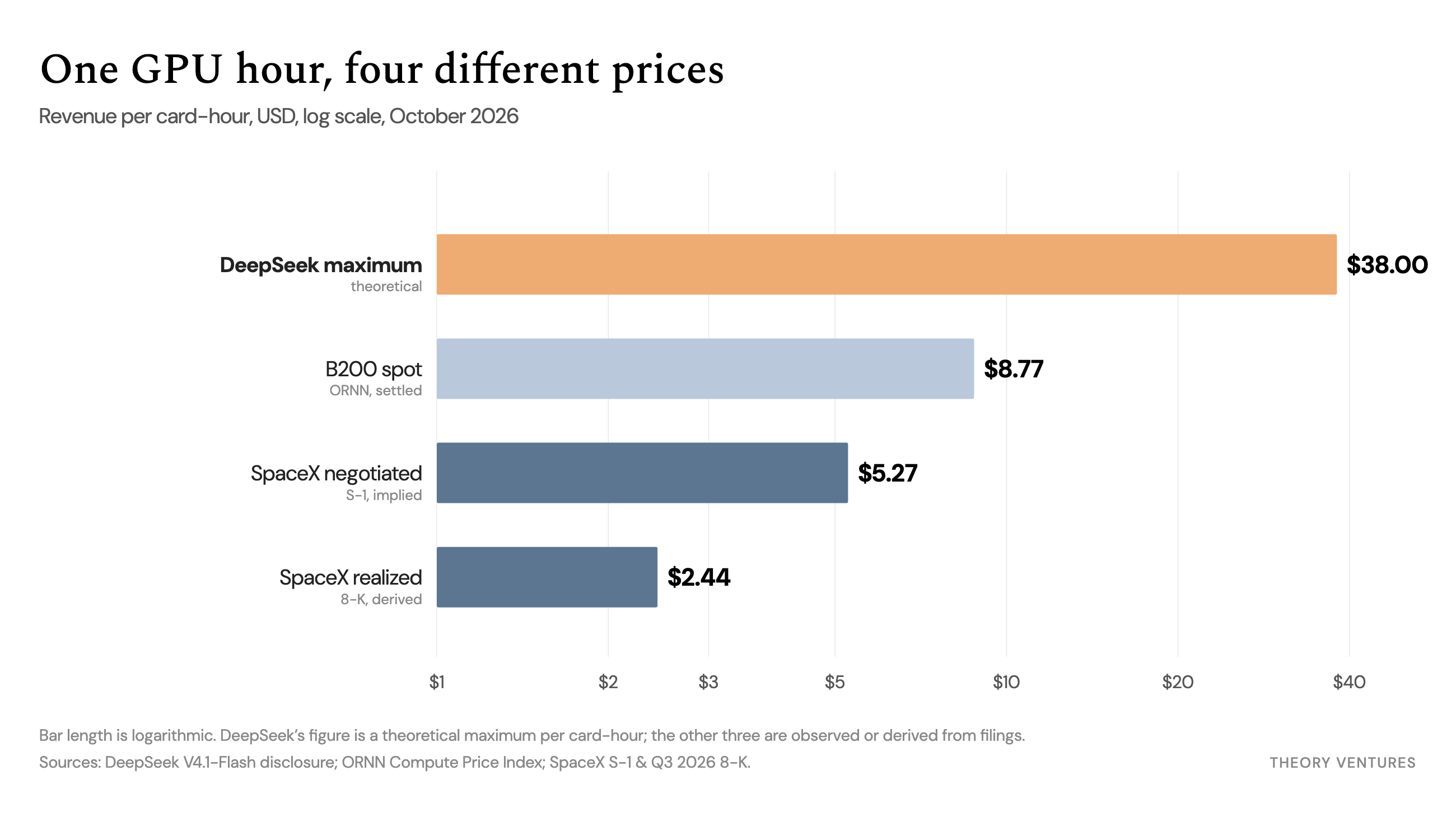
When you break down the math from these reports, you see four distinct ways to price a single GPU hour. At the top, you have the theoretical peak. DeepSeek’s inference disclosure suggests a maximum value of roughly $38 per hour. This is the 'dream' scenario—perfect utilization, high-value tasks, and zero waste. It is a number that looks great in a pitch deck but rarely survives contact with reality.
Then you have the standard rental market. If you go to a cloud provider today, you are likely paying between $4 and $5 per hour for an H100. This is the baseline for most startups. It’s expensive, but it’s accessible. However, the most interesting number comes from SpaceX’s third-quarter filings, which show a realized revenue of $2.44 per hour. This is the 'real world' price—the actual cash hitting the bank after accounting for idle time, maintenance, and technical debt.
Even at that lower $2.44 figure, the economics are staggering. When you factor in the cost of the hardware, the electricity, and the data center space, the math suggests a payback period of less than a year. In the world of physical infrastructure, that is unheard of. If you build a bridge or a power plant, you hope to break even in a decade. If you build a GPU cluster, you are playing with house money by month eleven.
The Scarcity Trap
The common argument against this level of profitability is that supply will eventually catch up and crush the price. In a normal market, that’s exactly what happens. But the AI hardware market isn't normal. The 2027 supply pipeline for these chips and the facilities to house them is largely unbuilt. We are talking about massive power requirements that the current electrical grid isn't ready to handle.
For builders, this means the 'cheap compute' era is a myth. We aren't going to see a 90% drop in inference costs because the demand for that compute is scaling faster than the ability to forge the silicon. If you are building a wrapper or a thin application layer, you are at the mercy of this ladder. You are paying the $4.50 retail price while the big players are realizing $2.44 costs on their own metal.
Why Utilization is the Only Metric That Matters
The gap between DeepSeek’s $38 theoretical max and SpaceX’s $2.44 realized revenue is where the winners will be decided. This is the 'utilization gap.' Most AI startups are incredibly inefficient with their compute. They over-provision, they fail to optimize their models for specific hardware, and they treat GPU time like an infinite resource because they have VC cash to burn.
As a founder, your goal shouldn't just be to build a better model. It should be to bridge that gap. If you can get your realized value up to $5 or $10 per hour through better orchestration or specialized inference, you aren't just a software company anymore—you’re an infrastructure arbitrage machine. You are buying a commodity and selling a high-value result, and that is where the real margin lives.
The Founder Perspective
I’ve seen a lot of cycles where 'infrastructure' was a dirty word. Software was supposed to have 90% margins, and hardware was for suckers. But in the AI era, the hardware is the moat. If you don't own your compute or have a highly optimized way to use it, you don't own your business. You are just a tenant in someone else's data center, paying their mortgage and then some.
We need to stop looking at H100s as a cost of doing business and start looking at them as the primary revenue generator. SpaceX isn't just a rocket company anymore; they are a compute provider that happens to have a very efficient way to deploy assets. They understand that the ladder has room to grow. As more enterprises move from 'experimenting' with AI to 'deploying' AI, the demand for reliable, large-scale inference will only push these prices higher.
The 2027 supply pipeline is a ghost town. If you think compute is expensive now, wait until every Fortune 500 company tries to move their entire workflow onto the chain.
The takeaway for builders is simple but harsh: stop ignoring the bill. If your business model relies on GPU prices dropping significantly in the next three years, you are building on sand. The data shows that even at 'low' realized prices, the people owning the hardware are winning. You either need to own the metal, or you need to be so efficient that the price of the metal doesn't matter. There is no middle ground left on the ladder.
Read the original at Tomasz Tunguz →