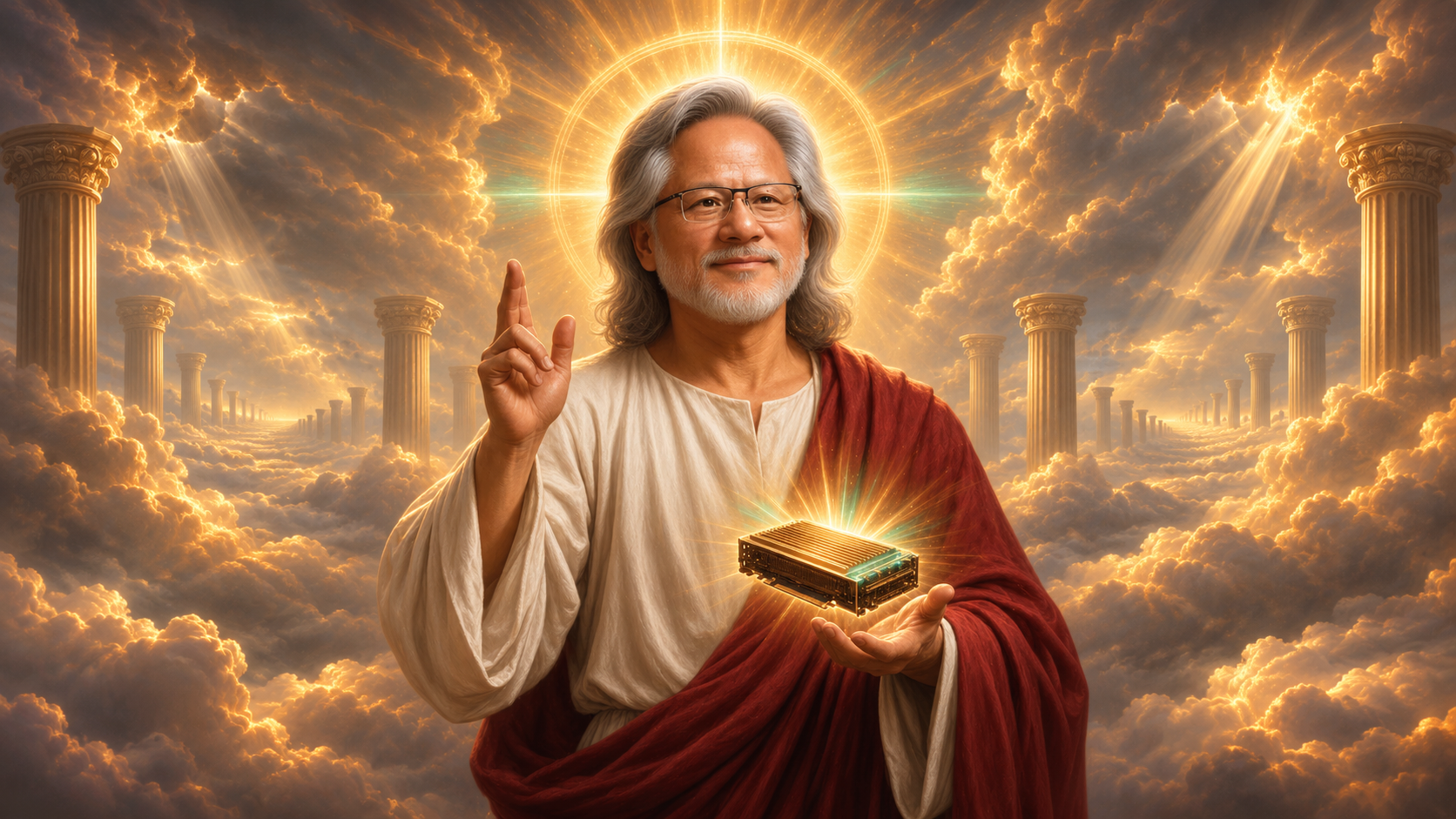
The tech industry doesn't do quiet returns. When Jensen Huang stepped back into the captain's chair at Nvidia this week, the internet didn't just notice; it exploded. The man they call 'GPU Jesus' is back, and the optics surrounding his return tell us more about the current state of the AI arms race than any quarterly earnings report ever could.
The Cult of the Leather Jacket
We have reached a strange inflection point in technology where CEOs are treated like professional wrestlers. The memes flooding social media aren't just jokes; they are signals of tribalism in the builder community. For anyone actually building in AI, Jensen isn't just a corporate executive. He is the guy who controls the silicon. If you want to train a model, you need his hardware. This dependency has turned a hardware manufacturer into a deity-like figure for developers who are tired of cloud constraints.
The 'GPU Jesus' moniker is funny, but it’s also a bit dark. It highlights a massive bottleneck. We are all living in a world where the speed of innovation is dictated by how many H100s or B200s one company can pump out of its factories. His return reinforces the idea that Nvidia isn't just a component of the AI revolution—it is the foundation.
The Villain Arc: Anthropic and the Competitive Friction
Every hero story needs a foil, and the internet has decided that Anthropic’s Dario Amodei fits the bill for this particular cycle. While Jensen is being painted as the savior of compute, the memes have cast Amodei as the skeptical antagonist. This isn't necessarily based on personal animosity, but rather on the diverging philosophies of how AI should be built and regulated.
As builders, we see this play out in real-time. On one side, you have the 'more compute, more power' camp led by Nvidia's hardware. On the other, you have the safety-first, alignment-heavy approach often associated with Anthropic. The friction between these two ideologies is where the real work happens. When the memes pit these two against each other, they are really talking about the tension between raw scaling and controlled deployment.
Why Builders Should Care About the Hype
It is easy to dismiss the 'meme parade' as fluff. But if you are a founder, you need to look at what these memes are actually celebrating: availability. The excitement around Jensen's return is rooted in the hope that Nvidia will continue to push the boundaries of what is possible at the edge and in the data center.
- Compute as Currency: In 2024, compute is more valuable than cash for many startups. Jensen’s leadership style has historically favored aggressive production cycles.
- Software Integration: Nvidia isn't just a chip company anymore. Their CUDA platform is the moat. Jensen’s return ensures that the roadmap for software-hardware integration remains tight.
- The Talent Magnet: Engineers want to work where the legends are. This comeback stabilizes Nvidia’s internal culture, which is essential for maintaining their lead over competitors like AMD or Intel.
The Skeptical Founder's View
Let’s be honest for a second. The deification of CEOs is usually a red flag. We saw it with Elon, we saw it with Sam Altman during the OpenAI board saga, and now we are seeing it with Jensen. As a builder, you should be wary of any ecosystem that relies too heavily on a single personality or a single supplier.
The moment we stop looking at the benchmarks and start looking at the leather jacket is the moment we lose our edge as objective engineers.
Nvidia’s dominance is impressive, but it’s also a single point of failure for the entire industry. If the 'GPU Jesus' narrative keeps growing, it masks the real issues we face: high energy costs, supply chain fragility, and the lack of viable alternatives for high-end training. We shouldn't be celebrating the return of a leader as much as we should be asking when the market will become competitive enough that one man's career moves don't move the entire needle of human progress.
The WWE of Tech
The involvement of Hollywood and the WWE in the discourse around this comeback isn't a coincidence. Tech has become entertainment. When Nvidia's market cap rivals the GDP of entire nations, the CEO becomes a global celebrity. For those of us in the trenches writing code and deploying agents, this celebrity status is a double-edged sword. It brings investment and attention to the space, but it also creates a lot of noise that doesn't help us ship better products.
We need to separate the 'meme-ified' version of Nvidia from the actual hardware we are buying. The hype is at an all-time high, and while Jensen is a visionary, he’s still a CEO who needs to answer to shareholders and navigate a complex geopolitical landscape regarding chip exports. The memes don't show the struggle of the supply chain or the yield issues at the foundries.
The Takeaway for the Rest of Us
Jensen Huang is back, and the market is happy. But for the builders, the mission hasn't changed. Whether it’s 'GPU Jesus' or anyone else at the helm, our job is to find the most efficient way to turn electricity into intelligence.
Don't get distracted by the parade. Use the hardware, respect the engineering, but keep your eyes on the decentralization of compute. The goal shouldn't be to worship the provider; the goal is to build something so good that the hardware it runs on becomes secondary.
Read the original at Decrypt →