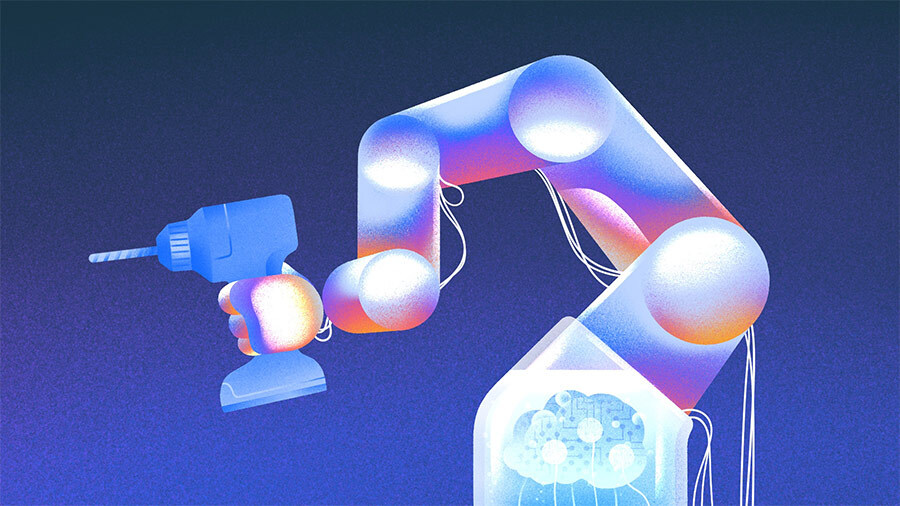
The Massive Bet on Imitation Learning
In the world of hardware, we usually see incremental progress. A sensor gets slightly better, a motor gets a bit more efficient, or a battery lasts another ten minutes. But Genesis AI just signaled that the next era of industrial labor isn't about the hardware at all. By securing $500 million in Series A funding at a $3.5 billion valuation, they are putting a very expensive flag in the ground for a concept known as imitation learning.
If you have spent any time in a modern warehouse, you know that robots are already there. But they are rigid. They follow pre-programmed paths and struggle the moment a box is slightly out of place or a human walks into their lane unexpectedly. Genesis is trying to bridge that gap by teaching robots to move the way we do. Not by coding every joint movement, but by feeding them data of humans performing physical tasks. It is a software-first approach to a hardware problem, and the venture capital world is clearly all-in on the shift.
Why the Valuation Feels Like a Fever Dream
Let’s be honest about the numbers. A $3.5 billion valuation for a Series A company is objectively wild. We are seeing a spillover from the generative AI boom, where investors are terrified of missing the next foundational layer. In this case, the foundation isn't a large language model; it is a large behavior model. The theory is that if you can own the data set for how a human picks up a crate or sorts a heavy pallet, you own the operating system for every factory on the planet.
But for those of us building in this space, we have to look past the shiny $500 million figure. This kind of capital brings immense pressure. Genesis isn't just competing against other startups; they are competing against the physics of the real world. A robot that learns from human movement still needs to operate at a scale and speed that makes economic sense for a factory manager. If the "learned" movement is too slow or the compute power required to run the model is too high, the hardware remains a desk ornament.
The Shift From Programmed to Taught
For decades, robotics was a field of precise mathematics. You calculated the exact torque and trajectory. Genesis is moving us toward a future where we simply show the machine what to do. This mimics how we’ve seen AI evolve in other sectors. We stopped trying to teach computers the rules of grammar and started showing them billions of pages of text until they understood the patterns. Genesis is doing this with kinetic energy.
This is a significant pivot for builders. If you are developing tools for the industrial sector, the focus is shifting away from "hard-coded" solutions and toward data acquisition. The winner in the robotics race won't necessarily have the best hydraulic arm; they will have the most diverse and high-quality library of human physical data. That is what this $500 million is actually buying: the ability to ingest and process human labor as a data stream.
What This Means for the Founder Community
If you are a founder looking at this deal, don't get distracted by the nine-figure check. Instead, look at the infrastructure required to make this work. Genesis needs massive amounts of video data, motion capture, and edge computing to process these movements in real-time. There is a massive secondary market forming around the support systems for these behavior models.
We also need to consider the "trust gap." Factory owners are notoriously conservative. They care about uptime and safety above all else. A robot that learns by imitation is, by definition, less predictable than one that follows a hard-coded script. The challenge for Genesis—and any builder following in their footsteps—is proving that a machine learning from a human won't also pick up human errors or unpredictable quirks that lead to downtime.
The Skeptic's Corner
I’ve seen plenty of "revolutionary" robotics companies burn through hundreds of millions only to realize that the real world is much messier than a lab. A warehouse floor is dusty, the lighting changes, and floors are rarely perfectly level. Imitation learning is brilliant in a controlled environment, but it has to survive the chaos of a 24-hour shipping hub.
The valuation also assumes that this technology will scale horizontally across every industry. But picking up a fragile electronic component is fundamentally different from moving a heavy engine block. Can one model really learn both, or are we looking at a future where specialized models are required for every niche? If it's the latter, the $3.5 billion price tag might be a bit premature.
The Reality of Labor Displacement
We can't talk about Genesis AI without talking about the work they are automating. This isn't just about making things faster; it's about replacing human roles that are physically taxing and often dangerous. From a founder's perspective, this is a massive opportunity to solve the labor shortage issues that have plagued the logistics industry for years. From a societal perspective, it is a reminder that the physical world is no longer a safe haven from the reach of artificial intelligence.
The goal for Genesis is to make these robots as ubiquitous as the forklift. To get there, they have to prove that their models can adapt to new environments without months of retraining. That is the holy grail of robotics: generalized physical intelligence.
Final Takeaway for Builders
The Genesis AI raise is a massive bet on the digitization of physical movement. For builders, the takeaway is clear: the value is moving up the stack. Don't just build a better tool; build a way to capture the data that makes the tool smarter. Whether Genesis succeeds or fails, they have validated the idea that the next generation of industrial power will be built on human-imitation software, not just better gears and motors. Keep your eye on the data sets, because that is where the real moat is being dug.
Read the original at Crunchbase News →