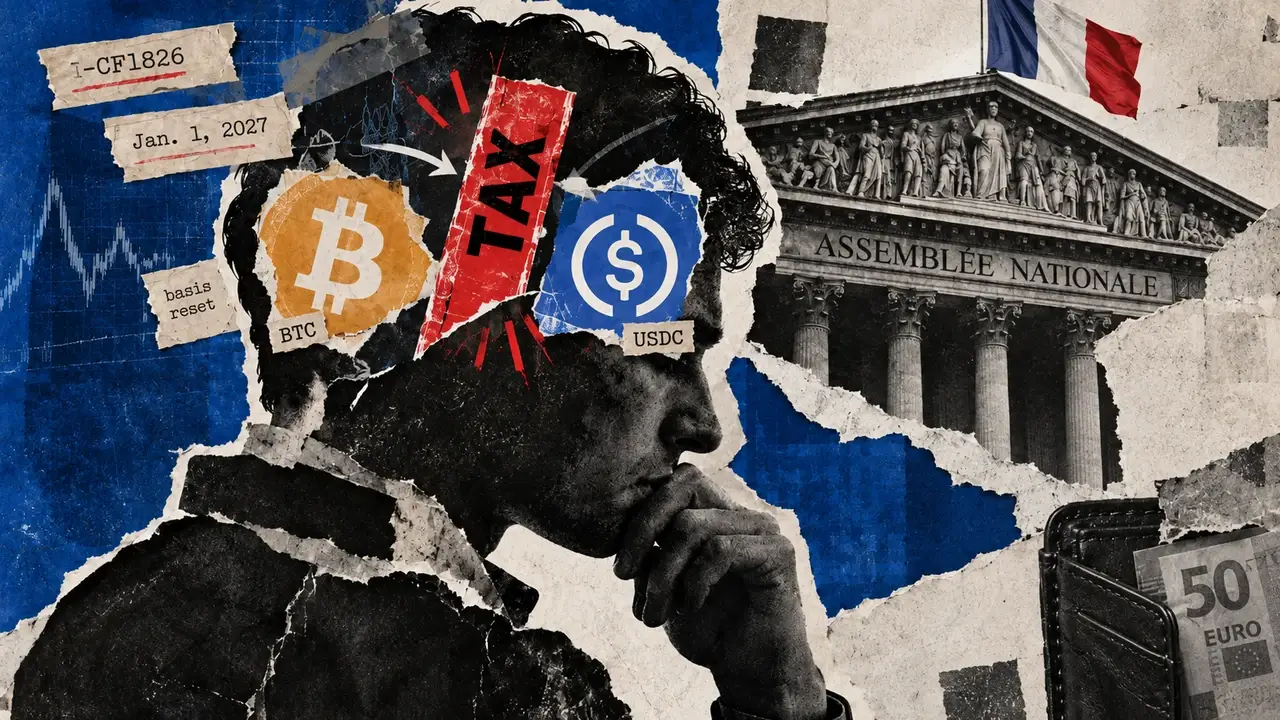
The End of the Stablecoin Safe Harbor
For years, the crypto industry has operated under a semi-official truce with tax authorities in several European jurisdictions. You could trade Bitcoin for USDC, or Ethereum for a stablecoin, and as long as you didn't touch 'real' money—fiat currency—you didn't owe the government a cut. It was a closed loop that allowed builders and traders to rebalance their portfolios without the friction of a tax event. That era is coming to a close in France.
A new amendment approved by the French National Assembly’s finance committee is looking to strip away this deferral. If this becomes law, swapping your volatile crypto assets for e-money tokens like USDC or EURC will be treated exactly like cashing out to a bank account. For anyone building in this space, this isn't just a change in accounting; it is a fundamental shift in how capital flows through the ecosystem.
Understanding the Shift in Basis
The proposal doesn't just stop at taxing the swap. It changes the math behind how your gains are calculated. Traditionally, many jurisdictions look at the total value of your portfolio to determine the 'cost basis' of the coins you sell. The new French proposal suggests a shift toward using the specific acquisition price of the assets being traded. While this sounds like a technicality, it can significantly increase the immediate tax liability for long-term holders who are just trying to move into a stable position during market volatility.
The logic from the regulators is simple: stablecoins, especially those compliant with the Markets in Crypto-Assets (MiCA) regulation, are increasingly seen as functional equivalents to cash. If a token is stable, regulated, and pegged to a sovereign currency, the French government argues that moving into that token is, for all intents and purposes, a realization of profit.
What This Means for Founders and Builders
If you are a founder running a treasury or a developer receiving grants in crypto, this creates a massive liquidity problem. Until now, you could move into a stablecoin to protect your runway during a market crash without losing 30% of that runway to the tax man instantly. Under these new rules, the simple act of 'de-risking' becomes a taxable event.
This forces builders to make a difficult choice: stay in volatile assets and risk their project's survival on market swings, or move to stables and take an immediate haircut on their capital. For a startup, that 20% to 30% difference in capital can be the difference between six months of development and a total shutdown.
The MiCA Paradox
There is a certain irony here. The MiCA framework was designed to bring clarity and legitimacy to the European crypto market. It created a category for 'e-money tokens' (EMTs) that are highly regulated and backed by reserves. But that very legitimacy is what is now being used to justify taxing them like cash.
By following the rules and using MiCA-compliant stables, French users are essentially raising their hands and admitting they are holding a cash equivalent. The regulators are effectively saying: if it looks like cash and acts like cash, we are going to tax it like cash.
The Operational Burden
Beyond the actual cost of the tax, the administrative burden here is a nightmare. Most crypto accounting software is still catching up to complex multi-chain environments. If every single swap to a stablecoin requires a calculated gain or loss based on a new acquisition basis, the cost of compliance for a small fund or a solo developer goes through the roof. You will likely spend more time in a spreadsheet than in a code editor.
Short-Term vs. Long-Term Impacts
In the short term, we might see a flight of capital away from French-regulated entities or a hesitance to use MiCA-compliant stablecoins in favor of more decentralized, non-compliant alternatives. This is likely the opposite of what the French government wants, but it is the natural result of high-friction tax policies.
In the long term, this sets a precedent for the rest of the EU. France is often a bellwether for European financial policy. If this amendment sticks, expect to see similar moves in Germany, Italy, and beyond. The 'closed loop' of crypto is being pried open by tax authorities who are hungry for revenue and tired of waiting for users to exit back to the traditional banking system.
The Founder's Takeaway
If you are operating in France or the EU, the 'wait and see' approach to tax compliance is officially over. You need to look at your treasury management through a new lens. Stablecoins can no longer be viewed as a tax-neutral safe haven. They are now a realization event.
Builders should start preparing for a more aggressive tax environment by keeping more granular records and perhaps reconsidering their legal jurisdictions if their business model relies on frequent rebalancing. The era of the tax-free crypto-to-crypto swap was a gift that we all knew wouldn't last forever, but seeing it end in one of Europe's most prominent tech hubs is a wake-up call for the entire industry.
Read the original at CryptoSlate →