The Anatomy of a Hype Cycle
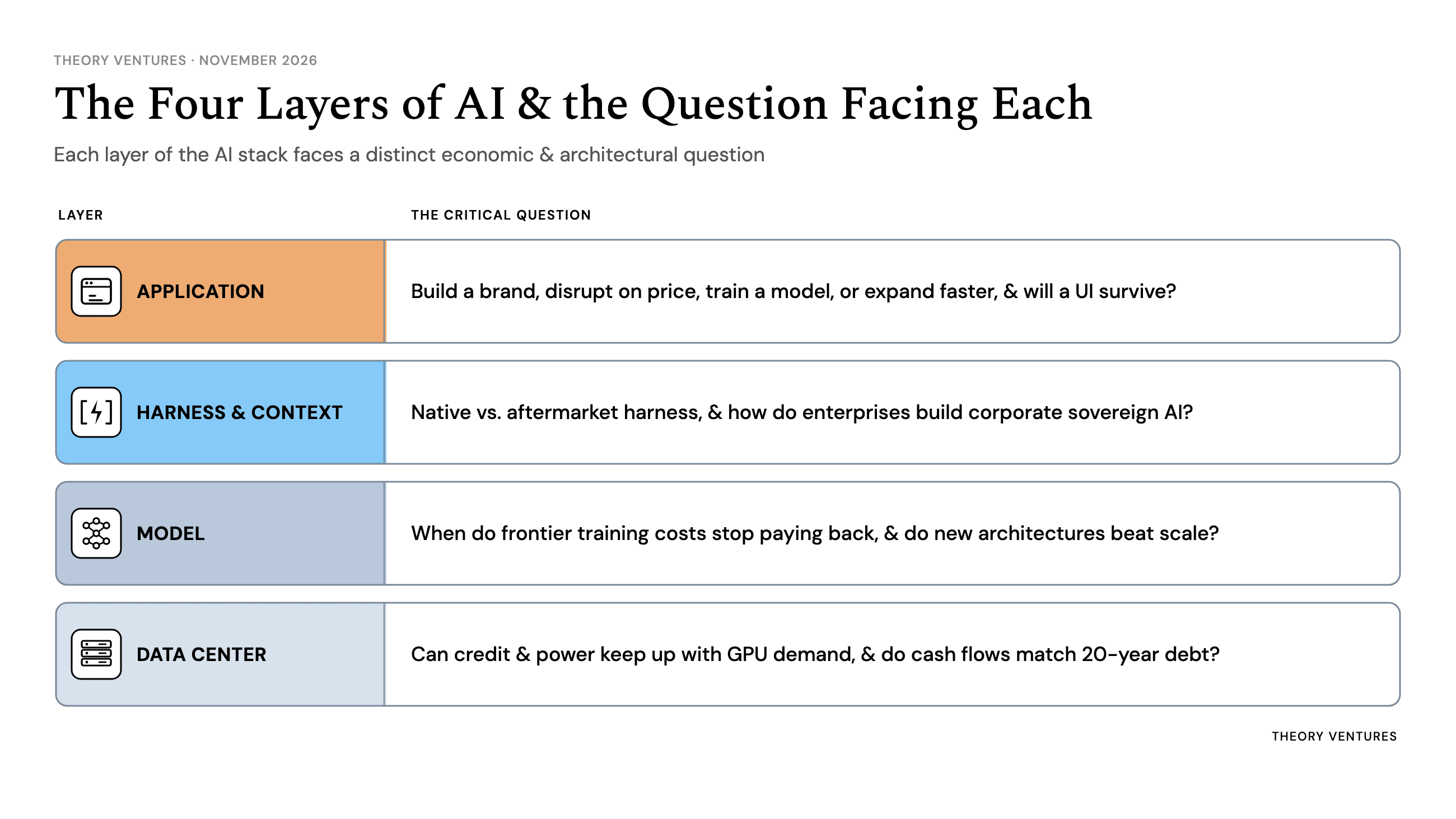
Everyone is talking about the AI revolution, but few are talking about the plumbing. If you look past the flashy demos and the Twitter threads, the industry is actually just a four-story building. Each floor has a different tenant, and right now, all of them are worried about the rent. As a founder, you have to decide which floor you want to live on, because the economics of the basement are vastly different from the penthouse.
We are currently witnessing a massive capital reallocation. The money is flowing into data centers, flowing through models, and eventually trickling down to applications. But there are unresolved questions at every level. If you don't understand how these layers interact, you’re just gambling on a trend. Here is how the stack actually breaks down from the ground up.
The Basement: Data Centers and the GPU Tax
The foundation of everything is the data center. This is where the physical reality of AI hits the road. We aren't just talking about cloud storage anymore; we are talking about massive clusters of H100s and the electricity required to keep them from melting. The economic question here is simple but terrifying: how do we finance this?
In the SaaS era, you could scale on a credit card or a modest seed round. In the AI era, the entry fee for the infrastructure layer is billions of dollars. Because the cost of GPUs is so high, the cost of capital becomes the primary bottleneck. If interest rates stay high, the cost of building these digital cathedrals becomes prohibitive for anyone but the hyperscalers. For builders, this means you are tethered to the pricing whims of a few massive providers. The basement is crowded, expensive, and owned by landlords who aren't afraid to raise the rent.
The Engine Room: The Model Layer
Above the hardware sits the model. This is where the magic happens, but it’s also where the most brutal competition lives. The big question here is whether these models will become commodities. We’re seeing a race to the bottom in terms of pricing, while the cost to train the next generation of frontier models doubles every few months.
If a model from an open-source community can perform at 90% of the level of a proprietary model from a billion-dollar lab, the economic moat of the lab starts to look like a puddle. For founders, the lesson is clear: don't bet your entire company on a single model's unique capabilities. Those capabilities will be standard features across every model within six months. The model is the engine, but you don't win a race just by having a good engine anymore.
The Control Room: Harness and Context
This is the layer I find most interesting for founders. The 'harness' is everything that surrounds the model—the RAG (Retrieval-Augmented Generation) pipelines, the prompt engineering, the vector databases, and the fine-tuning logic. It is the layer that turns a general-purpose AI into something that actually works for a specific business.
The economic question here is about efficiency. As GPU costs rise, the value of the harness increases. If you can build a harness that allows a smaller, cheaper model to perform as well as a massive, expensive one, you’ve created real value. This is where 'co-design' comes in. By optimizing how the model interacts with the specific context of a user’s data, you can serve more people with the same amount of hardware. This is the only layer where you can truly engineer your way out of high infrastructure costs.
The Penthouse: The Application Layer
Finally, we have the application. This is what the user actually sees. The question here is one of retention and 'moats.' If your application is just a thin wrapper around a prompt, you don't have a business; you have a feature that someone else will integrate into a platform next Tuesday.
The application layer is struggling with the 'incumbent advantage.' In the early days of mobile, startups had the edge because big companies were slow to adapt. In AI, Microsoft, Google, and Adobe are moving faster than the startups. They already have the distribution. To win here, you have to find a workflow that is so specific and so painful that a general-purpose tool can't solve it. You need to own the data and the user's daily habit, not just the AI output.
The Interplay: Why It Matters for Builders
These layers don't exist in isolation. They are constantly pushing and pulling on each other. When the cost of financing a data center goes up, the engineers in the harness layer have to work twice as hard to optimize inference. When a new model comes out that is 10x more efficient, it suddenly makes a whole new class of applications economically viable.
The most successful founders I’m seeing right now are the ones who understand 'inference co-design.' They aren't just calling an API; they are thinking about how to squeeze every bit of utility out of the hardware. They are building systems where the harness and the model work in tandem to reduce the load on the data center. This isn't just a technical trick; it's a financial necessity.
The Takeaway for Founders
If you are building in the AI space today, you need to stop thinking about 'AI' as a singular thing. You are building in a stack. If you’re at the application layer, your biggest threat isn't other startups—it's the model providers moving up the stack and the hardware providers raising costs.
The winners won't be the ones with the flashiest LLM. The winners will be the ones who build the best harness for specific, high-value contexts. They will be the ones who figure out how to provide the most value while consuming the least amount of GPU time. In a world where compute is the new oil, efficiency isn't just a goal—it’s the only way to survive.
The real innovation isn't just in the model; it's in how we bridge the gap between expensive hardware and actual human utility.
Stop chasing the hype of the model layer unless you have a sovereign wealth fund backing you. Focus on the harness. Build the logic that makes the expensive stuff work cheaper and better. That’s where the actual equity is going to be built in the next five years.
Read the original at Tomasz Tunguz →