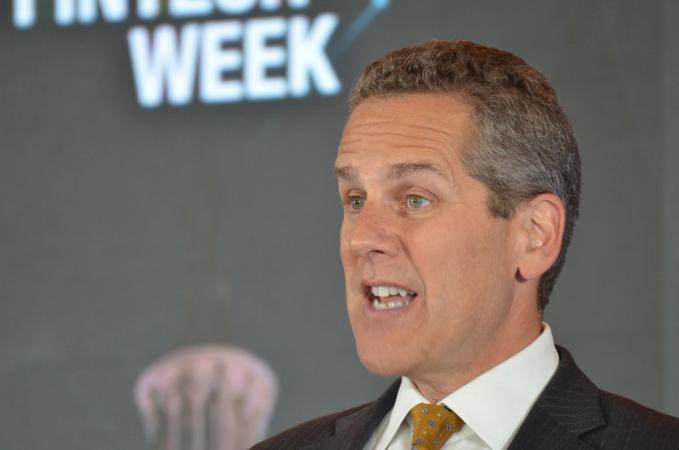
We have spent the last decade building systems designed to move money at the speed of light. Now, the regulators are finally waking up to the reality that those same systems might move money faster than the banks can actually handle it. Federal Reserve Vice Chair for Supervision Michael Barr recently shared some thoughts in Italy that should serve as a cold shower for anyone building in the automated finance space.
The core of the issue isn't just that AI is smart; it's that AI is fast. Barr is sounding the alarm on a future where AI agents, programmed to protect a user's capital, could trigger a bank run in minutes. Not days, not hours. Minutes.
The End of the Human Buffer
In the old days, a bank run had a physical limit. You had to wait for the branch to open. You had to stand in a line. Even with the advent of mobile banking apps, there was still a human "latency" involved. A human has to read the news, feel the panic, open the app, and click the button. That friction provided a buffer, a tiny window for regulators or bank executives to issue statements, stabilize the situation, or halt trading.
AI agents remove that friction entirely. If an autonomous agent is programmed to monitor a bank's balance sheet or social sentiment, and it detects a 5% drop in liquidity, it doesn't wait for a human to wake up. It executes the withdrawal immediately. When thousands of agents do this simultaneously, the bank isn't just failing; it is vanishing before the Fed can even get a pot of coffee started.
Why Builders Should Care
If you are building in the DeFi space or working on AI-driven treasury management, this isn't just a regulatory hurdle. It is a fundamental architecture problem. Barr’s warning highlights that we are moving toward a "high-frequency" financial system where the traditional safeguards—like deposit insurance or the discount window—might be too slow to matter.
- Liquidity is the new security: In an AI-driven world, your code can be perfect, but if the underlying liquidity can vanish in 60 seconds, your protocol is a ghost town.
- Systemic Synchronization: Most AI agents will likely use the same few large language models or market data feeds. This creates a herd mentality that is baked into the code. If one agent decides to exit, they all might.
- The Bypass Problem: Barr also mentioned concerns about AI systems bypassing traditional security controls. This isn't necessarily about hacking; it's about the ability of AI to find loopholes in how banks process large-scale automated transactions.
The Regulatory Blowback
When the Fed starts talking about AI agents as a systemic risk, you can bet that the next wave of compliance is going to be heavy. We are looking at a future where "know your customer" (KYC) might evolve into "know your agent." Regulators will likely demand kill switches or speed limits on automated withdrawals.
For founders, this means the era of "move fast and break things" in financial tech is hitting a wall of physics. You can't break the banking system and expect the Fed to just stand by. If your startup relies on the ability to move massive amounts of capital autonomously, you need to start thinking about how to prove to regulators that your agents won't contribute to a cascade failure.
The Skeptic's View
Barr’s concerns are valid, but there is also a bit of the old guard protecting the status quo here. The traditional banking system is built on fractional reserves—it relies on the fact that not everyone wants their money at once. AI exposes the fragility of that lie. Instead of blaming the AI for being too fast, maybe we should be looking at why the banks are too slow to keep up with modern technology.
However, we have to be realistic. We aren't going to get a full-reserve banking system overnight. We are going to get more rules. If you are building an AI agent for finance, you should be preparing for audits that look at your decision-making logic, not just your balance sheet.
The speed of light is a feature for the user, but a bug for the central banker.
What Happens Next
We are going to see a push for "circuit breakers" in digital banking that look a lot like the ones we see in the stock market. If a bank sees an anomalous spike in AI-driven withdrawals, the system will simply shut down. This defeats the purpose of a 24/7 digital economy, but it is the most likely band-aid the Fed will apply.
As builders, we need to focus on building more resilient, decentralized liquidity pools that don't rely on a single central point of failure. If the traditional banks can't handle the speed of AI, then the future belongs to the systems that can. But even then, we have to solve the problem of the "algorithmic herd." If every AI is looking at the same data and coming to the same conclusion to sell, no amount of decentralization will save the price floor.
The Takeaway
Michael Barr isn't just guessing; he's signaling. The Fed sees AI agents as a threat to the stability of the dollar-based banking system. If you're building in this space, stop focusing solely on the efficiency of your bot. Start focusing on the stability of the ecosystem. If your agent is fast enough to kill a bank, the regulators will be fast enough to kill your company.
Read the original at CoinDesk →