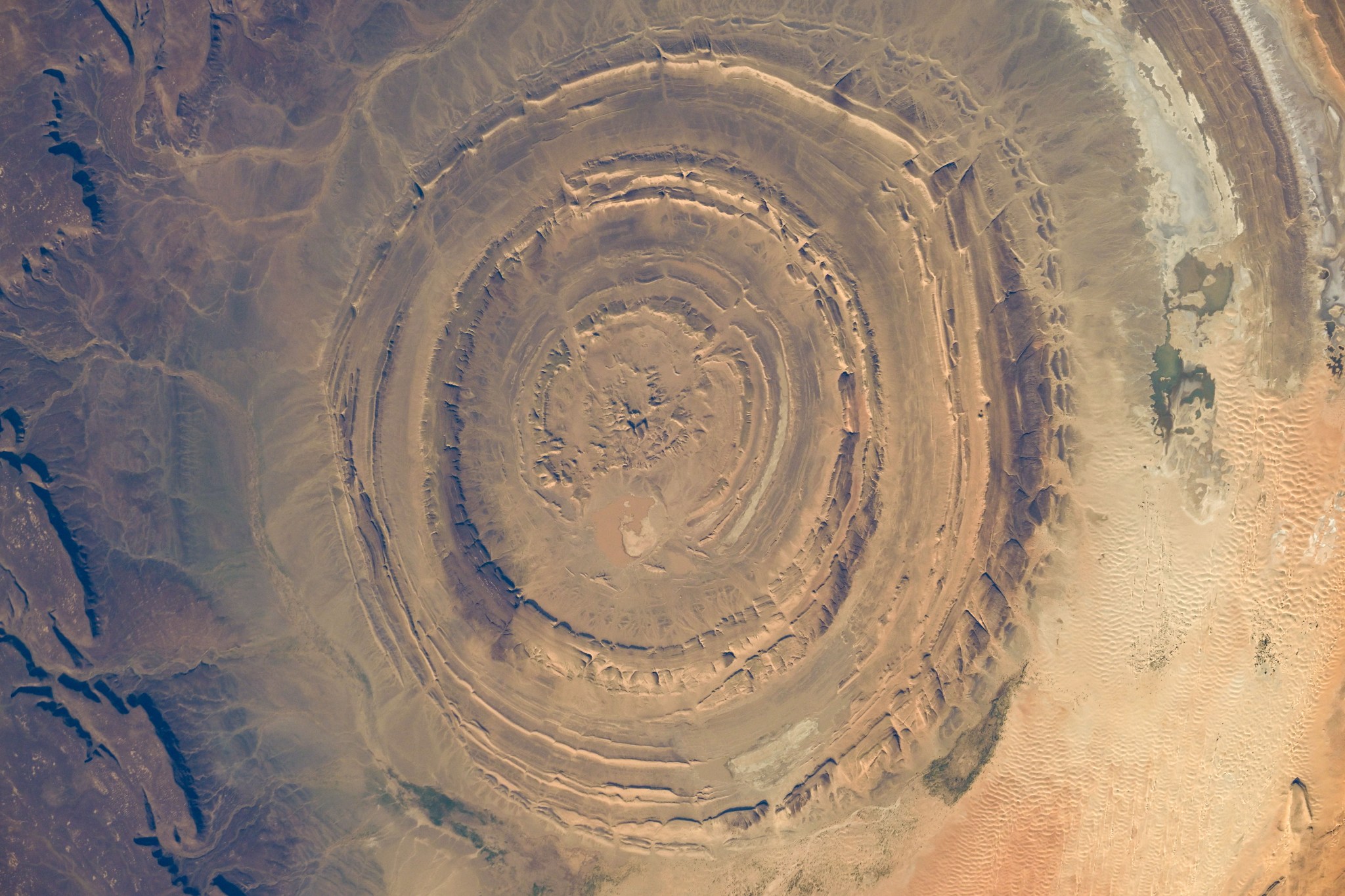
NASA just dropped a fresh view of the Richat Structure, better known as the Eye of the Sahara, taken from the International Space Station. Even from orbit, the thing is massive—a 25-mile wide bullseye in the middle of Mauritania. For most people, it is a cool desktop wallpaper. For builders, it is a 100-million-year-old lesson in structural integrity, visibility, and the reality of long-term systems.
The Architecture of Slow Burn
This isnt a meteorite crater, though it looks like one. It is an eroded geological dome. Roughly 100 million years ago, igneous activity pushed the earth up, creating a literal uplift of various rock types. Over eons, the softer layers washed away, leaving the hard rhyolite and gabbro ridges we see today. In the crypto world, we talk about Lindy effect—the idea that the longer something has survived, the longer it is likely to survive. The Richat Structure is the ultimate Lindy monument.
When you are building a protocol or an AI agent, you are often focused on the next sprint or the quarterly roadmap. We think in months. Nature thinks in epochs. The Eye of the Sahara is what happens when you build with a core of high-density material and let the market—or in this case, the wind and rain—strip away everything that is fragile. What remains is the irreducible core.
Designing for Visibility
One of the most interesting things about the Richat Structure is that it is almost invisible from the ground. It is too big to comprehend when you are standing in the middle of it. It looks like just another stretch of desert. You need the macro perspective—the view from 250 miles up—to see the pattern.
I see founders make this mistake constantly with complex technical stacks. They are so deep in the weed of their specific consensus mechanism or their RAG implementation that they lose sight of the shape of the product. If your users need a PhD and a telescope to understand the value proposition of your project, you have a visibility problem. The Eye of the Sahara is a masterpiece of geometry, but it took a leap in human technology (spaceflight) for us to even realize what we were looking at. Do not make your users wait for a technology leap to understand your MVP.
The Resilience of the Hardened Core
Geologically, the circular rings are made of resistant rocks. The valleys between them are where the weaker sedimentary layers used to be. This is a perfect metaphor for lean development. In a bull market, every project looks like a solid dome. There is capital everywhere, covering up the flaws. But when the macro environment shifts—the metaphorical erosion—the weak layers disappear.
- Focus on the ridges: Identify the parts of your tech that are indispensable. These are your rhyolite ridges.
- Discard the silt: If a feature only exists because you had a grant to burn, it will erode. Get rid of it now.
- Acknowledge the timeline: You are not building for a week. You are building for a decade. Is your codebase resilient enough to handle 10 years of 'weather'?
The Founder Perspective
When I look at NASA's imagery of Mauritania, I don't see a miracle. I see a process. It is a reminder that complexity often emerges from simple forces: heat, pressure, and time. We tend to over-engineer our solutions because we are impatient. We try to build the 25-mile wide bullseye in a weekend by throwing VC money at it. That is the equivalent of trying to paint the desert. It won't last.
True structural success comes from the bottom up. You start with the 'igneous' spark—the raw idea—and you let the pressure of real-world usage harden it. You have to be okay with the fact that much of what you build will be stripped away by the market. That isn't failure; that is refinement. The Eye is beautiful precisely because of what is missing.
The Takeaway for Builders
The lesson here is simple but difficult to execute: Build things that get better as they are tested. Most software is like a sandcastle; it requires constant maintenance just to stay upright. The Richat Structure is the opposite. It is a system where the harshness of the environment actually revealed its most impressive features. If you are building in Web3 or AI right now, ask yourself: If the hype cycles stopped tomorrow and the funding dried up, what part of your project would still be standing 100 million years from now?
Architecture is not just about what you add; it is about what survives the erosion of time.
We are currently in a period of intense 'geological' activity in the tech space. AI is pushing the crust up, creating domes of speculation. Some of these will be craters. Others will be Eyes—structures that define the landscape for generations. If you want to be the latter, focus on the resistant layers. Focus on the hard problems that others find too difficult to drill into. The view from the top is only worth it if there is something substantial left to see.
Read the original at NASA Breaking News →