The Policy Pivot at HTX
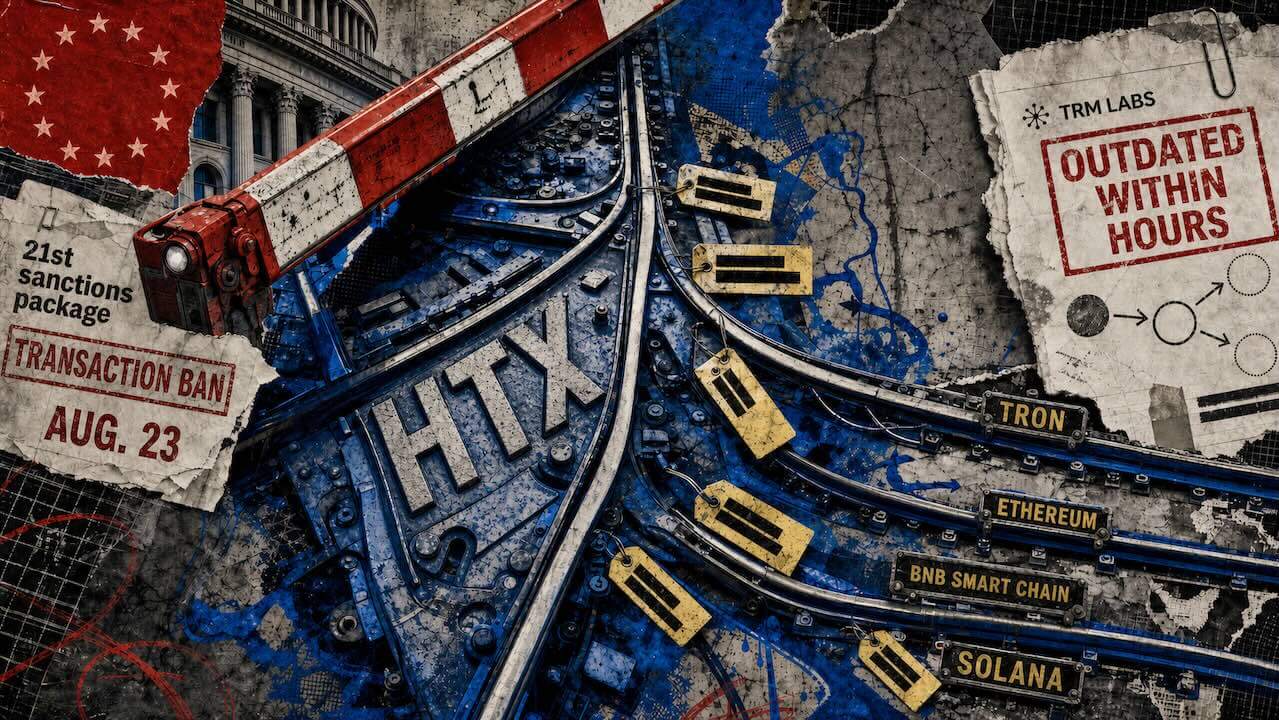
The European Union just dropped its 21st sanctions package, and the headline for anybody building in the exchange space is clear: HTX, formerly known as Huobi, is now officially on the blacklist. By targeting Huobi Global S.A., the EU is drawing a hard line in the sand regarding how offshore exchanges interact with sanctioned jurisdictions, specifically Russia. This isn't just another minor compliance hurdle; it’s a full-scale transaction ban that kicks in on August 23rd.
If you've been following the industry for more than a week, you know the history here. Huobi was once a titan of the early industry, a bedrock of the Asian markets that eventually rebranded to HTX under the advisory of Justin Sun. Rebranding, however, doesn't erase a paper trail. The EU is looking at the financial rails being used to bypass traditional banking restrictions, and they’ve decided that HTX’s role in these networks is no longer something they can ignore.
The Russian Connection and the Shifting Rails
The core of this crackdown stems from the way capital moves when a country is cut off from SWIFT. Russia has become a laboratory for alternative financial routing. For the last couple of years, we've seen a constant cat-and-mouse game where one off-ramp is blocked and two more appear. The EU’s perspective is that HTX has become a primary conduit for these shifting rails. They aren't just looking at the exchange as a place to trade tokens; they are looking at it as a piece of infrastructure that allows state-linked actors to move value across borders.
For builders, this is the most important part of the story. The regulators are no longer just looking for 'illegal' activity in the sense of theft or fraud. They are looking at the intent of the infrastructure. If your platform is perceived as a tool for geopolitical evasion, the technical elegance of your code won't save you from a transaction ban. The EU is effectively telling its citizens and operators: if you touch HTX, you’re touching a sanctioned entity. That’s a massive liability for any European-based project or liquidity provider.
The Founder’s Dilemma: Neutrality vs. Compliance
There has always been this ideal in the crypto space that 'code is law' and that protocols should remain neutral. It’s a beautiful sentiment, but it’s hitting the brick wall of geopolitical reality. HTX has tried to maintain its position as a global, somewhat untouchable entity, but the EU has shown that they can simply cut the cord to the European banking and operational sectors. When the ban goes live in late August, it effectively cordons off HTX from the entire European market.
I’ve talked to plenty of founders who think they can outrun these types of designations by moving their headquarters every six months or playing a shell game with corporate entities. The problem is that the EU is now targeting the brand and the operational entity behind it, regardless of where they claim to be based this month. If you are building a DeFi protocol that relies on HTX for price feeds or liquidity, you now have a ticking clock to find an alternative. You cannot build a sustainable product on top of a foundation that is legally radioactive in one of the world's largest economies.
The Ripple Effect on Liquidity
What happens when a major exchange gets blacklisted? Liquidity doesn't just disappear; it migrates. We are likely to see a significant outflow of capital from HTX as EU-based users and institutions scramble to get their funds out before the August deadline. This creates a vacuum. It also creates a massive opportunity for exchanges that have played the compliance game from day one. In the short term, expect volatility. In the long term, expect a more balkanized crypto market.
We are moving toward a world where 'Global Crypto' is becoming a myth. Instead, we’re going to have 'Compliant Crypto' in the West and 'Offshore Crypto' everywhere else. The bridge between those two worlds is getting narrower and more dangerous to cross. HTX was one of the biggest bridges, and the EU just set it on fire. If your business model depends on these bridges staying open, you need to re-evaluate your risk profile immediately.
Why This Matters for Builders
There are three big takeaways for anyone building in this space right now. First, the 'jurisdiction hopping' strategy is failing. Regulators are looking through the shell companies to the brand itself. Second, the 'Russia-linked' label is the ultimate deal-breaker. Anything even tangentially related to sanctioned state actors is going to be scrutinized with a magnifying glass. Third, the gap between being 'unregulated' and being 'sanctioned' is closing.
The EU isn't just asking HTX to follow KYC rules; they are banning transactions entirely. That’s a nuclear option. It tells me that the diplomatic phase of regulation is ending, and the enforcement phase is in full swing. If you’re a founder, you have to ask yourself: is the liquidity or the feature set of an offshore exchange worth the risk of being cut off from the European market? For most of you, the answer should be a resounding no.
The era of the 'untouchable' offshore exchange is ending. You can't bridge to the future if your bridge is built on sanctioned ground.
Looking Ahead to August 23rd
We have a few weeks before the full weight of this ban is felt. During this window, we’ll probably see a lot of PR from HTX trying to downplay the impact. Ignore the hype. Look at the numbers. Watch the wallet outflows. The European Union has a long memory and a very heavy hand when it comes to sanctions enforcement. They aren't doing this to be 'mean' to crypto; they are doing it because they view these exchanges as holes in their economic defenses.
If you have assets on HTX or your project is integrated with their services, the time to move was yesterday. The August 23rd deadline is not a suggestion. It’s a hard cutoff. We’re watching a major piece of the industry’s history get carved out of the Western financial system. It’s a sober reminder that while the technology is decentralized, the people and the companies behind it are still very much subject to the laws of the physical world.
Read the original at CryptoSlate →