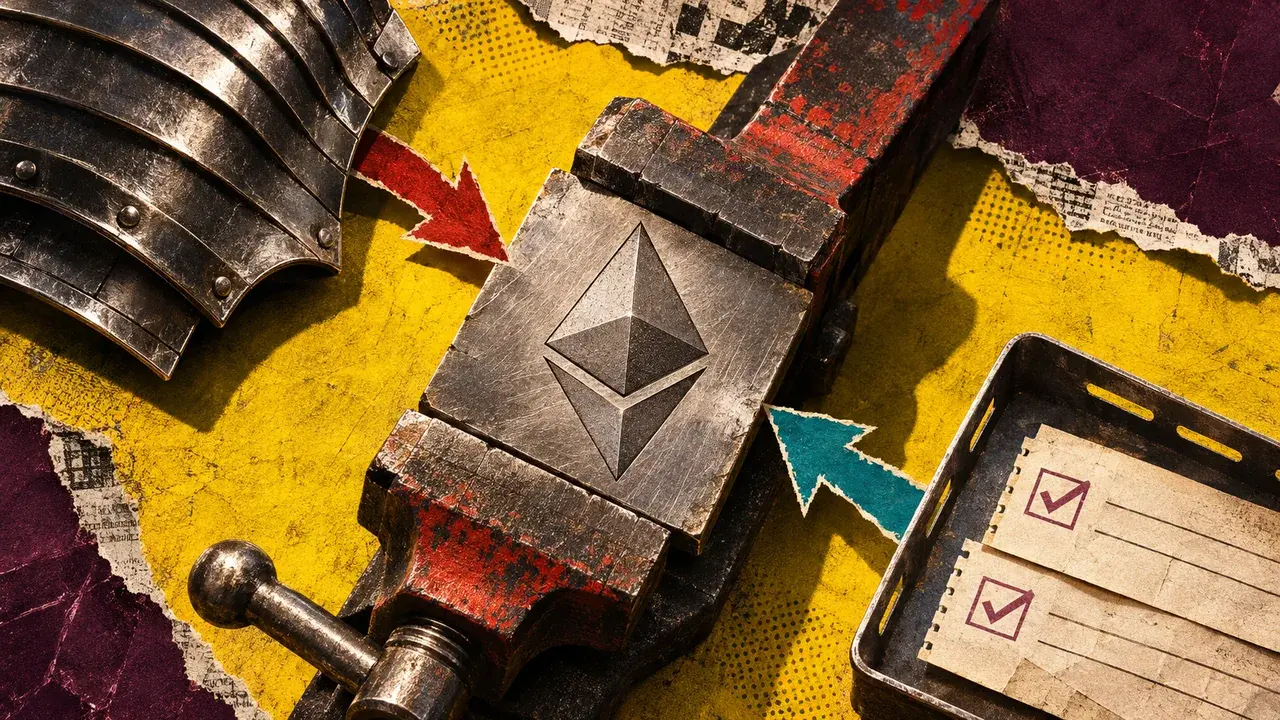
We talk a lot about the technical debt of legacy banking, but the reality is that Ethereum is starting to accumulate its own brand of debt. Right now, the developers at the heart of the ecosystem are staring down a dilemma that every founder recognizes: do you ship the feature the users need today, or do you refactor the entire engine because you know a storm is coming in five years?
The War on Censorship
The immediate problem is censorship. For a network that prides itself on being permissionless, Ethereum has a growing middleman problem. When you send a transaction, it doesn't just jump onto the chain. It goes through a sophisticated supply chain of builders and relayers. Because of regulatory pressure and the way MEV (Maximal Extractable Value) works, certain transactions are being sidelined. If a builder doesn't like your address or the protocol you are using, they can simply ignore you.
The proposed fix is called FOCIL, or Fork-Choice Inclusion Lists. The idea is simple: force validators to include certain transactions, stripping away the power of builders to pick and choose who gets to play. It is a vital upgrade for anyone building on-chain who wants to ensure their users aren't blocked by a centralized gatekeeper. At the recent developer gathering in Bogotá, this was a high priority. It felt like the finish line was in sight.
The Quantum Shadow
While the FOCIL discussions were happening, a second, more existential threat started sucking the air out of the room. We are talking about quantum computing. Now, usually, when people talk about quantum threats in crypto, I roll my eyes. It feels like a problem for the 2030s. But for the people maintaining a multibillion-dollar settlement layer, the 2030s are tomorrow.
Ethereum currently uses a specific type of cryptography for its validator signatures. If a quantum computer powerful enough to crack those signatures surfaces, the network's security model evaporates. To fix this, developers are looking at something called MaxEB (Max Effective Balance) and a complete redesign of how the network reaches consensus. This isn't a patch; it is a foundation swap. It involves moving to STARK-based signatures that are resistant to quantum attacks.
The Talent Bottleneck
Here is where the builder's reality hits. The pool of people who actually understand the intersection of Ethereum's consensus layer and post-quantum cryptography is tiny. We aren't talking about hundreds of engineers; we are talking about a handful of specialists. These are the same people who are tasked with implementing FOCIL.
The debate currently happening is whether these specialists should stay focused on the censorship fight or pivot to the quantum defense. If they do both, both projects slow down. If they prioritize quantum resistance, the censorship problem—the thing affecting builders right now—persists for another year or two. As a founder, this is the ultimate trade-off. Do you fix the leaking roof, or do you start reinforcing the foundation against an earthquake that might happen eventually?
What This Means for Builders
If you are building an app on Ethereum today, this uncertainty matters. A delay in FOCIL means you have to continue designing your systems with the assumption that transaction inclusion isn't guaranteed. It means MEV will continue to be a dominant, and often distorting, force on the network. It means the "permissionless" nature of the network remains slightly asterisked by the builders who control the blocks.
However, the shift toward quantum resistance also tells us something about Ethereum's long-term roadmap. The developers are clearly willing to sacrifice short-term feature delivery to ensure the network exists in twenty years. That is a signal of maturity, even if it is frustrating for those of us trying to ship products in the current cycle.
The Strategy Shift
We are seeing a move away from the "move fast and break things" era of Ethereum. The stakes are too high now. The complexity of these upgrades—MaxEB, PeerDAS, and FOCIL—is overlapping. When you change how validators sign messages to be quantum-safe, it changes how you have to implement inclusion lists. You can't really do one without the other anymore without creating a mess of code that will need to be ripped out later.
This is the hidden cost of decentralization. In a centralized company, the CTO would just mandate a 60-hour work week and hire ten more people. In an open-source protocol, you can't just throw money at the problem because the expertise doesn't exist at scale. You are limited by the cognitive load of a very small group of humans.
The Reality Check
Let's be honest: censorship is the bigger threat to Ethereum's soul right now. If the network becomes a series of gated sandboxes controlled by a few builders in regulated jurisdictions, it doesn't matter if it's quantum-secure. Nobody will want to use it for anything meaningful.
The developers kept FOCIL on the schedule for now, but the tone has shifted. There is a growing consensus that a unified upgrade might be the only way forward. Instead of a series of small wins, we might be looking at one massive, high-risk transition. For those of us on the ground, that means we should expect the "current state" of Ethereum—with all its censorship quirks and MEV games—to last longer than the roadmap suggests.
Ethereum is no longer a startup. It is a legacy system trying to upgrade its engine while flying at 30,000 feet. Every turn of the wrench has to be calculated, because there is no landing gear.
My takeaway? Don't wait for the protocol to solve your censorship or cost problems. If you're a founder, you need to be looking at Layer 2s and alternative inclusion strategies today. The core devs are busy building a bunker for a future war, which means the problems of today are going to be ours to manage for a while longer.
The Final Word
We need to stop looking at the Ethereum roadmap as a set of dates and start looking at it as a set of compromises. The tension between fixing censorship and preparing for quantum threats is the most honest look we've had at the project's priorities in years. It’s a reminder that in crypto, as in business, you can't have it all at once.
Read the original at CryptoSlate →