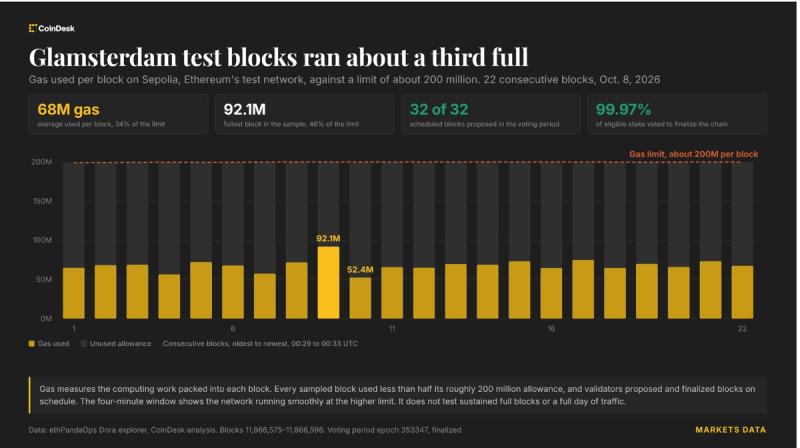
We have been hearing about Ethereum scaling for a decade. Usually, that conversation involves complex layer-2 math or the mythical promise of sharding. But recently, the technical focus shifted back to the engine room. During the Glamsterdam upgrade rehearsal on the Sepolia testnet, the network pushed its gas limit to nearly 200 million per block. That is a massive jump from the current 30 million limit on the mainnet.
For those not living in the weeds of protocol development, the gas limit is essentially the block's budget. It determines how much computational work can fit into a single ten-second window. Increasing this limit has always been a point of contention. Push it too high, and you price out independent validators because the hardware requirements become astronomical. Keep it too low, and the network stays congested and expensive. The Sepolia test shows the community is finally ready to see what happens when we open the taps.
The Gap Between Capacity and Usage
One detail from the Sepolia run caught my eye: even with a 200 million gas ceiling, the actual blocks were often using less than half of that allowance. This is a classic founder dilemma. You build a bigger warehouse, but you do not necessarily have more inventory to fill it immediately. The capacity is there to handle spikes, but the baseline demand is still catching up to the infrastructure.
As a builder, this tells me that the technical bottleneck is moving. We are moving away from a world where every single byte of data is a luxury expense. If these numbers eventually hit the mainnet, we are looking at a three-to-five-fold increase in what the base layer can handle. However, having a bigger budget does not mean we should write sloppy code. Efficiency still matters, but the claustrophobia of the 30 million limit might finally be lifting.
Why Builders Should Care About Glamsterdam
The Glamsterdam upgrade is not just a vanity project for core devs. It represents a fundamental shift in how Ethereum handles execution. For years, the mantra was "move everything to L2." While that is still the roadmap, a beefier L1 makes those L2s even more efficient. If the base layer can process more gas, the cost of settling batches from Arbitrum, Optimism, or Base drops significantly.
If you are building an application that requires high-frequency interactions or complex smart contract logic, this is your green light. The "Ethereum is too slow" argument is losing its teeth. We are seeing a move toward a high-throughput environment that maintains the decentralization that made Ethereum valuable in the first place. But there is a catch: the physical cost of running a node is going to go up. We need to watch how this impacts the diversity of the validator set.
The Hardware Tax
Every time we increase the gas limit, we are essentially asking node operators to buy better CPUs and faster SSDs. This is the hidden cost of scaling. In my view, this is where the skepticism should live. If Ethereum becomes a network that only runs in professional data centers, it loses its soul. The Sepolia test shows that 200 million gas is technically feasible, but the long-term data on state growth and synchronization speeds will be the real trial.
Founders need to consider the longevity of the chain. A fast chain that bloats out of control in three years is a liability, not an asset. Glamsterdam seems to be striking a balance, but it is a delicate one. The testnet environment is a vacuum; real-world mainnet conditions involve MEV bots, complex arbitrage, and unpredictable traffic patterns that stress the system in ways a rehearsal cannot fully simulate.
Takeaway for the Ecosystem
The successful run on Sepolia is a milestone, but not a finish line. It proves that the software can handle a higher computational load without breaking. For the average developer, this means you can start dreaming bigger regarding on-chain logic. We are moving toward a period where the infrastructure might actually be ahead of the use cases.
My advice? Watch the state growth metrics coming out of these tests. Capacity is great, but sustainability is what keeps us in business. If the Glamsterdam changes make it to the mainnet, the competitive landscape for alt-L1s gets a lot tougher. Ethereum is proving it can still evolve, even if it moves with the deliberate speed of a giant.
Read the original at CoinDesk →