The Leveraged Beta Problem
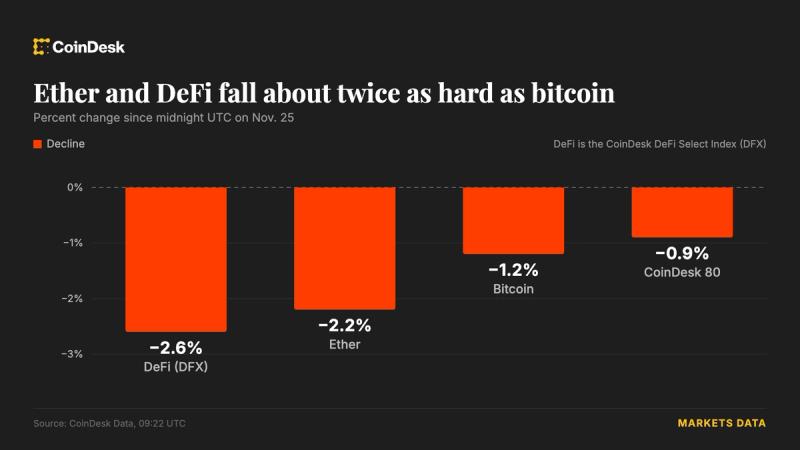
We are seeing a familiar pattern play out in the markets this week. As equities start to wobble and the broader stock selloff gains momentum, the crypto market is reacting exactly how the textbooks say it should—but with a painful twist for anyone holding anything other than Bitcoin. While Bitcoin is down about 1.2% since the UTC midnight flip, Ether and the broader DeFi sector are bleeding out at double that rate. This isn't just a random dip; it is a clear signal of where the market's confidence actually lies when the chips are down.
For those of us building in this space, this divergence is a reality check. We often talk about Ether as the world's computer and DeFi as the future of finance, but in the eyes of the macro market, these assets are still treated as high-beta plays on Bitcoin, which itself is treated as a high-beta play on tech stocks. When the S&P 500 gets a cold, Bitcoin catches a flu, and DeFi ends up in the ICU.
The Utility Trap
It is frustrating to watch. You have protocols that are generating real fees, processing billions in volume, and maintaining solid codebases, yet their token prices are getting slaughtered because of macro headwinds that have nothing to do with their technology. This is what I call the utility trap. Builders focus so much on the tech and the throughput that they forget the market treats their tokens like speculative tech stocks rather than commodities or currencies.
Bitcoin has managed to distance itself slightly from the pack. It is still correlated to risk-on assets, but that 1.2% drop compared to the 2.5% or 3% slides we are seeing in ETH and top-tier DeFi tokens shows that the store-of-value narrative is holding up better than the smart contract platform narrative. In a selloff, investors retreat to the most liquid, most established asset. In crypto, that is, and likely always will be, Bitcoin.
What This Means for Founders
If you are running a project or building a protocol right now, you need to understand that your token's price is currently a hostage to the Nasdaq. No amount of "partnerships" or minor UI updates will break that correlation in the short term. The market is currently in a de-risking phase, and when people de-risk, they sell their most volatile assets first. DeFi tokens, with their lower liquidity and higher complexity, are the first to be dumped.
This is a time for lean operations. If your runway was calculated based on your native token's price staying stable while Bitcoin crab-walks, you are in trouble. You have to assume that in every major equity correction, your treasury is going to take a hit twice as hard as the headline crypto numbers suggest. I have seen too many founders get wiped out because they didn't account for this multiplier effect.
The Liquidity Vacuum
Why does DeFi fall twice as hard? It comes down to liquidity. Most DeFi protocols have their liquidity paired against ETH or stablecoins, but the exit ramp is usually much narrower than it is for Bitcoin. When the big players start rotating out of risk, they don't sell their $10 million positions in a small-cap lending protocol slowly; they market sell and move to cash or BTC. This creates a cascading effect where thin order books lead to massive price slippage.
Furthermore, the "yield" that many of these protocols offer becomes less attractive when the underlying asset is dropping 3% a day. A 10% APY doesn't mean anything if the principal is down 20% in a week. This causes the yield farmers and the mercenary capital to flee, further accelerating the price drop. It is a feedback loop that Bitcoin is largely immune to because Bitcoin doesn't rely on these complex yield mechanics to justify its existence.
Separating Signal from Noise
We shouldn't mistake price action for protocol health, but we also shouldn't be delusional. If the market is telling us that it doesn't value these platforms during a stress test, we need to ask why. Part of the problem is that we haven't yet proven that these protocols can thrive independently of the speculative mania that surrounds them. We are still in the "prove it" phase of development.
The takeaway for builders is simple: stop watching the candles and start watching the macro indicators. If the equity selloff resumes in earnest, we are going to see a further flushing out of the ecosystem. This isn't necessarily a bad thing for the long term—it clears out the noise and the weak hands—but it is going to be a painful bridge to cross for anyone who is over-leveraged or under-capitalized.
The Long Game
I am still long on the idea of decentralized finance, but I am increasingly skeptical of the current tokenomic models that fail so spectacularly at the first sign of a market correction. We need to build better ways to capture value that aren't just derivatives of Bitcoin's price action. Until then, we are just riding the waves of a much larger ocean controlled by traditional finance and central bank policies.
Keep your head down, watch your burn, and don't get distracted by the fact that your token is down more than BTC. It is not a reflection of your code; it is a reflection of a market that still doesn't know how to price anything other than digital gold. The volatility is the price we pay for being early, but you have to be able to survive the volatility to reap the rewards.
The market can stay irrational longer than you can stay solvent, but it can also stay correlated longer than you can stay funded.
My advice? Focus on building products that people use because they need them, not because they want to farm a token. The projects that survive this equity-driven selloff will be the ones that have real users who aren't just there for the incentives. Everyone else is just waiting for the next Bitcoin pump to bail them out.
Read the original at CoinDesk →