Nature's Beta Launch
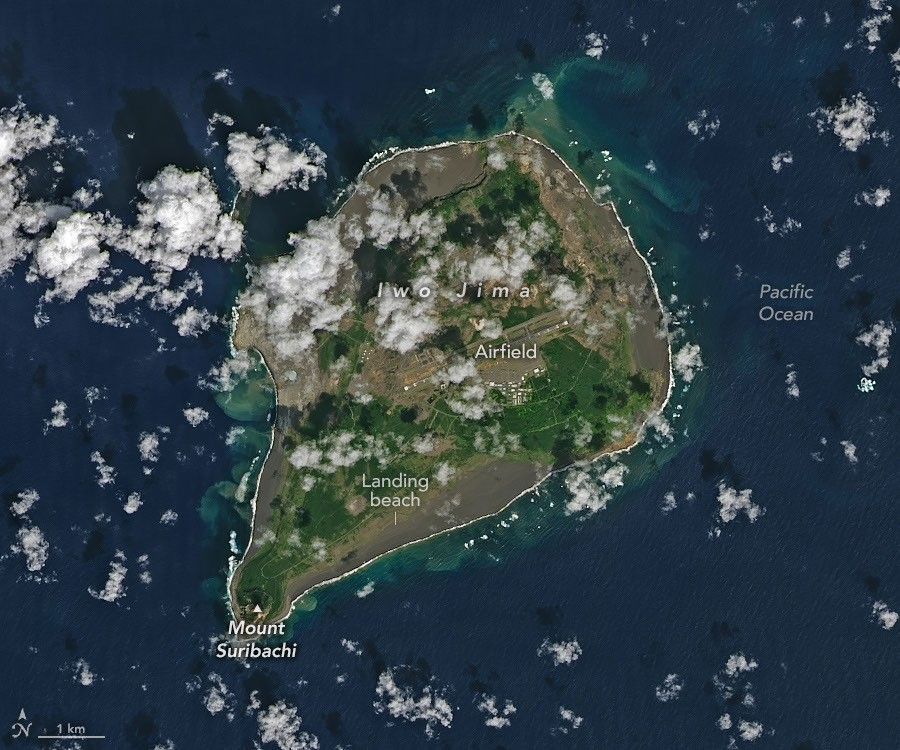
Building in the crypto and AI space feels a lot like watching the recent volcanic activity near Iwo Jima. One day you have a clear boundary, and the next, the earth decides to ship a new feature. NASA's Earth Observatory recently captured imagery showing a significant expansion of the island’s southeast coast. This wasn't a planned expansion; it was a violent, subterranean push that literally added real estate to one of the most historically significant spots in the Pacific.
For those of us obsessed with building lasting systems, there is a lesson here about the difference between growth and stability. The eruption just off the shore created a brand new stretch of beach. It looks impressive from a satellite view, but the scientists watching it aren't ready to sell tickets yet. There is a fundamental uncertainty about whether this land is a permanent fixture or just a temporary spike in the data.
The Fragility of Instant Scale
When a volcano erupts underwater, it’s a high-energy event that forces material to the surface. In the tech world, we see this when a project gets a sudden influx of venture capital or a massive spike in user adoption due to a viral loop. You suddenly have a larger footprint. You look bigger on the map. But just like the new ash and rock on Iwo Jima’s shore, that growth is often unconsolidated.
The ocean is a harsh auditor. Wave action and currents immediately begin testing the integrity of new land. If the material is mostly loose tephra—basically volcanic ash and small rocks—it gets washed away as quickly as it arrived. For founders, this is the equivalent of acquiring a million users who have no retention. You have the land, but you don't have the foundation. Unless there is a continuous flow of lava that hardens into solid rock, the beach is just a temporary illusion.
Why Builders Should Care About Erosion
We often talk about 'moats' in business, but we rarely talk about the ground the moat is protecting. I see a lot of AI startups right now that are building on top of LLM wrappers. They are essentially the new beach at Iwo Jima. They’ve appeared overnight because the underlying 'volcano' (OpenAI or Anthropic) pushed out a new capability. It looks like they’ve expanded their territory, but they are entirely at the mercy of the next tide.
- Temporary vs. Permanent: Is your recent growth backed by 'hardened rock' (proprietary tech, deep moats) or 'ash' (marketing spend, hype)?
- External Dependencies: The new land at Iwo Jima didn't ask to be there; it was pushed. If your business exists only because of another platform's API, you aren't the island; you're the sediment.
- The Cost of Maintenance: Defending a shifting coastline is expensive. It’s better to build where the ground is already solid.
The Founder's Perspective on Volatility
I’ve spent a lot of time looking at how systems fail. Usually, they fail because the builders mistook a temporary surge for a permanent shift in the landscape. When NASA observes these islands, they don't immediately update every map in the world. They wait. They watch to see if the erosion outpaces the creation.
As a founder, you need that same level of skepticism regarding your own progress. If you see a massive spike in metrics, don't immediately lease a bigger office or double your burn. You need to wait to see if that growth hardens. In the case of Iwo Jima, the island has a long history of rising and sinking. It is a geologically restless place. The tech sector—specifically the intersection of decentralized finance and machine learning—is our version of the Pacific Ring of Fire.
Growth is easy to measure, but stability is hard to prove. Don't confuse the two when the ground starts moving.
Hardening the Foundation
So, how do you turn ash into rock? In geology, it takes heat, pressure, and time. In building a company, it takes product-market fit, sustainable unit economics, and a community that isn't just there for a subsidized ride. If you are building in AI right now, your 'hard rock' is your unique data set or your specific execution. If you are in crypto, it's your actual utility and security, not your token price during a bull run.
The NASA report notes that the longevity of this new beach is 'unclear.' That is a refreshingly honest take. We should use that language more in our quarterly reports. Instead of saying we've 'disrupted the paradigm,' we should say we've 'expanded the beachhead, but the erosion rate remains a key metric.'
Navigating the Next Eruption
We are currently in a period of high volcanic activity in the tech world. Every week, a new model drops or a new protocol launches. It creates new land everywhere. It’s exciting, it’s noisy, and it makes for great headlines. But if you look at the history of these volcanic islands, most of them eventually disappear back under the waves.
The goal shouldn't just be to appear on the map. The goal is to stay there. That requires a level of honesty about what you’ve actually built. Is it a solid foundation that can withstand the inevitable cooling of the market, or is it just ash waiting for the tide to come back in?
The Takeaway
The Iwo Jima eruption is a physical reminder that the world is not static. Land can be created in an instant, but staying power is earned through geological time. For builders, the lesson is clear: don't get distracted by the size of your new beach. Focus on the density of your rock. If you aren't building something that can survive the erosion of a bear market or a technological shift, you're just managing a temporary landmark.
Read the original at NASA Breaking News →