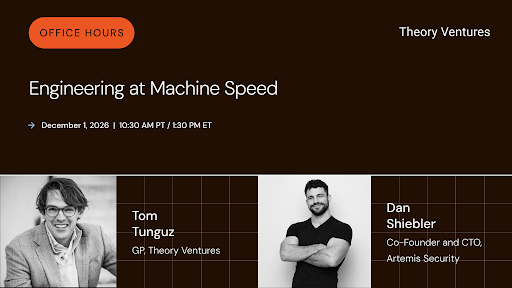
We have spent years talking about the 10x developer. In the crypto and AI space, we treat it like a mythical creature. But while we were busy debating whether AI will replace us, a small team at Artemis Security quietly redefined the baseline for what a single human can actually produce. They aren't just shipping fast; they are operating at a cadence that sounds physically impossible to most engineering managers.
Dan Shiebler, the CTO at Artemis, recently shared some numbers that should make every founder stop and re-evaluate their roadmap. In a single quarter, their team merged over 31,000 pull requests. To put that in perspective, many mid-sized startups struggle to hit 500 or 1,000 in the same timeframe. They are shipping most new feature requests in under twenty-four hours. This isn't just about working harder or drinking more caffeine. It is about a fundamental shift in how human engineers interact with the codebase.
The Multi-Agent Workflow
The core of this strategy isn't a single AI chatbot. It is a swarm. At Artemis, every engineer is effectively a manager of four to eight autonomous coding agents running in parallel. This changes the job description of a developer from someone who writes syntax to someone who orchestrates intent.
If you are a builder today, you probably use Copilot. You might use ChatGPT to debug a specific function. But running eight agents simultaneously means you are parallel-processing the entire development lifecycle. One agent might be refactoring a legacy module, another is writing unit tests for a new API endpoint, while a third is investigating a bug report. The human engineer sits in the middle, reviewing outputs and steering the ship. This is what Shiebler calls engineering at machine speed.
Quality Control in a High-Velocity Environment
The immediate skeptical response to 31,000 pull requests is usually: "That must be a mountain of garbage code." In a traditional environment, that would be true. If you tried to force humans to ship at that speed, the technical debt would bury the company in weeks. The only way to sustain this pace is to automate the quality gate as aggressively as you automate the code generation.
Artemis relies heavily on robust evaluation pipelines. When you are shipping at machine speed, you cannot rely on manual peer review for every line of code. It doesn't scale. Instead, the focus shifts to building the infrastructure that tests the code. The evaluation pipeline becomes the most important product the engineering team builds. If the pipeline is solid, the agents can fail fast and iterate without human intervention until the code meets the predefined standards.
What This Means for Founders
If you are building a startup right now, you need to realize that the competitive landscape just changed. If your competitor is using this model, they are out-shipping you by a factor of thirty. They are learning thirty times faster. They are fixing bugs before your team has even finished the daily stand-up meeting to discuss them.
However, there is a trap here. You cannot just buy eight subscriptions to an LLM and expect these results. This requires a cultural shift toward modularity. Agents struggle with monolithic, spaghetti codebases where a change in one place breaks something five layers deep. To work at machine speed, your architecture has to be clean, documented, and highly decoupled. You are basically building a playground where the AI can play safely without breaking the house.
The Death of the Feature Roadmap
In the old world, we planned features in two-week sprints. We had product requirement documents that took days to write. At Artemis, the gap between a customer asking for something and that thing existing in production is often less than a day. This effectively kills the traditional roadmap.
When you can ship that fast, the strategy changes from "What should we build next month?" to "What is the most important thing for the user right now?" It enables a level of responsiveness that was previously reserved for tiny two-person teams. Maintaining that agility as you scale is the holy grail of engineering management.
The Skeptic's Corner
I’m naturally skeptical of any metric that focuses on volume, like pull request counts. Pull requests are a proxy for activity, not necessarily for value. You could have an agent that makes a thousand tiny PRs to change variable names, and it wouldn't mean you're a better company. The real metric is the sub-24-hour delivery of feature requests.
There is also the risk of "LLM hallucinations" becoming permanent fixtures in the codebase. Even with great eval pipelines, AI-generated code can be subtle in its failures. It might work, but it might be inefficient or create security vulnerabilities that aren't caught by automated scanners. The burden on the human lead to be a high-level architect has never been higher. You aren't just checking for syntax anymore; you're checking for structural integrity.
Takeaway for Builders
Stop thinking of AI as a search engine for code and start thinking of it as a workforce. The goal for a modern founder shouldn't be to hire ten more engineers; it should be to enable their current engineers to manage a swarm of agents. The bottleneck is no longer how fast we can type or even how fast we can think. The bottleneck is how fast we can verify that the machine did what we asked it to do. If you can build a pipeline that verifies quality at scale, the speed takes care of itself.
Read the original at Tomasz Tunguz →