The Cost of Centralized Trust
We have spent years talking about the risks of centralization in crypto, but it usually takes a billion-dollar catastrophe to remind us why decentralization was the point in the first place. The recent security breach at Binance, resulting in a staggering $6.3 billion loss, is more than just a bad headline. It is a stress test for the entire industry. When the world's largest exchange catches a cold, the rest of the market ends up in the ICU.
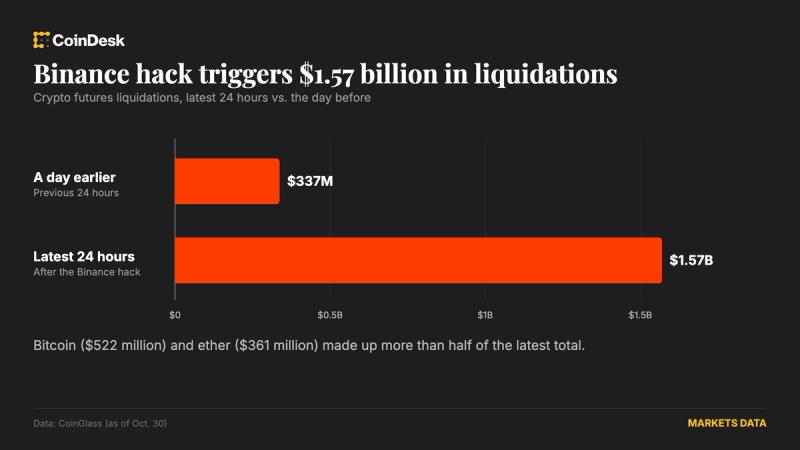
Following the news, Bitcoin took a dive toward the $77,350 mark. While that price might still seem high to those who bought in years ago, the velocity of the drop triggered a cascade of pain for traders. We saw $1.57 billion in futures liquidations in a matter of hours. For builders, this isn't just about market volatility; it is a lesson in systemic risk and the fragile nature of current liquidity structures.
The Liquidation Engine
When we look at $1.57 billion in liquidations, we are looking at the forced closing of positions by exchanges because traders no longer had enough collateral to cover their bets. This is the dark side of leverage. In a healthy market, a hack on one platform should be contained. In our current market, everything is so tightly wound and interconnected that a single point of failure at an exchange like Binance creates a vacuum that sucks the liquidity out of every other pair.
For founders, this is a reminder that the "user experience" of your dApp or protocol is often at the mercy of these giant, opaque entities. If your project relies on price feeds or liquidity originating from these centralized hubs, you are effectively inheriting their security posture. When their walls are breached, your users are the ones who pay the price through slippage, liquidations, and fear-driven exits.
Security is Not a Feature
A $6.3 billion exploit is hard to wrap your head around. It suggests that despite the billions spent on security audits and insurance funds, the complexity of these systems is outstripping our ability to defend them. For those of us building in the space, this should be a wake-up call. Security cannot be an afterthought or a line item you check off before a launch. It has to be the foundation.
We often see teams rushing to ship new features or chase the latest trend while their underlying architecture remains vulnerable. This event shows that no one is too big to fail. If Binance can lose this much, your startup is a rounding error for a sophisticated attacker. We need to move back toward a culture of "slow is smooth, and smooth is fast." Rigorous testing and a skeptical approach to third-party integrations are mandatory, not optional.
What This Means for Builders
If you are building a DeFi protocol or a consumer-facing crypto app, your first job today is to look at your dependencies. How much of your ecosystem relies on the stability of a single centralized exchange? If the answer is "a lot," you have work to do. We need to continue pushing for true on-chain liquidity and decentralized oracles that aren't easily manipulated by a single exchange's price action.
- Diversify Liquidity: Don't rely on a single venue for price discovery or asset storage.
- Transparency over Trust: Use the Binance hack as a case study for why Proof of Reserves is the bare minimum, not the gold standard.
- User Education: Be honest with your users about the risks of leverage. The $1.57 billion lost in liquidations represents real people losing real money because they didn't understand the volatility profile of the assets they were trading.
The Reality Check
I’ve seen plenty of cycles, and the reaction is always the same: shock, followed by a search for someone to blame, followed by a slow return to the status quo. We cannot afford to return to the status quo this time. The scale of this loss is unprecedented. It challenges the narrative that the industry has "matured" past the era of massive exchange hacks.
The truth is that as long as we prioritize convenience and speed over security and decentralization, these events will keep happening. As a founder, you have a choice. You can build on top of these shaky foundations and hope for the best, or you can do the hard work of building resilient, sovereign systems that don't collapse when a centralized giant fumbles the ball.
The Takeaway
The market will eventually recover, and Bitcoin will find its footing, but the trust lost in this event will take much longer to rebuild. The $1.57 billion liquidation event is a stark reminder that leverage is a double-edged sword and that centralized exchanges are still the biggest single points of failure in our industry. Build for a world where these giants don't exist, and you'll be building something that actually lasts.
The biggest risk in crypto isn't the code; it's the assumption that someone else has already secured it for you.
Read the original at CoinDesk →