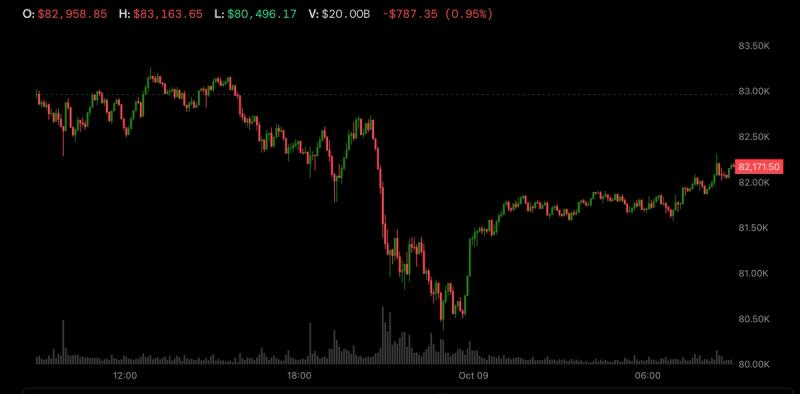
Markets have a long memory, even if the people trading them act like they don't. We are currently seeing a significant slide in crypto prices that feels all too familiar. As we approach the anniversary of the October 10, 2025 flash crash, the ghost of that $17,000 candle is haunting the order books again. Back then, Bitcoin fell from $122,000 to $105,000 in what felt like the blink of an eye. Today, the market is bracing for a repeat performance, and the tension is palpable.
The Trauma of the Flash Crash
For those who weren't staring at the charts last October, it's hard to describe the sheer speed of the collapse. It wasn't a slow bleed driven by macro data or a regulatory crackdown. It was a liquidity event—a violent, systemic purge that wiped out over-leveraged long positions in minutes. When you see $122,000 turn into $105,000 before your trading terminal can even refresh, it changes how you view risk. It changes how you build, too.
The current crumbling of prices isn't necessarily about a new fundamental flaw in the technology. It is about psychological resistance. Large-scale traders and algorithmic bots are programmed to recognize patterns, and the "anniversary effect" is a real phenomenon in finance. People remember where they lost money, and they tend to get defensive when the calendar hits that same date again.
What This Means for Builders
If you are a founder in the crypto or AI space, these price swings are noise, but they are noise that affects your signal. When the market crumbles, venture capital tightens. When the market crumbles, your team starts checking their bags instead of their pull requests. For builders, the lesson of the 2025 crash wasn't about the price of Bitcoin; it was about the fragility of the infrastructure we rely on.
We saw decentralized exchanges struggle with price feeds. We saw liquidations cascade because the network couldn't handle the sheer volume of panic. If you are building a product today, you have to assume that another $17,000 drop is always five minutes away. You have to build for the worst-case scenario. Honesty in development means acknowledging that the underlying rails are still volatile and occasionally unreliable.
The Illusion of Stability
For a while, the move toward $120,000 made everyone feel invincible. There was this narrative that crypto had finally matured, that the institutional money had smoothed out the edges. The 2025 crash shattered that illusion. It proved that no matter how many ETFs are approved, this is still a high-stakes environment where liquidity can vanish in an instant.
The current downturn is a reminder that we are still in the "wild west" phase, despite the suits and the shiny interfaces. As an editor, I see a lot of PR pitches trying to paint crypto as a safe haven. It’s not. It’s a laboratory. And in laboratories, things occasionally explode. The anniversary of the crash is just a reminder of that reality.
Risk Management Over Hype
Success in this space isn't about timing the bottom; it's about surviving the volatility. The founders who are still here after the 2025 crash are the ones who didn't keep their entire treasury in volatile assets. They are the ones who understood that a 15% drop in ten minutes is a feature of this system, not a bug.
- Treasury Management: Never keep 100% of your operating capital in the asset you are building on.
- User Experience: Design your UI to handle extreme volatility without crashing or giving users stale data.
- Mental Health: Stop tying your self-worth or your company’s value to the 24-hour change in Bitcoin’s price.
The markets are crumbling right now because people are afraid of history repeating itself. Whether it actually does or not is secondary to the fact that the fear exists. As a founder, you can't control the fear, but you can control how your company reacts to it. You build through the red candles so that you're ready when the green ones eventually return.
The biggest mistake a builder can make is believing the market owes them stability. It doesn't. It owes you nothing but a lesson in resilience.
We are likely to see more turbulence as we cross the October 10 threshold. My advice is to ignore the noise, look at your burn rate, and keep shipping. The technology hasn't changed because the price did. The problems we are trying to solve with AI and blockchain are still there, regardless of whether Bitcoin is at $122,000 or $105,000.
The Takeaway
The anniversary of the flash crash is a psychological hurdle, not a technical one. Markets are emotional, and right now, the emotion is caution. For the builder-first crowd, this is just another Tuesday. Use the downturn to stress-test your systems and your conviction. If your project only works when the market is up, you don't have a project—you have a gamble. Real builders thrive when the hype dies down and the tourists leave.
Read the original at CoinDesk →